by Melissa Donovan
Machine learning (ML), artificial intelligence (AI), and other smart algorithms make it more necessary than ever before to implement security solutions on additive manufacturing (AM) processes. Software solutions enhance resilience against cyber threats, sabotage, and unauthorized manipulation.
Above: Materialise Software’s Identify3D is an end-to-end cybersecurity and IP control platform built for AM supply chains.
While there are many advantages to ML and AI, the fact remains that their presence means security solutions are not optional. “The same connectivity that enables smarter manufacturing also widens the attack surface,” suggests Kyle Adriany, director of business development, Materialise Software.
How It’s Used
AM leverages ML for a number of positive reasons, however with its increased usage, systems are more vulnerable to cyber attacks and unauthorized use.
“ML is revolutionizing AM by enhancing process optimization, improving print quality, and offering predictive insights into production trends. These advancements are accelerating AM from an experimental stage to full-scale production across industries,” shares Marcellus Buchheit, president/CEO, Wibu-Systems USA Inc.
Designing and actual printing of parts benefits from AI and ML. “On the design side, AI-driven generative modeling tools reduce trial and error by automatically exploring and optimizing part geometries. During printing, ML algorithms fine-tune process parameters in real time to ensure consistent output quality without manual intervention,” adds Victor Gerdes, VP of global software product strategy, Stratasys.
Adriany says ML is helpful for catching defects in situations and supporting quality certification—which is identifying anomalies during the build rather than relying solely on post-process inspection. “That’s valuable, but it also means more software is connected to more machines, generating and consuming more sensitive data.”
AI and ML, while helpful, increase the burden of protecting every component of the AM workflow.
“In AM, the design file represents the intellectual property (IP), which is at the heart of the entire process, but it is only one component of the broader digital manufacturing pipeline. Protecting the entire workflow including slicing software, machine firmware, and printer execution systems is critical. Ensuring that only authorized users and systems can access or execute these assets prevents tampering, IP theft, and unauthorized production.
As the sector scales, failure to implement comprehensive security systems exposes manufacturers to significant risks, including gray market production, IP theft, and the creation of faulty or imitation parts on unauthorized machines,” notes Buchheit.
“Adversaries use AI tools to attempt attacks at scale—probing systems, generating phishing vectors, and automating intrusion attempts in ways that weren’t practical years ago,” explains Adriany.
Risk Awareness
Risk is heightened when AI and ML solutions are connected to AM. Systems are vulnerable to activities like data manipulation and file tampering.
“The risks that arise when connected AM systems are compromised are no longer theoretic. The core vulnerability in AM environments stems from the convergence of information technology (IT) and operational technology (OT). Traditional IT moves data. OT moves physical things, and 3D printers fall squarely into that category alongside CNC machines, robots, and automated production lines. When these two infrastructure types share the same network, protocols, and security approaches, the attack surface expands significantly. And unlike an IT failure, an OT failure can cause physical damage, disrupt production, or compromise the integrity of a printed part in ways that aren’t immediately visible,” explains Gerdes.
When AM workflows are compromised, manipulated designs, altered specifications, or even counterfeit production can occur. “Unauthorized changes in production parameters, particularly when design files are shared across various manufacturers or suppliers, make it increasingly difficult to control the integrity of the final product. Protecting against these risks requires a comprehensive approach to digital asset security,” explains Buchheit.
Adriany separates attacks in AM into two categories—tampering and unauthorized access. “Tampering means builds or files are modified to sabotage output—subtle parameter changes that affect material properties or part performance without being visually obvious. Unauthorized access means confidential IP is leaked, copied, or used outside its intended scope.”
When attacks occur on digital input, Adriany explains, the result is compromised physical output. “And increasingly, agentic AI solutions connected directly to machines open additional avenues for data misuse and leakage. The more autonomous and ‘connected’ the workflow, the greater the need for granular control over both machine access and IP usage.”
Gerdes agrees. “As organizations add printers, requestors, and supply chain partners to their AM operations, each of those risk categories compounds.”
Safety Protocols
Security software is available to prevent unauthorized access, tampering, data manipulation, and other types of activities that are increasingly common thanks to AI and ML.
According to Buchheit, security software protects not only design files, but the full AM workflow from slicing software to machine firmware and printer execution systems. “It ensures that unauthorized users and systems cannot access, modify, or misuse digital assets used in the AM process.”
In general, security software encrypts and controls the use of an IP from the moment it is authored to the machine where it is printed. “That means protecting files against tampering, enforcing who can access and use them, and ensuring production only happens under approved conditions—the right machine, material, and parameters. The goal is continuous control across the entire workflow, not just protecting files at rest or in transit, but maintaining the IP owner’s intent through execution,” says Adriany.
Buchheit admits that encryption is a cornerstone of security software, safeguarding files during storage and transfer. Digital rights management and advanced licensing technologies are also sought after features that ensure files can only be accessed and executed under approved conditions, including limits on production volume.
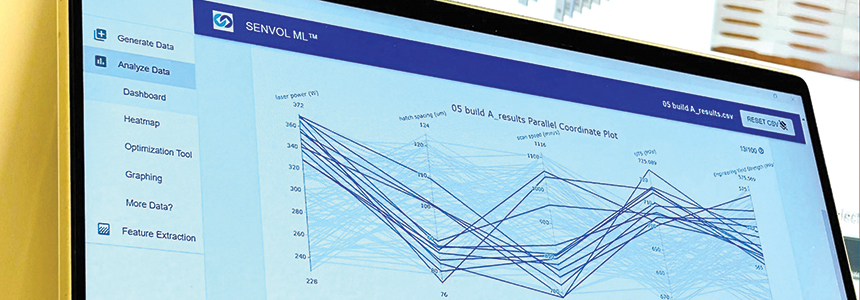
Another way to circumvent risk is localizing AI or ML software. “Security, particularly regarding AM data, is of high concern. ML software as a local install best addresses this concern. It does not connect to the cloud, and you do not even need to be connected to the internet to use it,” explains Zach Simkin, president, Senvol LLC.
Beware of the Consequences
The consequences of not implementing security software are severe. Despite how obvious these results are, it seems security software’s use in AM is in a gradual transition.
Adriany believes adoption is reactionary. “Organizations implement it after an attack has already caused harm. By that point, the damage is done.”
Repercussions include IP theft, counterfeit parts entering the supply chain, and, in the worst case scenario, product recalls or failures due to tampered files, admits Buchheit.
Other consequences involve machine downtime, IP loss, and compromised parts, all of which compound further downstream in the manufacturing process—no matter the sector. “A faulty aerospace component doesn’t just fail in isolation; it can ground assets, delay maintenance, and disrupt operations. Lost IP undermines revenue and trust. And suppliers who cannot demonstrate secure handling of sensitive manufacturing data increasingly lose eligibility for defense and aerospace work, regardless of their production capability,” notes Adriany.
Attackers gaining access to unsecured printer interfaces create trouble that leads to unfortunate end results. Things like manipulation of G-code files, altering print parameters, introducing structural defects, or causing printers to overheat are possible. “In research settings, these attacks have produced parts that pass visual inspection but fail under stress. In a production environment, that means defective tooling, failed end use parts, or compromised components making their way into downstream products,” says Gerdes.
“AM is a direct link between digital designs and physical products. Without protection, a compromised file can lead to catastrophic failure in the physical product, compromising safety, reliability, and performance. Simply put, unsecured files are a direct threat to both business and consumer safety,” says Buchheit.
AM users in aerospace, defense, and medical drive adoption of security software. These are segments “where the consequences of a compromised part are too severe to leave security as an afterthought. Defense will lead, but the same approach will extend into other regulated sectors as the model proves out,” suggests Adriany.
Buchheit believes that as AM grows beyond prototyping to become a mainstream manufacturing method—especially in critical sectors like aerospace, medical, and defense—security will become non-negotiable. “With an increasing reliance on distributed networks and digital supply chains, the need to secure digital assets is paramount. Security software and hardware will no longer be an optional enhancement; it will be a standard requirement to protect IP, ensure product quality, and maintain trust in AM processes.”
Regulatory frameworks are also accelerating the shift. “Standards including NIST, IEC 62443, and ISO/ASTM 52907 are establishing security requirements specifically relevant to AM environments. Organizations that want to operate in defense supply chains, sell to regulated industries, or participate in distributed digital manufacturing will increasingly need to demonstrate compliance with these frameworks, not just good intentions,” states Gerdes.
Solution Selection
Assembrix addresses the challenge of security with an AM platform designed specifically for secure distributed production. Instead of sending files directly to printers or external partners, OEMs manage production through a controlled digital environment. Build files are encrypted, access is restricted to authorized users and machines, and each print job is executed under predefined rules set by the IP owner. Sensitive data is never exposed as open files, even when production takes place remotely, while real time visibility and full traceability allow OEMs to monitor production, maintain audit trails, and ensure consistency across sites.
Materialise’s Identify3D is an end-to-end cybersecurity and IP control platform built for AM supply chains. It encrypts, distributes, and traces digital part data from authoring through machine execution, giving IP owners continuous control over how, where, and the number of times a part can be produced. What sets it apart is machine-level integration. Rather than stopping at file protection, Identify3D extends control through the last mile, eliminating compliance and security gaps at the junction between the machine and upstream IT systems. The result is a platform that supports cybersecurity, IP protection, and quality assurance as a unified workflow.
Senvol ML is ML software specifically for AM. It can be used to analyze data from any AM machine, material, and process to rapidly optimize parameters, develop materials, and predict material properties. The software is provided as a local install, it does not connect to the cloud, and users do not need to be connected to the internet to use it. This is for software security.
Stratasys’ GrabCAD Streamline Pro is an enterprise software platform for managing AM at scale. It includes several components with distinct security roles, plus hardware and partner options for the most demanding security environments. For example, GrabCAD Shield is an industrial-grade hardware firewall device installed at the printer. Bi-directional protection defends the printer from the network and the network from the printer.
ProtectAM is a hardware and software upgrade for the Stratasys F900 printer that meets U.S. Department of Defense STIG cybersecurity requirements under DoDI 8510.01 and AFI 17-101. It provides an enclave controller running Red Hat Enterprise Linux as the sole network access point, creating a fully separated network area for the printer to operate.
Wibu-Systems provides CodeMeter, a software protection and licensing platform built for industrial environments, including AM. CodeMeter secures the entire AM workflow including design files, file transfer, slicing software, machine firmware, and printer execution systems. The platform combines encryption, flexible licensing, and secure key storage available both digitally and through physical dongles, providing tamper-resistant, hardware-backed protection. Manufacturers control which machines can print, where and how many parts can be produced, and ensure that files cannot be reused outside authorized environments. This prevents unauthorized use and gray market production while providing full traceability across distributed manufacturing networks. In addition to security, CodeMeter enables new business models including pay-per-print workflows and secure digital spare parts distribution via ecommerce platforms.
Smart Algorithms
While ML and AI enhance AM, their use isn’t without consequences. The entire AM supply chain is susceptible to risk, whether it is file tampering or IP theft. Security software prevents attacks and protects against unauthorized use. The need for this type of solution will only increase as ML and AI continue to be part of the AM discussion.
Jun2026, Industrial Print Magazine