by Cassandra Balentine
Glass provides a convenient and beautiful surface for decoration. However, it can be tricky for ink adhesion. For glass decoration expected to last beyond initial handling, pretreatment is a critical part of the digital direct to object (DTO) printing process.
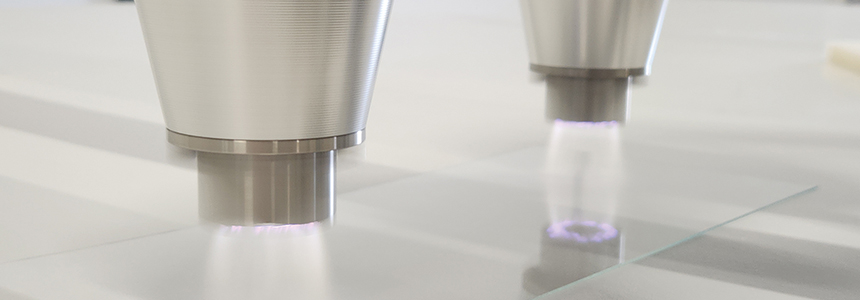
Above: Plasma energy is at the core of 3DT’s PlasmaDyne Pro, revolutionizing surface treatment and adhesion performance in manufacturing.
Success with Glass
For digital DTO printing on glass, pretreatment is generally essential if the end application requires strong adhesion and long-term durability. “Ink chemistry has come a long way, but glass is still a demanding substrate. If the printed part needs to withstand handling, abrasion, washing, or environmental exposure, pretreatment is usually a key part of building a reliable process,” stresses Ken Tyler, national sales manger, Engineered Printing Solutions.
“While some glass surfaces may allow ink to adhere initially without pretreatment, long-term durability requirements such as scratch resistance, wash resistance, and environmental exposure almost always require surface preparation,” echos Sandi Baginski, creative director, Innovative Digital Systems.
According to Hugo Gonzalez, senior segment specialist, Mimaki USA, Inc., glass, while a printable substrate, has variability. “Its printability varies widely depending on the specific formulation, coatings, and manufacturing methods. Varieties of glass should be approached like any range of printed material, each type may require its own solution.”
Surface treatment ensures durability and lasting image vibrancy, but also helps remove dirt, debris, or other coatings that may affect adhesion. Tom Lang, digital product manager, Inkcups, explains that the limited resin in digital inks makes adhesion to glass challenging and following annealing—a controlled slow-cool heat treatment process that is part of glass manufacture—glassware is often sprayed with either a hot- or cold-end coating. “This coating is used to protect the glass during transit, but while this coating protects the glass, it also prevents inks from sticking to it.”
Bas Buser, global segment manager, printing applications, Plasmatreat GmbH, believes that it’s a little more nuanced. Pretreatment is essential for UV-curable inks, but not for ceramic inks. “Glass objects sometimes have a coating that makes it possible to print on with UV curing inks directly. It depends then on the coating, which can for example be an anti-scratch coating or a color varnish. But in general, a pretreatment on glass is needed.”
Tyler points out that for ink to properly adhere, it needs to wet out and anchor to the surface in a controlled way. “Glass can be difficult because the surface is not always naturally receptive enough for that to happen consistently. On top of that, two glass parts that appear very similar can behave quite differently depending on coatings, contamination, manufacturing variation, or even how they have been handled before printing. That’s why experience in handling glass is essential for success in DTO printing.”
Lang suggests that 24 hours after a graphic has been UV digitally printed onto the glass, some adhesion testing, including scratch, tape, and dishwasher tests, is recommended to assure that the ink has properly adhered to the glass, the edges are completely smooth, and the surface stays fully intact. “Getting pretreatment right demands an understanding of the end application and have enough knowledge of the right substrate to pair the right technique with the right ink and technology. This is why it’s advisable to work with an equipment manufacturer with expertise in pretreatment across a range of applications, inks, substrates, and printing methods.”
Understanding Surface Properties
Adhering UV-curable digital inks to glass is challenging due to its inherent surface characteristics. Glass is extremely smooth, non-porous, and features a low surface energy without pretreatment.
Several key properties work against strong ink bonding including low surface energy; a smooth, non-porous surface; chemical inertness; surface contamination sensitivity; presence of a hydrated surface layer; and high surface tension mismatch, suggests Buser.
Unlike porous materials, ink cannot penetrate the surface, so adhesion depends entirely on how well the ink bonds to the exterior layer, offers Baginski.
Poor adhesion on glass surfaces results from protective coatings or formation of glass corrosion during storage and transport, shares Dr. Arnd Schimanski, managing director, SURA Instruments GmbH.
The transition from inorganic glass to organic coating (ink) must be generated without mechanical stress in the coating for good adhesion, adds Schimanski.
Contamination is also a concern, as many glass products—especially containers—are subject to surface contaminants through the manufacturing process.
“Glass may be treated during manufacturing with protective coatings designed to reduce scratching, may have residual mold release, or packaging materials used to improve transport durability. While beneficial for the glass manufacturer, these contaminants can have an adverse effect to ink adhesion if they are not properly addressed through surface preparation prior to printing,” states Baginski.
Contamination can happen during other steps as well. Baginski points out that oils from handling, dust, moisture, and invisible residues can all negatively impact adhesion if proper cleaning and preparation procedures are not followed.
Also, all glass is not created equal. “For example, glass used for solar panels is a different chemistry than one might use for bottling liquids. Each additive compound has its own characteristics, each use might require a different coating that drastically affects its printability,” explains Gonzalez.
Growth of Digital
The growth of digital DTO printing influences pretreatment requirements and pushes their advancement. Faster line speeds and shorter cycles reduce the time available to pretreat the object.
As digital DTO printing continues to grow, expectations are dictated by and evolve based on market demands. “The requirements for a glass drinkware product vary greatly from an industrial-use glass panel, for example. Today’s customers expect prints that can withstand dishwashers, aggressive chemicals, heavy handling, extreme temperature changes, all while maintaining a long product lifecycle,” says Baginski.
Tyler adds that the increase in digital DTO printing has changed how people think about pretreatment. “Pretreatment has always been important in glass decoration, even in traditional analog processes. Digital has made pretreatment more integrated into the overall production workflow. In some cases, it can be brought inline as part of a digital cell, which helps with consistency and throughput.”
Further, digital DTO printing enables a variety of items to be decorated, and as such has expanded into new areas including packaging. Because of this, many operators need to understand how to decorate a broader range of different substrates and items than ever before. “This requires specialist knowledge and expertise into what level of adhesion and abrasion resistance each item requires, and this is why working with an equipment manufacturer is advisable to ensure the desired result is achieved,” states Lang.
Treatment Options
A variety of pretreatment options are suitable for digital DTO printing including chemical primers—wipes and sprays; flame and flame silicatization/Pyrosil; as well as corona and plasma.
Flame treatment works by cleaning and activating the glass surface. “The heat removes contaminants and increases surface energy, allowing ink to wet out more effectively,” shares Baginski.
Tyler explains that flame-based methods thermally activate the surface and Pyrosil deposits a silicon dioxide layer onto the substrate, which both increases surface energy and alters the surface chemistry to improve wettability and adhesion.
Schimanski says flames remove impurities like water, dust, and protection agents from the surface. Flame silicatization like Pyrosil forms a reactive silicate layer on the glass surface.
Surface tension after flame treatment is in the range of 50 to 60 millinewton per meter (mN/m) depending on flaming parameters. Pyrosil coating reaches 72 mN/m on glass surfaces and after primer application surface tension is between 48 and 56 mN/m depending on application parameters, adds Schimanski.
Pyrosil-type treatments chemically modify the surface to create stronger bonding sites for ink. “These systems are often used when durability requirements are especially demanding, which is critical for DTO printing on glass. Plasma and corona treatment operate similarly by modifying the surface at a molecular level, typically in automated production environments,” explains Baginski.
Corona uses a high-frequency, electrical discharge to raise the surface energy of the substrate, notes Tyler.
Each pretreatment approach used in digital glass printing is designed to solve adhesion challenges in different ways. Baginski says hand-applied primers and adhesion promoters create a bondable ink receptive layer between the ink and glass. “These are cost effective and easy to implement but can be labor dependent.”
Alternatively, jettable primers offer a more controlled approach by applying adhesion promoters only where ink will be printed. “This reduces waste and improves process efficiency,” notes Baginski.
Tyler adds that chemical primer wipes can also improve adhesion, although they are generally less practical for high-speed production environments.
“All of these treatments are trying to move the surface into a better adhesion window. The difference is in how they get there and how suitable they are for a given application, which is where the expertise of the supplier comes in,” concludes Tyler.
Determining Surface Treatment
The most appropriate pretreatment method depends on several features including glass and coating type, durability requirements, production speed and volume, ink chemistry, cost, and handling.
How well an ink bonds to a substrate depends on coatings, surface energy, dyne levels, and other bonding requirements. Lang says clean, untreated glass typically has a surface energy between 30 to 72 dynes, while most UV inks have a surface tension between 35 to 45 dynes.
“As a rule of thumb, the surface tension of the ink should be about ten dynes lower than the surface energy of the glass. For optimal adhesion, a surface energy of around 35 to 45 dynes is ideal. A dyne pen or a tensiometer can then be used to measure surface energy or surface wetting. Achieving the target dyne level does not guarantee adequate surface tension or adhesion. We always recommend validating ink bonding in conjunction with pretreatment by performing print testing, rather than relying solely on dyne level measurements,” offers Lang.
Lang says primer wipes can be effective for applications where durability and automation isn’t a priority, whereas applications that require strict adhesion testing or high levels of washability rely on flame treatment or automated systems to ensure high levels of adhesion.
When printing directly onto glass, Erik Kiel, president/owner, 3DT LLC, believes the choice of pretreatment method depends on several factors, including the type of glass being printed, the ink and ink system used, and the configuration and speed of the printing process. “Glass surfaces are extremely smooth and easily contaminated, so achieving adequate surface energy and cleanliness is critical for reliable ink adhesion.”
Both corona and atmospheric plasma treatments can increase surface energy when treated immediately prior to printing. “Corona treatment is often suitable for relatively wide, flat surfaces and certain production setups where speed is important. Atmospheric plasma can provide more concentrated cleaning and activation, which may be beneficial for complex shapes, localized treatment areas, or applications requiring very consistent adhesion. Integration with the printing line, part handling, and process speed are also important considerations,” explains Kiel.
For short-run customization or single-use products, a manual primer may be sufficient. For high-volume industrial production, automated flame or chemical pretreatment often delivers better consistency and scalability, comments Baginski. “Ultimately, the right answer is the one that supports reliable production—not just successful samples.”
Pretreatment selection is also driven by structured testing. “The right choice usually comes down to the part, the line, and the performance requirement. We look at the type of glass, the shape of the part, the production speed, whether the process needs to run inline, and what kind of durability the customer needs. A decorative indoor application may not require the same approach as a product that will face repeated washing or exposure to the elements. Cost and practicality matter too, but we always start with what works technically and then narrow it down from there,” notes Tyler.
Direct to Glass
Printing to glass is challenging, but also rewarding. Pretreatments ensure adhesion and durability of digitally decorated glass objects.
Baginski adds that the conversation is no longer just about making ink stick to the surface. It is about creating a more robust and streamlined manufacturing process.
Jun2026, Industrial Print Magazine