by Cassandra Balentine
Digital printing to corrugated is increasingly popular in many applications. UV systems offer both benefits and limitations to printing on this notoriously challenging media.
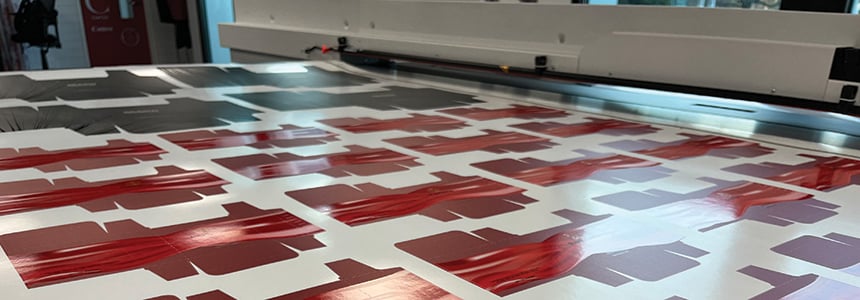
Above: Above and Right: Canon’s Arizona flatbed series is a stationery flatbed well suited for precise package prototyping, design proofing, localized structural samples, and intricate multi-layered displays.
UV is used for both full production and prototype printing directly onto corrugated board. Hardware as well as ink formulations have an effect on the end result.
From Prototyping to Manufacturing
UV printers print to corrugate for prototyping, short-run production, or full-scale manufacturing.
“The market has evolved such that print providers now invest heavily across all three segments based on operational needs,” offers Patrick Donigain, senior manager, large format printing solutions, Canon U.S.A., Inc.
While digital UV flatbed technology was once primarily for prototyping and mockups, Donigain explains that localized demand and SKU proliferation have fueled rapid growth in high-quality, short-run production using specialized roll-to-roll engines. “Simultaneously, display and packaging operations are adopting automated industrial flatbeds for full-scale digital manufacturing.”
Hugo Gonzalez, senior segment specialist, Mimaki USA, Inc., admits that while the more popular entry point is short-run work in the corrugated space, print providers take advantage of UV technology’s versatility and expand their portfolio with the range of products to match the ink and printer. “It provides an entry point for many shops into the corrugated print space while being able to provide other services without additional setup.”
In Tad Bozdech, product manager, Excelitas’, experience, a majority of customers use UV LED curing for full production runs. They focus on building large format, high throughput, single-pass printers.
“For the past 20-plus years, UV wide format has been the only game in town allowing for printing on corrugated board with relative ease and consistency,” shares James Stanley CPP, RPbD, business development manager packaging, Mutoh America, Inc.
Mark Crawford, product and business development manager, Vanguard Digital Printing Systems, sees the strongest growth in short-run production as well as a continued movement toward full-scale digital manufacturing. Converters and display producers invest in UV digital printing because it allows them to produce sellable, production-quality work with faster turnaround times, less setup, and fewer minimum order constraints.
Important Characteristics
In the digital UV print space for corrugated there are desirable ink characteristics.
Processing ability and appearance are two. “The ink needs to be able to resist being cut, creased, and flexed during finishing. This means it needs to remain flexible after curing, durable enough to resist handling, and it needs to remain adhered to the material when cut,” says Gonzalez.
Donigain feels that a broad, saturated color gamut is vital for precise brand replication in commercial displays. “Robust mechanical durability is essential for post-print workflows like automated cutting and creasing to help limit chipping or cracking. Additionally, low odor, formulations free of volatile organic compounds and hazardous air pollutants are important for handling and indoor use,” he adds.
Gonzalez says the ink needs to feature a wide gamut and opaque whites to remain vibrant even on materials that are not white.
“Best in class color is always job one. Beyond this, corrugated applications demand a challenging balance of flexibility and rub durability from the ink film,” comments Ted Pierpont, national sales manager, large format/textile/corrugated, Durst Image Technology US.
Stanley notes that ink with flexibility is important as most UV printed applications are cut on digital finishing equipment/CAD tables.
Digitech’s team says as corrugated applications require creasing and bending, UV inks must accommodate that. “Different formulas have different amounts of stretch to them.”
Bozdech points out that scratch resistance and low migration are of high importance since corrugated substrates tend to be absorbent unless they are coated.
Inks also need to cure efficiently at production speeds. According to Crawford, if the ink does not respond well to the curing system it can limit throughput or compromise adhesion, scratch resistance, and rub resistance. For corrugated work the finished print must also be able to withstand handling, cutting, creasing, folding, and shipping.
Coated Versus Uncoated
Coated and uncoated corrugated materials behave differently.
Uncoated corrugated substrates are generally more absorbent and less uniform. They may require an ink set or print strategy that manages penetration, dot gain, and surface variation. “The goal is to maintain color density and image quality while still achieving proper adhesion and durability,” says Crawford.
Uncoated corrugated board is highly porous, which Donigain points out can cause standard inks to penetrate fibers and complicate curing. Inks for these liners must control bleed and minimize dot gain. While some UV inks work on both surfaces with proper settings, coated substrates keep ink on the surface, enabling sharp dots, low ink consumption, and a broad color gamut.
“Due to the absorbency of uncoated substrates, we find that viscosity is a key consideration in inks designed for those substrates. To account for the slipperiness of coated surfaces, surface adhesion is a must have, so formulators design their inks with that in mind,” comments Bozdech.
Certain methods can improve printing on uncoated material. “While corrugated material does not generally require a primer, printing a base layer of primer can reduce the absorbency and improve the print quality. However, with a highly absorbent surface, it might be difficult to fully cure the printed ink once it has soaked into the fibers. This is why is it highly recommended that inks are tested on the actual application material. It is also always a good idea to purchase the right materials for the job; in this case, coated or surface-treated materials,” shares Gonzalez.
Coated corrugated liners typically provide a smoother and less absorbent print surface, which can support sharper detail, more uniform color, and stronger visual impact. “On these materials, ink formulation and curing must promote adhesion while controlling dot gain and maintaining a consistent surface finish,” notes Gonzalez.
Stanley explains that traditionally there has not been a differentiator between coated and uncoated corrugated media. “It is either flexible or more rigid ink, unlike flexographic or offset most UV wide format will not have the ability to swap inks after you start with one.”
UV Curing System
The curing system is fundamental to both image quality and productivity. UV lamps allow for fast drying inks that increase speeds and feeds through the printing equipment, shares Stanley.
Instant UV curing means faster production speeds and higher quality prints, according to the Digitech team.
“Curing can impact adhesion, flexibility, rub, and can be used strategically to control gloss level. In a well-designed system, it will deliver the needed cure energy at all print speeds,” adds Pierpont.
Gonzalez says the curing system determines how quickly the ink is fixed to the surface, which affects dot control, color consistency, adhesion, finish, and the ability to be immediately processed. “A good curing system is matched to the ink to provide the precise curing frequency at the right intensity without adding too much energy, which could heat or possibly damage substrates.”
UV LED provides near-instantaneous curing, allowing for very high process speeds. Bozdech points out that careful control of light exposure can produce either glossy or matte finishes. “In that way, there is a delicate interplay between the inkjet printheads and the UV curing light sources in determining the look and feel of the printed end product.”
Curing configurations establish the baseline for speed and quality, as output is limited by the system’s ability to immediately solidify ink. Donigain says precise lamp positioning freezes droplets to minimize spread and allow complete curing.
Curing consistency across the full print width is also critical. Uneven cure can lead to differences in gloss, adhesion, scratch resistance, and finishing performance. “In a production environment, reliable curing is one of the keys to predictable output,” comments Crawford.
Curing Evolution
Curing technology has transitioned from high-heat mercury vapor lamps to efficient UV LED arrays.
“The move from mercury halide lamps to LED greatly reduced media surface temperatures and the amount that sheets would move under the printing/curing unit. This innovation enables better print quality overall and helps mitigate registration and media hold down challenges,” explains Pierpont.
Donigain says that unlike traditional halide lamps that required mechanical shutters, significant heat, and typically a 30- to 60-second warm up, modern LED arrays offer instant electronic on/off functionality with no standby energy draw. Certain curing methods provide uniform curing across the swath, which helps limit gloss banding and provide consistent ink adhesion at high commercial speeds.
Most digital UV printing platforms now employ UV LED lamps that can be programmed for instant on/off use, which contributes to low heat and low running costs, while improving production speeds. It also allows a wider gamut of materials including thin and sensitive substrates, notes Gonzalez.
As print production speeds have increased, Bozdech says the demand for high-power UV LED light sources has grown proportionately. “In the past, air-cooled lamps dominated the market, since they are easiest to integrate, but more demanding processes have required the introduction of water cooled curing lamps.”
“Originally all machines had UV lamps on the sides of the printheads. Today there is a UV section on high-speed solutions that follows the printheads,” offers Stanley.
For corrugated applications, reduced heat of UV LED is especially valuable. “Corrugated board can be sensitive to temperature, moisture, and dimensional changes, so LED curing helps protect the substrate while still supporting high-quality production,” shares Crawford.
UV for Corrugated
UV print technology is effective for corrugated print. Continued advancements in inks, automation, and UV curing systems improve quality, efficiency, and sustainability for corrugated applications.
Sep2026, Industrial Print Magazine