By Cassandra Balentine
Three-dimensional (3D) build software is essential to obtaining the best quality and efficiency out of a production run. Several advancements, including real-time data monitoring, are now a reality.
The most significant are in simulation, smarter data preparation, and automation. Volker Schillen, product manager, Materialise, says simulation is more relevant in practical production workflows because it helps users predict possible print issues before they occur. “Increasingly, software is not only identifying risks, but also helping users adapt preparation strategies before printing.”
Another important advancement is that build software is getting smarter in the way it handles constraints automatically. “That improves consistency and reduces manual work,” comments Schillen.
Workflow integration is another recent advancement. “The industry is moving beyond standalone tools toward connected environments where build preparation, quality workflows, automation, and traceability work together. That is especially important for customers that want to move from prototyping toward scaled or regulated production,” shares Fabian Neugebauer, quality domain manager, Materialise.
Dr. Ali Tamijani, founder/CEO, Novineer, Inc., says advancements offer the ability to predict stiffness, strength, and failure using the actual sliced toolpath rather than treating a printed part as a uniform block of plastic. “That, combined with validated material cards built from physical testing, is what finally makes simulation of polymer extrusion parts trustworthy.”
Here we highlight certain build software solutions and advancements. Read more in our September issue.
EOS
EOS Smart Fusion is EOS’s closed-loop process control innovation for metal additive manufacturing (AM). Smart Fusion is already well established in the metal AM market as a proven technology that stabilizes heat input, reduces support structures, and enables more reliable builds. Manufacturers across industries rely on Smart Fusion to manage thermal variations and ensure stable, high‑quality production outcomes. Smart Fusion NextGen extends intelligent heat management and laser power control to an even broader range of applications and materials.
Building on years of process expertise and customer feedback, Smart Fusion NextGen introduces three major advancements. An optimized algorithm reduces downskin surface roughness, resulting in smoother, more consistent part surfaces, even in challenging geometries. Refined, localized heat control leads to noticeably improved dimensional accuracy on downskin and overhanging features by reducing overheating distortion. In overhangs below 15 degrees, Smart Fusion NextGen significantly minimizes pores in downskin. It has been documented that Smart Fusion led to a “false ceiling” in some instances. Now with Smart Fusion NextGen extreme low angles are built smoother and without these large pores.
Materialise
Materialise supports the 3D build space with a connected software portfolio built to serve additive manufacturing (AM) from build preparation to production management. Magics is a proven platform and market leader for build preparation across AM technologies and mixed machine fleets. It gives users the flexibility to prepare parts efficiently and reliably across a range of applications, according to the company.
CO-AM adds the broader production layer, connecting preparation, execution, traceability, and manufacturing management. This becomes increasingly important as customers move toward regulated, high throughput, or serial production. “We address this demand with three types of CO-AM packages, for specific needs—CO-AM Professional, CO-AM NPI, and CO-AM Enterprise,” says Schillen.
At last year’s Formnext, Materialise launched CO-AM Brix, a low-code, node connector capability designed to codify AM expertise into customizable workflows. This helps reduce manual work, standardize best practices, and automate complex preparation and quality-related processes.
“What differentiates us is that we do not look at build software as a standalone tool. As additive manufacturing scales, customers need more than build preparation alone; they need an ecosystem that connects automation, traceability, quality management, and production orchestration. That is why Materialise developed CO-AM as an open ecosystem, allowing customers to connect existing manufacturing tools and integrate additive into their broader production environment,” offers Neugebauer.
Another important differentiator is that it uses these technologies in its own production environments across multiple AM technologies. “That gives us practical insight into what manufacturers actually need when they move from prototyping to industrial production. We are not developing software in isolation, but everything we develop comes from real production experience and needs,” says Schillen.
Novineer
Novineer builds an AI-powered engineering software suite that removes the friction between physical parts and digital engineering. Three products span the workflow—NoviVision, NoviPath, and NoviDesign.
NoviVision is able to turn a few smartphone photographs of a physical component into an editable CAD model in about two minutes, roughly 90 percent of the modeling work automated, about 100 times faster than manual reconstruction, with STL and editable STEP outputs, and no scanning equipment or specialist training required.
NoviPath is a toolpath-aware performance simulation for AM parts. Unlike conventional FEA, which treats printed parts as uniform solids, NoviPath uses the actual layer-by-layer toolpath and validated material models to predict stiffness, strength, and failure before printing. It is integrated with Stratasys’ GrabCAD Print Pro, making Stratasys the first OEM to offer this capability in a production workflow, and early customers report up to 35 percent weight reduction on load-bearing parts.
NoviDesign completes the suite with generative design that produces optimized, editable, manufacturable CAD, not locked mesh outputs engineers can’t work with.
“What differentiates us is the combination of toolpath-level physics, an end-to-end digital thread and the depth behind it—more than 15 years of federally funded research,” shares Dr. Tamijani.
Senvol
Senvol’s machine learning (ML) software for AM, Senvol ML, helps to rapidly optimize parameters and develop materials. The software can be used to analyze data from any AM machine, material, and process. It is not build software, but it plays a key role in analyzing data from builds and using that data to generate predictive models that help with optimization.
Stratasys
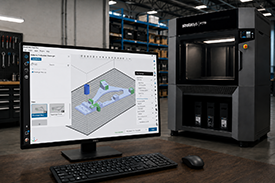
The core differentiator of Stratasys is that a single software suite runs all five of its 3D printing technologies, and that suite is purpose-built to get the most out of Stratasys high-performance industrial printers—easily, consistently, and at the highest quality. GrabCAD Print Pro is tuned to its hardware in ways a generic, neutral tool cannot match.
The Accuracy Center turns a single first-print scan into a warp-adjusted model that holds the tightest tolerances, Manufacturing Templates lock in repeatable results across operators and shifts, thickness and gap analysis catches problems before a job reaches the printer, and 3D array maximizes the number of parts produced within a given build window. The outcome is production-grade quality with less scrap, rework, and dependence on specialized skills.
Victor Gerdes, VP, software, Stratasys, says a few features of this product stand out. fixturemate by trinckle is built into GrabCAD Print Pro, so operators can design production fixtures without CAD skills, cutting fixture creation from days to hours. Building on that, the broader Additive App Suite from trinckle brings a library of automated design apps for everyday factory floor needs directly into GrabCAD Print and Print Pro, with an initial set of ten apps planned for launch in Q3 and the library expanding toward 15 by Formnext in November. Accuracy Center ingests a 3D scan of a first print to AI synthesize a warp adapted model to correct warpage on later builds, optimizing dimensional accuracy of any part while opening new use cases that demand the highest tolerances. GrabCAD Print Pro introduced build-level CO2e emissions estimation to support sustainability initiatives and regulatory compliance for manufacturers.
It also announced a partnership with Novineer to bring toolpath-aware performance simulation into GrabCAD Print Pro to predict real part performance pre-print, reducing risk and iteration. Novineer NoviPath in GrabCAD Print is in development and expected in the second half of 2026.
Sep2026, Industrial Print Magazine