by Melissa Donovan
Traditionally, post-processing additive manufactured (AM) parts was a manual process—removing supports, depowering parts, sanding, polishing, and cleaning. Today, manufacturers invest in automated systems that reduce labor, improve repeatability, and increase throughput. Some of these may include automated depowdering stations, robotic support removal, automated bead blasting, conveyorized cleaning systems, and robotic loading and unloading mechanisms.
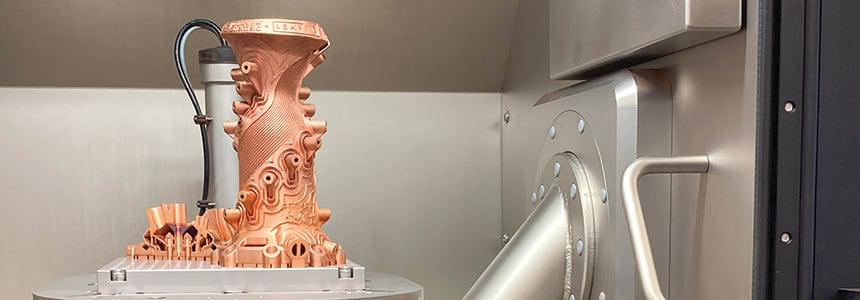
Above: Solukon offers a range of metal depowdering systems based on its SPR Smart Powder Recuperation technology.
Push to Automation
Labor, productivity, quality, and reliability are just some of the reasons manufacturers are automating the post processing of three-dimensional (3D) printed components.
According to Andreas Hartmann, CEO/CTO, Solukon, metal AM in particular has matured quickly.
“Build volumes are up, part geometries are growing more complex, and industries like aerospace, automotive, and medical are demanding tighter tolerances and full process documentation. Post processing and depowdering in particular are the bottleneck that manual workflows simply can no longer overcome.”
Hartmann believes there are three reasons the automation of post-processing 3D parts is expanding—scale and throughput pressure, part complexity, and material safety and compliance.
In terms of scale and throughput, with AM moving beyond prototyping and into serial production, each job continues to need to be processed with no delays. Manual solutions are slow, inconsistent, and tie up skilled operators. With production facilities running multiple printers, they cannot afford bottlenecks at the end of the line, explains Hartmann.
“The biggest driver is simple. 3D printing has grown past prototyping and into real production, and once you are making parts in volume, the hand finishing at the back end becomes the bottleneck. Your printer can run all night, but if every part still has to be finished by hand, that is where the work piles up,” agrees Michael Brokordt, marketing and sales manager, MicroTek Finishing.
Part complexity is commonplace. “Lattice structures, winding cooling channels, and internal geometries are what makes metal AM worth using and also what makes manual depowdering unreliable. Powder trapped in channels smaller than one millimeter cannot be shaken out by hand,” states Hartmann.
Material safety and compliance is more important than ever before, and automated systems are designed to monitor for safety issues. “Reactive metal powders like titanium or aluminum alloys carry real occupational health risks. Regulatory pressure and internal safety standards are pushing operators out of direct powder contact. Automated, closed-loop depowdering systems contain the powder, protect the operator, and create an auditable process record,” explains Hartmann.
With skilled finishers harder to find and even harder to retain, automating the post 3D printing process inspires productivity, quality, and reliability. Brokordt admits that manual work presents room for error. “Manual work drifts from day to day and from one person to the next, which turns scheduling into a guessing game. On quality, a controlled process does it the same way every time. Two people finishing by hand, or the same person at the end of a long week, will give you slightly different results. When a part has to hit a specification, that consistency is the whole point. On reliability, you end up with a result you can repeat and count on, part after part. That is what lets a manufacturer treat finishing as a dependable step in production instead of a variable at the end of the line.”
Consistency is essential. Depending on the part and material, when manually finishing a 3D printed piece, Cole Mathisen, director business development, Mass Finishing, Inc., says some clients might spend days trying to achieve the same surface finish as a part completed prior. This just isn’t practical.
“For aerospace applications, the consistency and repeatability of utilizing a specific recipe including speed, time, media, and compound are all important in ensuring quality across different lots of parts,” adds Mathisen.
System Benefits
Automated depowdering, robotic support removal, automated bead blasting, conveyorized cleaning systems, and robotic load/unload are a few examples of automated systems used in post processing.
When it comes to automated depowdering, “it frees skilled technicians from a repetitive, hazardous task and redeploys them where their expertise actually matters, for tasks like inspection, factory planning, or customer engineering,” shares Hartmann.
Automated depowdering offers a reliable cleaning process. Where manual depowdering opens up the process to error and defects, automation almost eliminates this, with the same maintenance results occurring for each identical part.
“Residual powder compromises downstream processes like heat treatment, HIP, surface finishing, and in functional parts, it is a defect,” adds Hartmann. “Automated depowdering is not a nice-to-have feature in the AM of metal parts. Rather, it is a key enabler, as it is the only way to achieve repeatable and therefore standardized post processing.”
Automated tumbling systems help smooth out batches of 3D printed parts. The rough pieces achieve a mirrored polish in some cases in less than hour, explains Mathisen, while spinning at high speeds.
Auto Pause
Even as the role of automated post processing of AM parts continues to evolve—more than ever as printing moves from prototyping to production—not all volumes or materials may necessitate automation.
The breakeven point, says Hartmann, depends on part complexity, material, cleaning requirements, labor costs, and process consistency. “In some cases, automation pays off even at relatively low volumes, particularly when manual depowdering is time consuming, hazardous, or difficult to reproduce.”
Ron Vogel, president, EDM Network, Inc., cautions that while many processes can be automated, with the heat treating and HIP requirements of some materials, unless these are brought in house, this does get in the way of the complete automation of 3D printing.
In regard to materials, “for expensive powders like titanium for example the breakeven point to invest in an automated depowdering system—with the ability to collect and reuse the unfused powder—comes a lot earlier as with more affordable powders,” continues Hartmann.
It is a case-by-case basis, admits Brokordt. “First and foremost, you have to solve the problem. Can the requirement actually be met, and is there even a technology that can take care of the whole job? That comes before anything else. Once you know the problem can be solved, then turnaround time and cost come into the picture. Different parts, volumes, and requirements land in very different places, so the honest answer is that you look at each one on its own rather than reaching for a magic number.”
Another example, given by Vogel, is the 3D laser powder bed fusion process, which is slow and can take many hours or days to print a build plate with say 30 parts. “To automate a process that takes 24 hours to print, but only say two to three hours to EDM does not make sense unless there are multiple 3D printers feeding one depowder machine, or one EDM, where the workload is balanced. Then automation can start to make economic sense.”
True Production
Automated post processing plays a pivotal role in making AM a true production technology.
“The printing itself has come a long way, but a printed part is not a finished part. It still has to be cleaned up and finished to meet a spec, and if that backend work stays slow and done by hand, it caps how far you can scale. Bringing consistency and repeatability to post processing is what lets manufacturers count on the finished result, part after part, and treat it as a dependable step in production,” shares Brokordt.
The reality is “you can’t have production without a viable post-processing method. If you are only looking at the automated production, you are missing the connection between the customer and the printer,” concludes Mathisen.
Oct2026, Industrial Print Magazine