by Industrial Print Magazine Staff
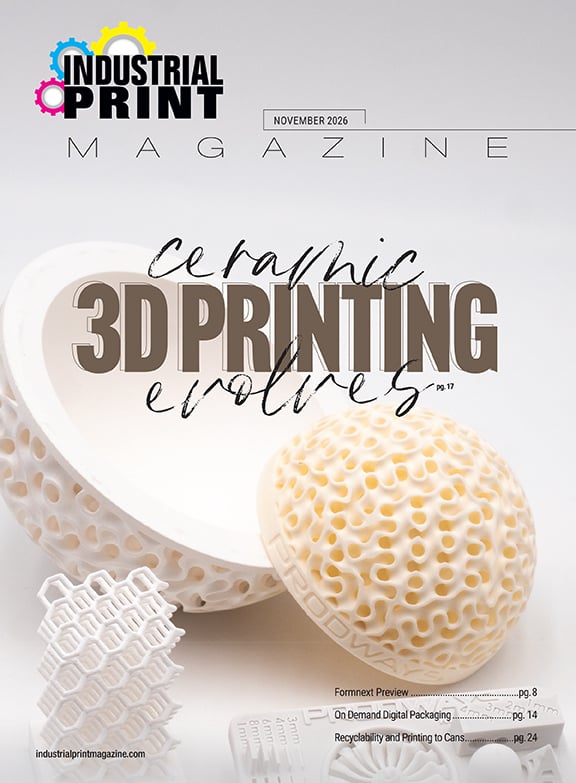
Additive manufacturing (AM) continues to evolve. While we often hear about plastic- and metal-based options for AM, ceramics is a viable material poised for growth.
Founded in 2022, originally as SiNAPTIC Technologies, Adva Cera is a Broomfield, CO-based provider of printed ceramic components engineered to meet the performance, precision, and scalability requirements of the most demanding industries.
It strives to deliver complex, advanced ceramic elements that are additively manufactured according to application-driven requirements. From early-stage development through production qualification, the company collaborates with OEMs, researchers, and other customers to produce ceramic components that overcome engineering challenges and withstand intensive performance demands.
Focused solely on advanced ceramic AM, Adva Cera aims to offer a solution where traditional manufacturing methods fall short. Its top-of-the-line ceramic AM technologies and expertise enable complex geometries, high-temperature performance, and material efficiency.
Leading the Charge
Adva Cera produces a range of ceramic components—from prototypes to production runs—for a number of industries using technical advanced ceramic AM.
It started out focused on medical implants; with a founding team comprised of individuals with expertise in the scope of medical devices. However, early on, the potential for ceramics in AM in additional areas became clear.
“We realized there’s more demand for AM ceramic components in several other industries,” confirms Dustin Williams, VP, business development, Adva Cera.
Today, it produces prototypes and production parts for aerospace and defense, transportation and industrial, energy, and semi conductor and electrical component industries, in addition to medical projects.
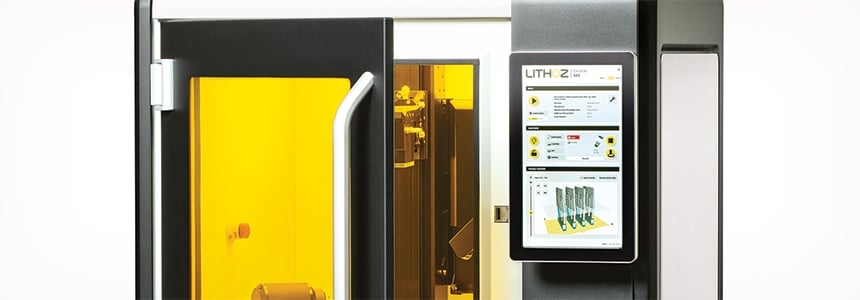
One Adva Cera’s earliest employees, Williams witnessed this shift in focus first hand. He says it started when its AM equipment provider, Lithoz, would refer customers to them. “Lithoz conducts demo prints for customers, but not everybody is going to buy a printer and all of the infrastructure that goes along with it.”
Branching out, the manufacturer became well educated on other areas that technical advanced ceramic AM could positively impact. “It is my job in business development to identify industries that can take advantage of the technology and materials that we offer,” adds Williams.
It is important to note that while ceramic AM is an established technology, it is still emerging. Therefore, Williams stresses the importance of working closely with the engineers of its clients no matter what the job or industry is. “Many people aren’t even aware of ceramic’s capabilities. It starts with education, showing customers what we are capable of and what the technology can do in terms of size, tolerances, and features.”
The company is quality focused and holds an AS9100 certification, which is the international quality management system or QMS standard for the aviation, space, and defense industries.
Additionally, it is registered with the International Traffic in Arms Regulations’ or ITAR, signifying that it meets the requirements applicable to suppliers supporting controlled programs or materials.
Ceramic Materials
With an arsenal of ten ceramic AM devices, from both Lithoz and Prodways Printers, Adva Cera is uniquely positioned to print with a variety of ceramic materials, including oxides, nitrides, and bioceramics.
Oxide-based technical ceramics are known for their versatility, stability, and proven performance across many industries. When combined with AM, oxide ceramics enable greater design freedom while maintaining the material properties required for demanding environments.
The oxide-based materials Adva Cera utilizes include alumina and zirconia. Williams recognizes alumina as the most popular, as it is the most ubiquitous and can be used for multiple applications.
The company also uses advanced nitride-based ceramics. These materials are ideal for applications requiring exceptional mechanical strength, thermal performance, and reliability.
Nitride-based ceramic materials are widely used in environments where components must withstand extreme temperatures, mechanical loads, and chemically aggressive conditions.
Among its nitrate-based ceramic materials are aluminum nitrade and silicone nitrade.
Its bioceramics are developed for AM applications in medical, dental, and orthopedic fields. These advanced bioceramic materials are designed to support biocompatibility, osteoconductivity, and controlled resorption.
The material is known as hydroxyapatite (HA), which is a naturally occurring mineral and a primary component of human bone. As a bioceramics material, HA offers exceptional biocompatibility and osteoconductivity, making it ideal for applications that require strong biological integration.
Additively manufactured HA enables the creation of well-defined, porous, and patient-specific structures that promote bone cell growth. Once implanted, HA scaffolds support bone ingrowth while the material is gradually resorbed and replaced with newly formed natural bone.
As far as AM, ceramics is “the last frontier,” according to Williams. He feels that these materials can be utilized in many applications that probably aren’t taken advantage of today.
“Ceramics are difficult to manufacture no matter the method because of their properties. Some great features they offer include thermal management and temperature resistance. They are also electrical isolating or insulated. While this is true for plastics and some metals, ceramics also have excellent wear resistance for demanding environments like space,” explains Williams.
The Onboarding Process
The typical journey for a Adva Cera customer starts with a concept or problem. A client meeting involves engineers trying to understand the problem or concept and working together in design.
These teams go through their ideas and designs, add modifications when necessary, and once the design is agreed upon a prototype is produced. “Depending on the needs, this can be a first run with some initial testing, or a tier two prototype with very strict dimensional requirements,” shares Williams.
Then the customer takes the component to ensure it is performing as expected. After some refinements, dimensional adjustments, or feature testing, it moves straight to production.
The turnaround time depends on the design process, as well as the number of components.
On the Horizon
The future of technical advanced ceramic AM is bright. Williams feels we’re just scratching the surface of what is possible.
One of the most exciting developments is around ceramic core production. This is the element that defines the internal geometry of a final part. It must withstand the extreme heat and mechanical stresses that are incurred by the investment casting process, and it must be removed from the solidified part without damaging it.
Ceramic cores are conventionally produced using silica via injection molding, which tend to take months or even years to produce. The material is thermally stable and dissolvable, making it ideal for this application.
Advancements in AM printed silica cores use the same material but eliminate the lead time constraints as well as introduce new capabilities, like creating complex designs that improve thermal management with internal features like directional cooling channels. “We’re just touching the surface of what’s is capable with this technology,” stresses Williams.
Advanced Ceramics
Adva Cera is fully adept in working with ceramic materials. Experienced in the features and benefits of advanced technical ceramic AM, it partners with manufacturers that need anything from prototypes to production runs.
Nov2026, Industrial Print Magazine