by Melissa Donovan
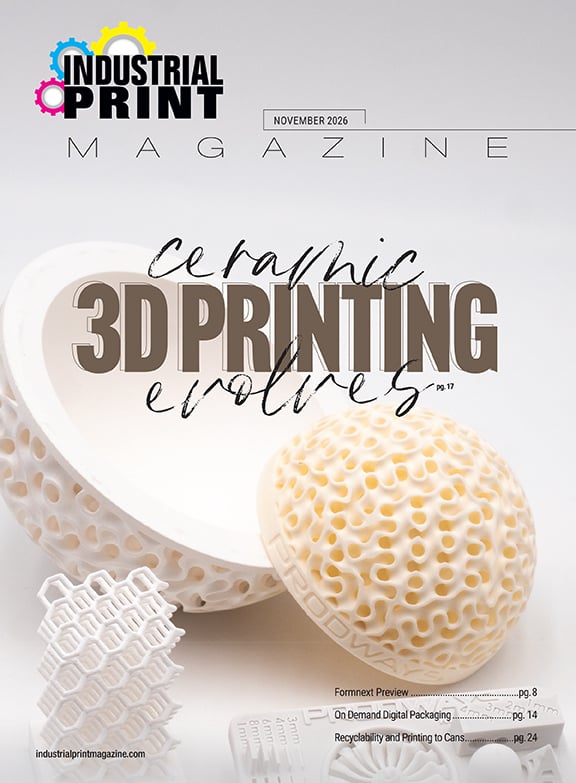
Ceramic three-dimensional (3D) printers are increasingly deployed in production print, rather than just laboratories for research and development (R&D). Aerospace, medical, electronics, and energy are all industries finding favor with 3D ceramic print.
While the speeds and finer resolution capabilities of the machines allow for this advancement, what is also pivotal is the ability to print with materials beyond traditional alumina and zirconia like aluminum nitride (AIN), silica-based ceramics, calcium phosphates, silicon nitride, and silicon carbide.
Determining when to use these materials is based on their highly specific properties and how that fits the final part.
New Materials
A number of ceramic-based materials are compatible with additive manufacturing (AM). AIN, silica-based ceramics, and calcium phosphates are three options that have been scaled and proven for use in industrial and production settings.
“The range of ceramic materials available for AM is expanding, with increasing interest in materials selected for very specific thermal, electrical, mechanical, or chemical properties,” admits Sébastien Jacoberger, marketing manager, Prodways Printers.
According to Dr. Johannes Homa, CEO, Lithoz, AIN, silica-based ceramics, and calcium phosphates each recently crossed important industrial milestones—growing clinical or field evidence, verifications, and large-scale adoption. Across a material portfolio that spans over 50 ceramics, Dr. Homa admits that these three are the fastest growing in terms of demand at Lithoz.
“They open up entirely new industries and application spaces that were previously beyond the scope of ceramic AM,” continues Homa.
Beyond AIN, silica-based ceramics, and calcium phosphates, Maxence Bourjol, sales manager, 3DCeram Sinto, says there is growing interest in silicon nitride and silicon carbide.
Bourjol points out that not any one of these materials is better than other, as they provide a specific property or application. “Ultimately, the material should always be selected according to the function and operating environment of the final part.”
“The main trend is therefore not simply the replacement of traditional ceramics by newer materials, but the development of a broader range of printable ceramics adapted to specific industrial applications,” agrees Jacoberger.
Application Growth
With new materials, there is an opportunity to expand ceramic AM into new industries and create applications not once possible.
“We see strong potential in industries such as semiconductors, aerospace, space, and defense. In semiconductor applications, ceramics can provide thermal management, electrical insulation, and performance in demanding wafer-processing environments,” shares Bourjol.
AIN is known for its thermal conductivity. An additional advantage, it remains electrically isolating at the same time. “Thanks to these superior geometries and thermal expansion closely matched to silicon, AlN is an incredibly attractive option for critical thermal management tasks in semiconductor manufacturing, propulsion systems, and data center cooling, to name a few,” explains Dr. Homa.
Lithoz printers work with AIN to create ultra-precise 3D printed components previously unfeasible. Its CeraFab Systems operate via lithography-based ceramic manufacturing (LCM) and print with a ceramic-loaded liquid (slurry). Based on a CAD model, the parts are 3D printed via selective blue light exposure. After thermal post processing concludes, the binder is removed and the components are sintered, resulting in fully dense ceramic components.
Silica-based materials, commonly used for casting cores like turbine blades, also allow for a level of geometric complexity previously unattainable. “These casting cores are critical for next-generation engines that rely on high turbine inlet temperatures as well as advanced internal cooling,” shares Dr. Homa.
“One of the most established applications is investment casting, particularly in aerospace. Silica-based ceramics can be used to produce complex ceramic cores and molds for turbine components. AM enables the production of complex internal geometries while reducing or eliminating the need for tooling in certain applications,” adds Jacoberger.
Calcium phosphates are increasingly used in bone replacement applications. Calcium phosphate implants made from hydroxyapatite or beta-tricalcium phosphate and 3D printed using Lithoz LCM technology offer an attractive alternative to conventional procedures. The ceramic composition closely resembles bone, and the LCM process allows for the engineering of precise porosities that allows bone ingrowth. That way, the implants are gradually resorbed and replaced by natural bone.
Over a decade of research has gone into Lithoz’s LCM process in relation to printed calcium phosphate. In tandem with Lithoz, German implant manufacturer KLS Martin co-developed and validated the process. KLS Martin offers LCM printed solutions via its surgeon-facing Individual Patient Solutions Gate for planning, ordering, and delivering patient-specific implants.
“This moves 3D printed ceramic implants from a special request to a widely available standard product for surgeons worldwide,” explains Dr. Homa.
For aerospace, space, and defense, silicon nitride and silicon carbide are utilized for their high-temperature resistance, thermal shock resistance, and ability to operate in harsh environments, notes Bourjol. “AM adds another advantage by combining these material properties with complex geometries, internal channels, and lightweight designs that can be difficult to achieve conventionally.”
“In these markets, ceramic AM combines the functional properties of technical ceramics with the ability to produce complex geometries that can be difficult to manufacture using conventional processes,” admits Jacoberger.
The Production Future
The introduction of materials like AIN, silica-based ceramics, calcium phosphates, silicon nitride, and silicon carbide influence the future of 3D ceramic printing in production environments.
“They help ceramic AM move beyond prototyping and R&D toward high-value industrial applications and production. AM can shorten the time required to start production, eliminate tooling, and make small and medium series economically relevant,” attests Bourjol.
Dr. Homa agrees. “these materials enable entirely new applications in industries that have not traditionally relied on ceramics, expanding the scope of LCM.”
“As more ceramic formulations become available and qualified for AM, manufacturers can address a wider range of applications and increasingly use the technology for functional and production parts,” says Jacoberger.
Material advancement is just one part of breaking into new industries and growing AM in production printing environments, cautions Dr. Homa. “It must pay off at an operational level. This is where the entire Lithoz LCM ecosystem comes into play. The technology enables dynamic responses, reduces costs and production times, and often consolidates components that previously required assembly from multiple parts into a single unit. Furthermore, Lithoz machinery offers geographical independence and short supply chains.”
“Successful production requires control of the complete process chain—from material formulation and printing to cleaning, debinding, sintering, and final qualification,” agrees Bourjol. At 3DCeram Sinto the entire process chain is addressed and the company supports its customers in developing the know-how needed to control it themselves, from the first trials through to qualified production using its stereolithography (SLA) 3D printers.
The 3DCeram Sinto SCALE range is based on top-down SLA and is designed with scalability in mind. Customers can develop their material and process and start running small scale productions on the C101 EASY FAB at a build volume of 100x100x150 millimeters (mm), then transfer production to larger platforms such as the C1000 FLEXMATIC 320x320x200 mm, and ultimately the C3601 ULTIMATE 600x600x300 mm.
Jacoberger says the position at Prodways Printers is similar. “Repeatability, dimensional accuracy, process control, debinding and sintering, and consistent final part quality are equally important. For this reason, we believe the future of ceramic AM will rely on complete and controlled workflows, combining printing technology, qualified materials, and optimized post processing.”
Prodways Printers’ CERAM PRO range is based on its proprietary MOVINGLight digital light processing (DLP) technology, a vat photopolymerization process developed for high-precision ceramic AM. The CERAM PRO 365 works with validated ceramic formulations including silica-based materials for investment casting applications and alumina for advanced technical ceramic applications. The CERAM PRO 385 and 405 complements the range, particularly for R&D, application development, and ceramic material development.
Traditional Need
Despite the recent discussions around new materials and their capabilities, there is still a need for traditional materials like alumina and zirconia.
For example, Jacoberger suggests that alumina remains one of the most important technical ceramics for industrial applications. “It combines electrical insulation, thermal resistance, chemical stability, and good mechanical properties, making it suitable for a range of demanding applications.”
According to Dr. Homa, “traditional materials aren’t legacy materials being phased out, they’re still the default choice for most applications, simply because their properties match the requirement—predictable mechanical behavior, proven biocompatibility, and decades of process knowledge. The ceramic material itself isn’t replaced; rather, the range of applications and industries is expanding.”
“New materials complement existing ceramics rather than replace them. The choice of material will increasingly depend on the requirements of the final application,” admits Jacoberger.
Ceramic Variety
The newest material options for ceramic 3D printing are not replacing traditional materials like alumina and zirconia, but expanding and growing the market. Material development plays a role in the transition of ceramic AM from prototyping toward industrial production.
Nov2026, Industrial Print Magazine