By Cassandra Balentine
Part 3 of 4
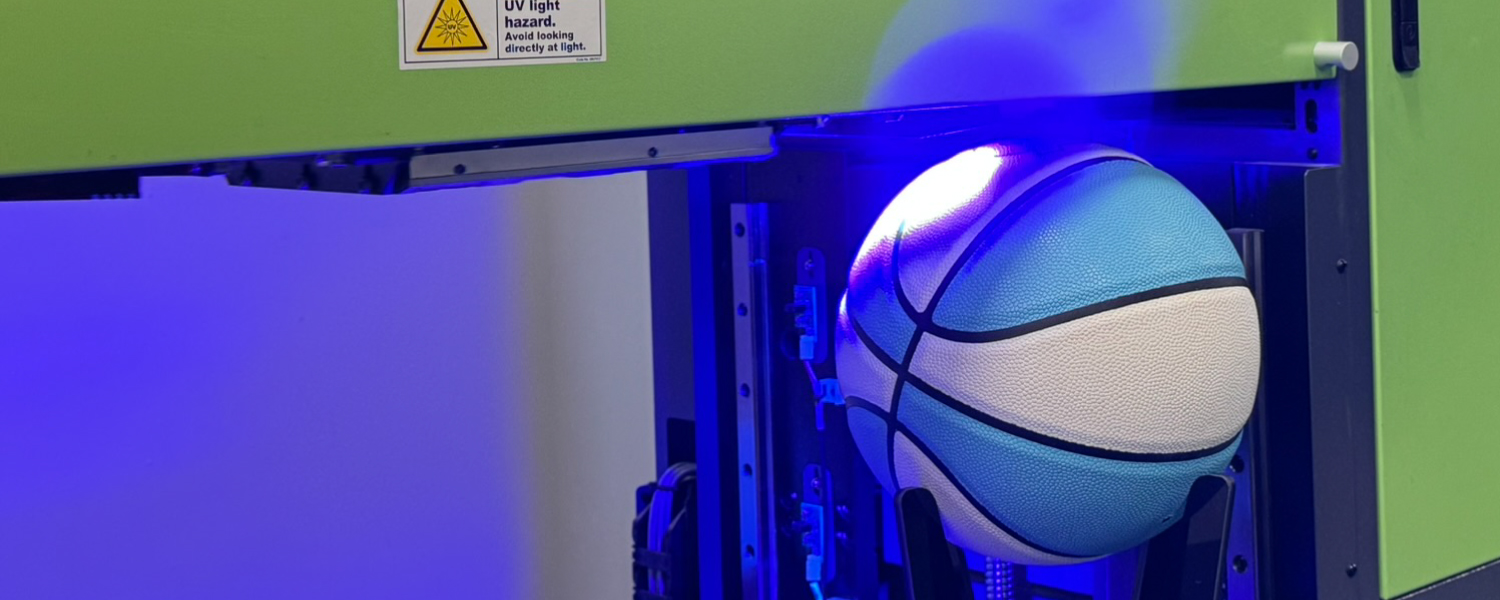
Direct to object (DTO) printing on a variety of products, including curved surfaces and other unique shapes continues to grow in terms of technology as well as use cases. This is parallel to the continued adoption of artificial intelligence (AI) tools.
Dan Valles, business development manager, OEM printheads, Epson, says AI is contributing to the advancement of digital workflows for DTO printing. “There is potential for AI to improve efficiency in print preparation based on shape data, automate the evaluation and correction of trial print results, and visualize quality risks. AI also has the potential to support the entire process—from print preparation to building in quality.”
AI is expected to play a growing role in DTO printing by automating print preparation, optimizing workflows, and enhancing quality inspection. “AI-enhanced art software for example, allows design teams to take an idea from concept to production quicker than ever before,” comments Michael Perrelli, sales director, Innovative Digital Systems.
In print preparation, Boris Liberman, senior engineering manager, Engineered Printing Solutions, says AI could help automate repetitive file handling tasks, support recipe selection, and reduce setup complexity for high SKU production environments. “That matters because manufacturers are dealing with shorter runs, regional variants, seasonal SKUs, serialization, traceability, and regulatory coding. Digital DTO is valuable in those environments because it reduces tooling and make-ready, and AI could make those workflows even more efficient.”
While the industry is still in the early stages of AI adoption, Tom Lang, digital products manager, Inkcups, expects it to streamline print preparation by helping automate artwork positioning, optimize print layouts, and simplify job setup for complex 3D objects. “Some customers already use AI to generate artwork from scratch. While this can significantly reduce design time, AI-generated artwork should still be reviewed through a quality control process before being released to production to ensure it meets design intent, printability, and brand standards.”
Tumi Mosiah, product marketing manager, Boston Industrial Solutions, Inc., adds that AI-assisted systems could help recognize a part, analyze its geometry, identify printable areas, optimize print strategies, and reduce the amount of manual programming required for new components. “AI can also improve inspection by identifying missing print, registration errors, color variation, and other defects. We see AI as a tool that can augment the printing process and make it more intelligent and automated, while still relying on sound mechanical engineering, ink chemistry, and process controls.”
AI learning may also apply to optimizing the printing process, specifically, the calculations involved in ensuring accurate control of the printing systems where there is plenty of variety in the shape of the object are complex. “Utilizing AI to identify quality issues during manufacturing is becoming more widely used. This is because the system can learn which variations or defects are acceptable and which ones are not during the setup of the system. Hence, you want to automate the quality control process,” states Paul Edwards, VP, digital vision, INX International Ink Co.
When it comes to UV flatbed printing, Lon Riley, founder, DPI Lab, LLC, points out that AI-based camera systems are providing a giant leap forward in productivity of irregularly shaped, but flat, objects. “Traditionally, irregularly-shaped objects would require one to produce a custom jig, or first print a complex template to the print bed—before placing object exactly within the defined template. Newer technologies allow an operator to simply place the items on the bed and scan to determine location. This reduces setup time and error rate, as well as optimizing the full available print area of the system.”
In terms of automation and inspection, Liberman says AI could be particularly useful when paired with machine vision. “Complex 3D objects can be harder to inspect than flat parts because defects may appear across curves, textures, recesses or varying angles. AI-enabled inspection could help identify defects, monitor drift, predict maintenance needs and support more closed-loop process control. That said, AI will not replace application engineering.”
Looking ahead, Lang predicts AI will likely play an even larger role through predictive maintenance, automated process optimization, and intelligent production analytics. “These capabilities can help manufacturers reduce downtime, improve consistency, and simplify operation as DTO printing becomes increasingly automated.”
Even with advancements in AI, Liberman stresses that successful DTO still depends on understanding substrates, surface energy, pretreatment, ink chemistry, curing, part geometry, and end use performance requirements.
Nevin White, sales manager, Koenig & Bauer Kammann (US) Inc., says there is an important distinction between AI as a tool versus being used as the solution. “When it becomes the solution, details get missed or overlooked entirely. The complexity of decorating 3D objects at production speed requires human judgment at key points in the process. AI works best when it’s supporting that judgment, not replacing it.”
Oct2026, DPS Magazine