by Cassandra Balentine
Direct to object (DTO) printing continues to advance, leveraging digital print technology to accommodate customization and smaller print runs. Today, print buyers and customers print directly to almost any object. However, certain products—like curved, contoured, uneven, textured, tiered, and cylindrical—present challenges.
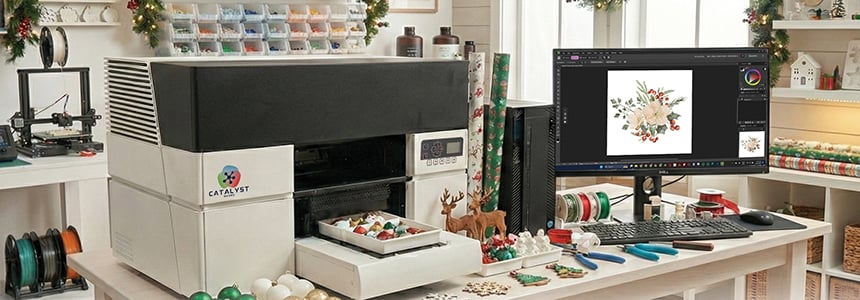
Above: When it comes to irregularly shaped—but flat—objects, DPI’s Catalyst Camera Vision AI system allows companies to accurately print to the objects, based on the scanned shape.
Michael Perrelli, sales director, Innovative Digital Systems, says the demand for higher quality graphics on uniquely shaped products—from coolers and sports balls to tumblers and other drinkware—is driving much of today’s innovation.
Growing Demand
There is an uptick in DTO printing for industries such as sporting goods, footwear, and personal protective equipment. Dan Valles, business development manager, OEM printheads, Epson, says examples include safety and sports helmets, shoe components, and other molded products with curved, textured, uneven, or tiered surfaces.
As manufacturers look to eliminate labels, pad printing, and other secondary decoration processes, they are increasingly interested in printing directly onto complex 3D components, states Tom Lang, digital products manager, Inkcups.
“We see this across packaging, medical, industrial components, promotional products, drinkware, consumer goods, and larger molded product applications,” notes Boris Liberman, senior engineering manager, Engineered Printing Solutions.
DTO printing on irregular surfaces isn’t necessarily driven by a specific industry. “This type of printing suits a range of substrates with many different shapes, thicknesses, and curves. I have experienced industries ranging from guitar foot pedals to more common industrial-type applications like gauge surfaces and dials,” shares Emilio Rangel, product manager, Mutoh America, Inc.
Sporting goods represents one of the highest growth verticals in custom printing, in general, but also for printing on irregular objects. “Printing logos and sponsorships on baseballs and golf balls for tournaments or events is increasingly popular. In addition, we print on paddles for racquet sports, custom protective gear, and even full-wrap logos on major league baseball bats,” comments Lon Riley, founder, DPI Lab, LLC.
Automotive is another area. Tumi Mosiah, product marketing manager, Boston Industrial Solutions, Inc., sees manufacturers increasingly looking to print directly onto finished or near-finished components to eliminate labels, transfers, and secondary decoration processes in the automotive field. “Examples include automotive interior components like dashboards and consoles; appliance housings and control panels; electronics housings; industrial enclosures; and molded medical equipment components. These parts feature curves, recesses, raised sections, ribs, textures, and changes in elevation.”
Premium packaging is also changing how product is perceived. It is becoming a necessity rather than a luxury, “as brands across virtually every industry compete for attention on increasingly crowded shelves,” notes Perrelli.
In all industries, the goal is the same—shelf awareness. According to Nevin White, sales manager, Koenig & Bauer Kammann (US) Inc., the underlying motivation in markets like craft brewing and spirits, cosmetics and personal care, etc. is shelf presence. “When two products sit next to each other at retail, the one with better decoration wins.”
Another major vertical is plastics manufacturing. “We’re seeing a lot of plastics manufacturing coming back from overseas, which was traditionally produced and then pad printed with any additional marking or decoration. Manufacturers here are looking for different marking technologies that allow cost-effective short runs, and digital UV is a perfect replacement for pad printing and other older, more limiting technologies,” adds Riley.
Complex Considerations
Compared with printing on flat surfaces, complex shapes present three primary challenges. First, the distance between the printhead and the object’s surface can vary significantly, making it difficult to maintain ink placement. Second, graphics and images can become distorted when applied on irregular surfaces, requiring pre-compensation based on the specific geometry of the object. Third, the angle that ink droplets land changes across different contours and slopes and can affect image quality, color consistency, and detail, explains Valles.
Ink throw distance refers to the gap between an inkjet printhead and the item or substrate it is printing on. “When printing on smooth, flat surfaces using a flatbed printer or even around a cylindrical shape using cylindrical DTO printing, this gap will typically be a few millimeters. This is to ensure accurate placement of ink droplets and avoid any blurring, but it also helps to avoid spatter and nozzle damage. However, this has historically meant that items with irregular surfaces or variations in height or diameter were difficult or even impossible to decorate using DTO printing,” explains Gregory Harwood, director of digital product management and global service, Inkcups.
“There are physical limits to how far shape following can be achieved, so verification for each target application is a prerequisite,” states Valles.
Early DTO printers required an extremely small gap between the printhead and the surface of the substrate to maintain image quality. “While this worked well for flat objects or those with little to no height variation, it severely limited what decorators could print,” explains Perrelli.
“As the object gets farther and farther from the printhead, you will lose quality from a combination of the alignment and the ability of the ink to effectively land in the right place. Cylindrical items are typically not difficult to print with inkjet, given the same curvature limitations. Many systems will use a smaller portion of the printhead when printing smaller diameters. This will slow down the print process but result in a higher quality imprint along the print surface,” notes Perrelli.
Mosiah adds that on a complex 3D part, the distance and angle between the printhead and surface can change continuously, affecting dot placement, resolution, and ink deposition.
The difficulty arises from the difference in height the ink must drop to the surface of the object. The ability to maintain accuracy with both detail and color over these distances is what makes UV printing so valuable in this space, says Rangel.
With irregular objects, Liberman points out that the system has to maintain accurate drop placement across changing heights, angles, and distances from the printhead. Tapered walls, compound curves, handles, tiered features, and semi-spherical shapes can all affect registration and motion control. “The object may also need to be printed from a specific orientation, such as horizontally, vertically, from the side, or top down. In rotational applications, the motion of the part and the print system must be synchronized precisely.”
Complex shapes once required artwork restrictions or alternative print methods because printheads, software, and ink technology had not yet evolved enough to maintain accurate ink placement across uneven surfaces. As the distance between the printhead and the object changed, image registration, sharpness, and overall print quality quickly deteriorated. “Today’s high-gap printing technology has changed that. Advances in printheads, motion control, software, and UV inks allow decorators to produce crisp, vibrant graphics on curved, contoured, and irregularly shaped objects—opening the door to applications that were once considered impossible and/or limited,” adds Perrelli.
Part handling is often as important as imaging. “The system has to understand what areas of the product can be touched, how the part can be held without distortion, what surfaces require pretreatment, and how to avoid contact with freshly printed areas. In many complex DTO applications, solving the part-handling challenge comes before solving the print challenge,” offers Liberman.
Complex parts can also have recesses, sharp transitions, textures, and varying surface characteristics. “The part must be accurately fixtured and the printing system must navigate the geometry without collisions while maintaining the required image quality,” adds Mosiah.
For UV flatbed printers, the physical mechanism is effectively linear, and the systems are aligned to provide the highest print quality at a defined distance between the printhead and the target of the print. However, for curved surfaces Riley explains that the highest print quality is achieved within that alignment window.
Since high-quality industrial printing is dependent on high levels of reliability and accuracy, Philip Chu, UV product manager, Roland DGA Corp., says a fixture or jig helps ensure both, “as printing directly on irregular shapes by themselves often requires multiple touches that can slow down your production process.”
Achieving Consistency
Consistent image quality must be maintained across varying heights, angles, and textures when printing to unique objects.
Liberman feels that consistent image quality comes from controlling the full process. “That includes the substrate, pretreatment, ink, printhead position, motion system, cure strategy, fixturing, automation, and inspection. For complex objects, repeatability depends on how consistently the product is presented to the print system and how well the process accounts for geometry, surface condition, and normal production variation.”
Valles shares that 3D shape data it can pre-compensate for image scaling and control dot spread through curing, helping to ensure uniform image quality across 3D surfaces. In addition, it combines this with path control that keeps the head-to-work distance within the appropriate range, as well as printing technologies that make the seams between multiple paths less noticeable.
The placement of the printhead in relation to the substrate or object to be printed is critical to consistency. “The printhead and/or the object needs to be manipulated in such a way so the printhead has as consistent and as close a gap as possible. To accomplish this, an accurate motion control system is required. The system itself must know how the object is sized or oriented in such a manner that it can calculate the motion,” explains Paul Edwards, VP, digital division, INX International Ink Co.
Generally image quality is maintained through control of the dot size as well as the speed of the carriage moving over the object. “We have found that slowing the carriage speed down by sometimes up to less than half the normal speed of standard first surface printing gives the most optimal results,” says Rangel.
Accurate positioning of the part and understanding its geometry is essential. “Depending on the application, this can involve precision fixturing, controlled motion, printhead positioning, software compensation, and carefully selected print parameters,” adds Mosiah.
Ink management is also critical. “Temperature control and active circulation keep the ink system stable across the full production run. Viscosity drift and temperature variation are two of the fastest ways to lose consistency on a complex shape, and eliminating those variables is built into how the machine operates rather than left to the operator to manage,” explains White.
Mosiah points out that the ink must wet the surface appropriately, maintain image definition, and provide required adhesion and durability. “Ultimately, consistent DTO quality comes from coordinating the mechanical system, software, printheads, inks, and substrate preparation as one integrated process.”
The combination of powerful modern printheads, specialized software, and the right ink formulation give high-gap printing the ability to maintain exceptional image quality across height variations. “Additionally, engineering teams constantly invent fixturing solutions that maximize print size, image quality, and product consistency. With the advanced power of today’s high-gap UV printers, no shape is off limits and decorators can now offer more value to their customers than ever before,” shares Perrelli.
Pretreatment is often central to maintaining consistency in DTO printing. “Print quality is partly a surface outcome. Pretreatment raises surface energy, improves wetting, and creates a more uniform foundation so ink droplets can flow together into a smoother film. It can also reduce defects caused by contamination, fingerprints, molding residues, or surface-active additives that may interfere with adhesion and appearance,” adds Liberman.
Notes on Ink
Ink formulations also evolve to support more complex DTO applications.
The challenge is that many industrial parts are not designed with printability in mind. “Plastics can have low surface energy, carry molding residues, or contain additives that migrate to the surface. Smooth materials such as glass and some metals can also be difficult because they may not provide the surface characteristics needed for reliable bonding, even when they appear clean. As a result, ink formulation must be considered alongside pretreatment and cure strategy,” says Liberman.
Modern DTO applications often require inks and pretreatments be tested together for the exact substrate and end-use requirement. “Flame, plasma, corona, and pyrosil treatments are used to modify or prepare surfaces, while dry ice blasting or other cleaning methods may be needed when contamination is the barrier. The key point is that ink alone does not solve every application. Adhesion and image quality are system results influenced by substrate chemistry, surface condition, ink formulation, curing, and the mechanical or chemical stresses the part will face in use,” shares Liberman.
Primer development evolves in parallel, comments White. “A reliable, automated primer application changes what’s possible in terms of adhesion and durability, particularly on surfaces and substrates that have traditionally been difficult to decorate.”
Industrial inks are engineered for specific materials and end use requirements, including adhesion to plastics, composites, metals, and coated surfaces, as well as resistance to abrasion, chemicals, and environmental exposure. “For complex DTO applications, controlling wetting, spreading, curing, and adhesion is important. The trend is toward application-specific ink solutions that are matched to the substrate, surface preparation, printing process, and durability requirements of the finished product,” notes Mosiah.
The complexities of ink formulation can take several forms. Edwards says substrates can often be a challenge as far as achieving the adhesion and robustness required. “Printheads now have a capability of printing from very low to quite high viscosities for inkjet. And the ink formulations must be adapted to deal with the viscosity constraints, as well as to achieve reliable jetting at a distance from the substrate—which is often much higher compared to most normal graphics applications.”
Valles finds that ink formulations are evolving in a direction that balances adhesion and durability across a variety of substrates. Manufacturers look to print on more complex materials and shapes, so inks must be able to maintain image quality while withstanding handling, abrasion, and environmental exposure. “At the same time, advances in pretreatment, curing, and post-processing technologies enable more reliable printing on challenging surfaces while helping manufacturers achieve consistent, high-quality results,” shares Valles.
Perrelli says that while UV ink formulations now deliver stronger adhesion, greater flexibility, and improved durability across a wider range of shapes and substrates, that’s only part of the story. “The full story is in the perfect harmony between the right ink formulation, advanced printhead technology, and the innovative software that powers the whole system. When these elements are perfectly aligned, high-gap UV printers allow decorators to print on geometries and substrates once never possible.”
Liberman notes that ink formulations have evolved to support broader substrate compatibility, improved adhesion, better durability, and faster production workflows, particularly in UV inkjet applications. UV inks are important in production DTO because they cure instantly using LED technology, allowing parts to move directly from printing to assembly, inspection, or packaging. The cured ink can provide strong adhesion and surface hardness, although demanding outdoor or environmental applications may still require additional protection or process validation.
Ink technology advancements have come a long way, “making it possible to print directly on an ever-widening variety of substrates and expanding the range of applications for print professionals,” explains Chu. “Thanks to ink enhancements and other technological advancements, direct printing on materials and objects that were previously challenging or impossible is now an option.”
Adhesion characteristics are one of the more important factors in ink formulations that support these types of applications. “Having confidence that the materials will not need extra surface preparation reduces the steps needed to print. It also gives assurance that the product will hold up over time. Inks with strong adhesion also tend to be more resistant to cleaning and scratch resistance as well,” comments Rangel.
Unique Surfaces
Advances in printhead technology expand the possibilities of digital DTO printing. Precise droplet control, high throw distances, and reliable jetting enable high-quality output on even the most challenging surfaces.
Oct2026, Industrial Print Magazine