by Melissa Donovan
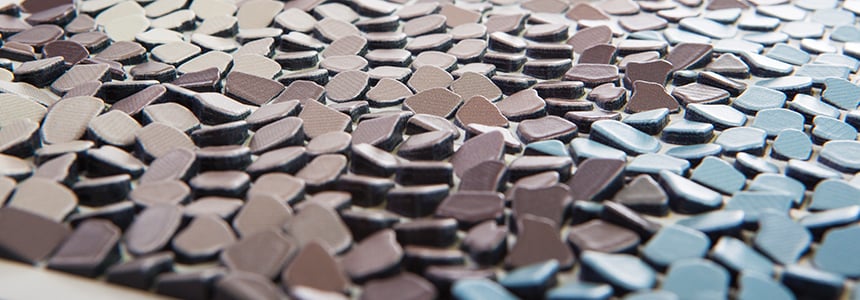
One of the fastest growing areas in decorative surface printing is digitally printing tactile, visually realistic surfaces. This includes raised UV ink textures that mimic wood, stone, and other natural materials; as well as registered embossing.
Above: Above: The non-evaporative nature of UV LED cure inks allows UV flatbed printers like the Canon Arizona to stack layers to achieve dimension.
Instead of the mechanical, more traditional ways of creating texture, tactile features are built by depositing multiple ink layers or using specialized structural inks. The goal is to eliminate repeating patterns to make flooring and furniture look closer to natural elements like wood or stone.
Printer manufacturers continue to create realism in this space. New hardware features higher print resolutions, expanded color gamuts, improved grayscale printing, and enhanced ink sets for layering. Software is available to build print files with multiple layers of ink, which provide both visual and physical texture.
Beyond aesthetics, functional benefits of digital decorative printing include scratch resistance, anti-fingerprint, antimicrobial, and wear resistance. Serving double duty, this means not only is a digitally printed piece nice to look at, it also serves a purpose.
Dealing with Demand
Tactile decorative printing is experiencing rapid growth. Market trends drive demand for more realistic digitally printed surfaces, with certain industries leading the adoption of digitally textured printing to create many types of applications—from flooring to cabinets and furniture.
The “trailblazer” of digitally textured printing is the flooring industry, according to Dr. Anke Pankoke, head of marketing/PR, Hymmen GmbH Maschinen- und Anlagenbau. However, the furniture industry is quickly becoming interested. “Not only because of the advantages of digital printing for flexibility and cost effectiveness but also concerning multiple design options including texture on unicolored surfaces that create unknown optical effects.”
Todd Rhinerson, senior specialist, product planning, Canon U.S.A., Inc., says some of the strongest adoption is in interior design and architecture. “Think replicating realistic wood grains or concrete textures on rigid panels, as well as luxury packaging and premium retail displays where ‘touch’ can help influence a purchase.”
Another segment using digital print is fine art reproduction. “Recreating an artist’s actual brushstrokes can add incredible value, alongside functional applications like tactile signage and braille,” adds Rhinerson.
“Across applications ranging from luxury vinyl tile and laminate flooring to cabinetry, furniture, wall panels, and architectural surfaces, digital tactile printing is evolving from a niche innovation into a core manufacturing strategy,” notes Rob Nelson, senior segment manager, Mimaki USA, Inc.
These industries add digital printing into their production facilities to meet demand from customers, who are fielding requests for tactile digital printing from their customers.
“When you look at what’s driving this rapid growth in tactile digital printing, it really boils down to three things. First, we see a collective ‘haptic craving.’ Consumers are fatigued by flat, digital screens and are drawn to physical, touchable experiences. Second, sourcing materials such as wood and stone can be expensive and logistically demanding. And third, digital flatbeds have all but removed some expensive, time-consuming barriers, which provides the potential to make short-run textured prints profitable,” explains Rhinerson.
Nelson believes that consumers, architects, as well as product and interior designers are no longer willing to compromise between aesthetics, customization, and performance. Instead they expect all three. “Digital printing technologies are uniquely equipped to meet these demands, enabling manufacturers to create highly authentic, customizable, and durable surfaces on demand.”
Delete the Repeat
The elimination of pattern repeats is important for decorative applications like flooring, cabinets, and furniture. One of the reasons users are attracted to digital printing is because it is cost effective.
“Consumers increasingly seek premium, natural-looking aesthetics without the high cost, supply constraints, or environmental impact associated with authentic materials. Digital printing makes it possible to replicate the beauty of rare woods, natural stone, marble, leather, and textiles on engineered substrates with exceptional realism. An oak-inspired floor, for example, can deliver the visual appeal of premium timber while reducing reliance on limited natural resources and supporting more sustainable manufacturing practices,” explains Nelson.
Buyers look for authenticity. Eliminating repetition gets close to the original as possible. “When we look at natural materials, whether it’s an oak plank, a slab of marble, or a walnut cabinet face, nature never repeats itself. Every knot, marble veining, and grain swirl is unique,” shares Rhinerson.
“If you’ve ever walked into a room with laminate flooring, tiled backsplash, or looked at a set of kitchen cabinets and immediately spotted the exact same knot or swirl over and over, your brain instantly recognizes a pattern. It breaks the organic illusion and can even create a mechanical look,” admits Rhinerson.
According to Kitt Jones, business development and product manager, Roland DGA Corp., “repeating patterns immediately signal that a surface is manufactured rather than natural, reducing the perceived value of products such as flooring, cabinetry, furniture, and decorative panels. Industrial UV digital printing allows manufacturers to produce natural non-repeating textures significantly reducing visible pattern repetition while maintaining precise color consistency and production efficiency.”
Dr. Pankoke agrees, saying one of the main achievements of digital printing is getting as close to nature as possible—especially because in nature there are no repetitions in design at all.
The larger the surface area of the graphic, the more important it is to have no or few repetitions as possible. It is challenging to achieve this goal when using other traditional print methods. Digital printing makes it possible because a huge amount of data can be stored in the printer, for example 50 to 100 different flooring planks. This is opposed to only five to eight planks on the gravure cylinder of an analog press, explains Dr. Pankoke.
“Digital printing has revolutionized this by shifting from print cylinders, dies, and films to digital files, which allows for today’s digital printers to process massive, non-repeating image layouts. Instead of a handful of unique planks, digital workflows can output dozens of entirely distinct boards or massive, continuous panels before a single design element ever repeats,” continues Rhinerson.
Closer Everyday
Thanks to the elimination of repeated patterns, digital decorative or textured printing is very close to replicating the appearance of natural materials.
“The ‘look and feel’ is already so close to nature that even experts need to take a very close look against the light to distinguish between the original and the copy,” admits Dr. Pankoke.
Rhinerson believes that two things still need to be addressed in terms of replicating the appearance of natural materials—multi-texture features and file creation bottlenecks.
Regarding multi-texture, Rhinerson notes that “nature isn’t one uniform look regarding surface finish. Replicating contrasting variable gloss levels is something that’s still being tackled.”
In terms of file creation bottlenecks, “creating 3D displacement maps typically requires highly specialized design skills and long hours to generate true, realistic dimensional print-ready files. Thankfully, software and artificial intelligence (AI) are constantly evolving to help shorten and simplify that process,” continues Rhinerson.
If there is any challenge left to overcome, Dr. Pankoke believes it isn’t so much visual, but the feel of the material and the sound when walking on it.
“The remaining challenge is not image quality, but continuing to improve designs and depth to perfectly replicate the uniqueness found in nature,” seconds Jones.
Bridging the gap between sight and touch, Canon’s PRISMAelevate XL allows for building up to four millimeters of unassisted elevation on the Canon Arizona 1300 and 2300 series printers. “This means when you look at a printed piece of distressed oak, you can now physically feel the ridges, the grain, and dips that your eye has already registered. We’re no longer just creating an imitation; we are engineering a sensory experience,” asserts Rhinerson.
“Nature is infinitely complex. Reproducing every microscopic variation in wood fiber or stone crystallization is still difficult. But the gap is narrowing rapidly. The largest issue is scale, can digital production keep up with industrial needs? The more relevant question has become—how can we use digital technology to improve upon nature and create experiences, functionality, and differentiations that natural materials alone cannot provide?” asks Nelson.
Improvements Make it Possible
Digital hardware, ink, and software evolve along with buyer and user expectations. Each part of the process brings digital decorative printing closer to not only the appearance but also the feel of natural surfaces such as wood, concrete, or marble.
“The shift from ‘flat’ to ‘felt’ relies heavily on the hardware, inks, and software working together,” admits Rhinerson.
Hardware
Improvements in print resolution, color gamut, and printheads contribute to decorative printing that yields more realistic applications like flooring, cabinets, and furniture.
New technologies offer precision and accuracy. “Since creating texture with a digital printer relies on multiple passes of the print carriage to jet one ink drop directly on top of another, a precise drop size and dot placement is crucial for clean, crisp images. High resolutions and pinpoint head positioning means that ink can be deposited with extreme accuracy, creating smooth gradations and very sharp definition,” explains Rhinerson.
Many of today’s wide format flatbed printers offer the ability to raise the print carriage. “When building height, it’s crucial for the print carriage to adjust along with the ink build to avoid printhead strikes and to maintain dot registration. Having the ability to automatically raise the carriage between physical passes of the gantry, precise dot control can be maintained without the need for operator intervention,” says Rhinerson.
Ink
Ink also evolves to support digital tactile printing. The process of layering ink to create texture is notable.
Hymmen uses a patented Digital Lacquer Embossing technology to produce tactile depths up to more than 20 μm. “This technology uses a different type of ink to emboss the surface in the desired design. The relevant design is derived with a special software tool from the original four-color picture with the natural look,” explains Dr. Pankoke.
Another option is UV LED ink. “To build physical dimension, instant cure inks with outstanding adhesion properties are necessary. The non-evaporative nature of UV LED cure inks instantly ‘freeze’ the droplet in place before it can spread out. This allows UV printers to stack layers to achieve dimension,” shares Rhinerson.
Ink sets like Canon’s IJC357 are designed with a unique balance of flexibility and adhesion. Especially when printing tactile elements on challenging substrates like wood or plastics, these inks are designed to bond well and to help users create highly durable surfaces that can hold up over time.
Mimaki’s specially formulated UV LED inks have grown a niche market in the industry, producing safe, color accurate, and long-lasting inks. Most of the company’s UV printer lines can produce tactile printing. The ink can be deposited in multiple layers, building measurable surface height, enabling a printer to create peaks, valleys, grain structures, and embossed effects directly during production.
All of Roland’s UV inkjets, including flatbeds within the VersaObject family and roll-to-roll models in the TrueVis Series, make incorporating eye-catching special effects quick and simple, according to the company. Roland’s Dimense digital printing system works differently than UV printing methods, but it’s also capable of creating physical surface texture, which it accomplishes through a specialized ink, media, and heat process, but is limited to Dimense roll-fed media.
Software
Software plays a key role in creating realistic textured surfaces, with AI and advanced imaging developing textured print files at an increased pace.
“The software component ties this all together. As the inks and hardware evolve, so does the software,” admits Rhinerson. What used to take hours to create layer stacking using technical graphic software, can now take minutes with dedicated prepress software.”
For example, Canon’s PRISMAelevate XL or PRISMAguide XL software streamlines the textured file creation process, even allowing for on-screen 3D previews and providing ink utilization estimates for each print.
Hymmen ECHO—Easy Color Calibration & Homogenious Output—shifts defect correction and homogenization from hardware-based control to an intelligent, software-driven solution. “This delivers measurable benefits for our customers, including reduced setup times, lower hardware wear, and enhanced color accuracy. The hardware or printheads can always be kept running at their best performance level without changing the hardware settings at all,” notes Dr. Pankoke.
AI is used in this application, says Rhinerson. Software such as Canon’s HeightIQ uses AI to quickly view and recognize elements in an image, then generate the grayscale render used to create elevation.
“With the ability to easily manipulate digital files, a new world opens up. Digital file designs can now create those seemingly conflicting, random, and contradictory patterns that we see throughout nature, and with the prevalence of AI-assisted designing, it will only make it more random and therefore, more natural looking,” adds Nelson.
Jones believes AI is poised to accelerate the design process and creation of unique, non-repeating surface designs that further enhance realism and customization.
Functioning Focus
Beyond appearance, functional advantages such as scratch resistance, anti-fingerprint, antimicrobial, and wear resistance are provided by digitally printed textured surfaces. These are each created using different methods.
Hymmen tests lacquers and inks with its partner, Hesse Lignal, to create the ideal combination for the situation at hand. The correct thickness of each layer, the time it takes to dry, and amount of steps between printer and base coat influence the function of the textured surface.
“Of all the functional demands we hear of, wear and scratch resistance is most frequently requested. If you are printing textures for surfaces that experience physical interaction, like braille and wayfinding signage, the print has to stand up to everyday wear. When we talk about maximizing the durability of textured or elevated prints it starts with a highly durable yet somewhat flexible ink. Combine that with proper surface preparation and additional finishing steps depending on the application,” advises Rhinerson.
For the flooring industry, Dr. Pankoke says there are higher standards for scratch and wear resistance. Furniture manufacturers prioritize anti-fingerprint and antimicrobial features.
“Anti-fingerprint and antimicrobial finishes are also gaining traction in healthcare, hospitality, retail, and commercial interiors, where cleanliness and ease of maintenance are key purchasing factors,” explains Jones.
Compared to Analog
Digital texture printing offers manufacturers a host of advantages compared to traditional embossing methods commonly used for decorative applications like flooring, cabinets, and furniture.
“Traditional texturing, whether you’re making flooring, cabinets, or furniture components, relies on physical tooling like engraved steel rollers, stamping plates, or heavy machining dies. Digital printing textures can remove many of the bottlenecks associated with the traditional approach—reducing set up costs and capital expenditures, limiting costly downtime, and enhancing customization and design agility,” says Rhinerson.
Customization is one of the more attractive benefits. Users “can create all manner of wood grain textured, stone type, embossing, and even material effects. Also, the ability to print a small test amount to make sure it matches your desired effect before committing to the expense of longer runs is huge,” adds Nelson.
According to Dr. Pankoke, digital lacquer embossing is finally closing the gap between the advantages of digital décor printing and the structuring process. “Digital embossing is catching up in terms of flexibility and economic benefits. All of the advantages of digital printing such as shorter time to market, lower stock size (capital expenditure), and individual customer décors, are now also available with embossing.”
“Creating a textured roller for embossing, or a set of stamping dies can cost thousands of dollars along with weeks of manufacturing. Because of this, the manufacturer must often commit to large order quantities just to break even on the tooling portion. Even a simple mockup or prototype can cost time and money. Digital printing replaces the tooling with a digital file, drastically reducing setup time and upfront costs. You can create a single prototype or short run just as you can a run of thousands,” notes Rhinerson.
The Real Thing
Digital decorative surface printing offers both practical and aesthetic benefits. The use of this technology over more traditional processes continues to grow as it succeeds in recreating textures and patterns only seen in nature.
“Digital printing has come staggeringly close to replicating natural materials. Thanks to high-resolution printheads, wide color gamuts, and equipment precision, a digitally printed wood grain or marble slab can easily fool the eye from a normal viewing distance,” says Rhinerson.
Oct2026, Industrial Print Magazine