by Cassandra Balentine
Beyond its primary role of file preparation, modern build software for three-dimensional (3D) printing offers valuable insights that allow operators to identify issues, reduce waste, and make informed decisions in real time.
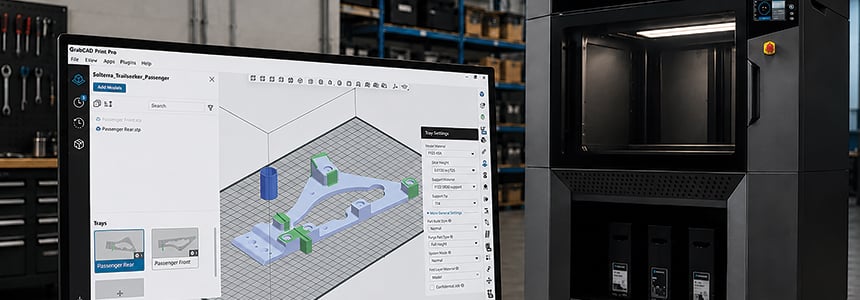
Above: Elevate AM with Stratasys’ GrabCAD Print Pro.
Latest Features
Just a few short years ago, build software was solely print preparation, utilized to slice models, set machines, generate a tool path, and send it to the printer.
Dr. Ali Tamijani, founder/CEO, Novineer, Inc., explains that build software historically drove the machine, but it didn’t really understand the part. “The biggest shift since then is that build software has become an engineering decision layer rather than a setup utility. It now carries intelligence about how a part will actually behave, accounting for orientation, layer direction, infill, and material anisotropy, and it increasingly connects to the broader digital thread that runs from the physical part through design and simulation to production.”
One of the biggest advancements in build software is the increased use of simulation to identify print risks before a build starts, reduce scrap, and improve first-time-right performance, notes Volker Schillen, product manager, Materialise. Build software is also smarter in how it prepares data. It does this by taking process constraints into account earlier and consistently, while becoming more efficient at handling the growing volumes of data generated by larger and complex part geometries.
Fabian Neugebauer, quality domain manager, Materialise, adds that context matters. In prototyping, flexibility is key because every geometry is different. In mass customization and higher throughput environments, users want automation.
In serial production the focus becomes even more demanding because manufacturers want to optimize every detail for repeatability, cost, and quality. “So overall, build software is becoming more intelligent, automated, and closely connected to real production requirements,” adds Neugebauer.
The software application that was only for print preparation—tasks like orienting a part and generating supports—now spans design automation, performance simulation, fleet analytics, sustainability tracking, and security, according to Victor Gerdes, VP, software, Stratasys.
Demanding More
3D parts manufacturers demand more from build software with functionalities like process monitoring and automation.
It is important to note that process monitoring and automation are not mutually exclusive. “At first there were process monitoring sensors, but not much certainty about what to do with the sensor data and how to interpret it. That has improved, and valuable insights can now be gleaned from sensor data. The final step in the process is to automate the feedback cycle so that builds can automatically self correct,” says Zach Simkin, president, Senvol.
Gerdes agrees that these two functions reinforce each other. “On automation—specifically software, customers want to remove manual, specialized steps. Extending automation includes integration of robots on the factory floor to interact with 3D printers—yes—there is growing demand for comprehensive and secure APIs to integrate the robots and 3D printers for pre- and post-build workflows.”
Automation is essential when companies want higher throughput, less manual intervention, and more standardized preparation workflows. “That is particularly true when similar parts are produced repeatedly or when companies want to scale operations without scaling manual effort,” offers Schillen.
At the same time, process monitoring is becoming important as AM is used in demanding production environments. Neugebauer points out that in medical, aerospace, and other quality-sensitive industries, customers need visibility, traceability, and better control over what happens during production.
Moshe Benaish, director, Streamline Pro and IoT, global software, Stratasys, says when it comes to monitoring operations, customers want the data to optimize overall equipment effectiveness including visibility into utilization, uptime, and job status across a growing fleet. “Customers who are manufacturing or moving toward manufacturing 3D printed end use parts are looking for process monitoring capabilities to provide evidence of part quality, consistency, and repeatability.”
Machine Data
One perk of modern build software is the data it captures and shares in real time.
The types of data depend on the AM processes you’re working with, which machines you have, and more specifically the types of sensors the machines are equipped with. “Some machines have many sensors, and others have none. Of those that do have sensors, how well, if at all, those sensors are tied into the build software varies,” says Simkin.
Neugebauer feels that as manufacturers industrialize AM, they want this information available in a broader software environment, not isolated in machine-specific tools. That is relevant for companies running mixed fleets and trying to standardize visibility and traceability.
Schillen stresses that real-time machine monitoring is not the main job of build software itself. The primary role is to create the build and prepare the data the machine needs to print. Real-time monitoring belongs more to the production management and execution layer.
Frank Lindeman, customer success, Stratasys Software, points out that for companies with existing standard centralized monitoring solutions, some enable access to real-time printer telemetry and integrate it into external systems like SCADA/MES for monitoring and control.
Beyond Builds
Build software prepares files for print. However, today’s tools are able to optimize the process through simulations, smarter data preparation, and automation.
Sep2026, Industrial Print Magazine