
by Melissa Donovan
Resin printing, or photopolymer three-dimensional (3D) printing, builds objects layer-by-layer from liquid photopolymer resin cured by UV light. Technologies in this segment include stereolithography (SLA), digital light processing (DLP), and masked SLA (MSLA) also known as liquid crystal display (LCD). The result is highly detailed, smooth parts ideal for miniatures, prototypes, and even final pieces.
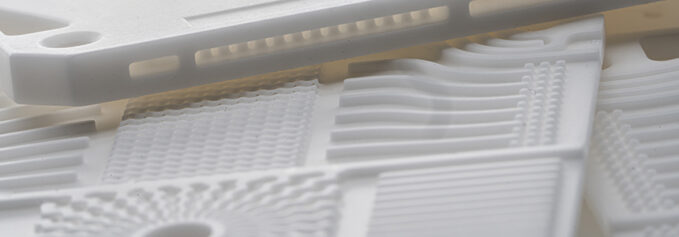
Above: With Lithoz’s LCM, the photopolymer acts as a binder within the liquified ceramic material and the printed parts need to undergo a second step, which is sintering.
While resin printing offers finer detail than other technologies, for example filament printing, the logistics are messier. Users are exposed to fumes, sticky resin, and solvents. To combat the risks, careful handling is encouraged through the use of personal protective equipment (PPE), ventilation, and post-processing techniques like washing and curing.
UV Power
Resin or photopolymer 3D printing involves building objects using UV light. Common processes are SLA, DLP, and LCD/MSLA. According to Johannes Homa, CEO/founder, Lithoz, there are two ways to build objects using UV light—either with pixels or a laser.
DLP and LCD are two pixel-based options, which “feature a bottom up approach with light exposure from underneath or a top down approach with exposure atop,” describes Homa.
Lithoz’s lithography-based ceramic manufacturing (LCM) process for ceramics uses the DLP principle in a bottom up approach. “When we developed LCM, it was the first time that DLP was adapted to successfully process highly filled ceramic resins at a level meeting the high-density demands for advanced ceramics,” explains Homa.
Perfect density is a key requirement in LCM that has evolved over time, notes Homa. “In LCM, where the photopolymer acts as a binder within the liquified ceramic material, the printed parts need to undergo a second step, which is sintering. This thermal treatment makes all resin-based ceramic technologies two-step processes.”
Laser-based SLA technology is one of the first commercialized 3D printing technologies, points out Homa. “In the beginning it was primarily used for prototypes due to poor material properties. These materials have made significant progress and today this technology is used in plastics, metal, and ceramics for mass production.”
Beyond SLA, DLP, LCD/MSLA, and LCM, Laura Galloway, director of marketing, Boston Micro Fabrication (BMF), says there are advanced photopolymer-based processes designed specifically for high-resolution and micro-scale fabrication. She provides the example of projection micro stereolithography (PµSL), which uses highly controlled optical systems to achieve micron-level accuracy and repeatability. BMF’s technology is based on this.
PµSL utilizes the benefits of both DLP and SLA. It involves printing in the top down direction of SLA. However rather than using a small spot laser, the entire image, or a section of the image is cured like in DLP.
Advancements in optics, light engines, and material science play a role in how photopolymer technology has evolved. “Feature sizes have shrunk dramatically while dimensional accuracy and surface quality have improved. At the same time, photopolymer materials expanded to include engineering-grade and application-specific resins, making the technology viable for functional testing, research, and low-volume production,” explains Galloway.
Resin Stand Out
Resin printing is distinctive due to its ability to create fine details, which leads to it being well suited for delicate, minute applications.
Overall, “resin-based 3D printing stands out for its ability to produce extremely fine features, smooth surface finishes, and highly complex geometries that are difficult or impossible to achieve with other additive methods such as extrusion or powder bed fusion,” says Galloway.
Narrowing it to specific processes like LCM, is useful, according to Homa, because it “produces intricate features, which make ceramic high-performance components lightweight yet enduring.”
Applications with requirements for high resolution and tight tolerances, complex internal channels or thin walls, and excellent surface quality without extensive post processing are all candidates for resin-based technology, according to Galloway.
Accurate parts are achieved via resin printing like DLP and LCD, making it ideal for parts in dentistry, medicine, and jewelry, notes Jim Hoeben, R&D and business development, Liqcreate.
“From a micro-precision standpoint, resin printing is commonly used for medical devices, microfluidics, electronics, photonics, and advanced research applications. In these areas, dimensional accuracy and geometric fidelity are often more critical than build speed or part size,” continues Galloway.
With Lithoz’s technology, Homa says it is used in industries like aerospace, medical technology, and dentistry.
“For various industries such as aerospace or semiconductors, typical applications are nozzles, injectors, membrane filters, or thrusters, all of which benefit from those internal complexities and also have frequent contact to harsh environments or corrosive chemicals. Applied to medical technology or the dental industry, these qualities allow for the creation of multi-feature surgical tools increasing patient well being as the miniaturization of components results in realizing even more minimal invasive features,” shares Homa.
Beware of Danger
Challenges arise during the printing process that users should consider.
Compared to fused filament fabrication (FFF) and fused deposition modeling (FDM) printing where an already polymerized material is used—monomers are reacted in the manufacturing process to form a final polymer that the user just needs to reheat and shape—resin printing involves an unformed polymer, states Hoeben.
The resin, as an unformed polymer, is dangerous. “Photopolymer resins are chemically reactive materials designed to cure under UV light. In their uncured state, these resins can cause skin, eye, or respiratory irritation if handled improperly,” cautions Galloway.
“For ceramic resin-based printing technologies, materials in liquid state are classified ‘irritant,’” admits Homa.
The resin “is formed inside the resin 3D printer by the reaction with UV light. So the monomers are still in the process. Now with smart development the most safe monomers available can be selected, but they are still chemicals. After printing, washing, and post curing the parts are in the same state as your FFF/FDM filament and safe to handle without gloves,” suggests Hoeben.
Resin printing is actually less harmful compared to other 3D printing options, notes Homa. “Compared to some ways of additively manufacturing metals, where there is the critical challenge of metal dust—requiring a whole range of safety measures such as respiratory protection and that under certain conditions is also subject to danger of explosions—photopolymer-based 3D printing is completely dust free and thus uncritical in health and security aspects.”
Post processing of the resins also raises concerns. “The post-processing steps required to clean and cure printed parts introduce further exposure to solvents and UV radiation. Because of this, resin printing environments—particularly in professional or industrial settings—must follow established safety practices to protect operators and ensure consistent, repeatable results,” notes Galloway.
Careful Handling
To combat issues with resin, careful handling and safety methods are required whether it be use of PPE, ventilation, or additional post-processing techniques that protect the user.
Hoeben points out that material selection is essential. “It all starts with material selection. There are a lot of resins out there, and the more affordable ones tend to use the most affordable raw materials, which in turn are less friendly to work with. Once you have chosen a material, always read the safety data sheet. All information on how to handle this material is available in that document.”
PPE can be as simple as wearing nitrile gloves when handling the resin, safety glasses/goggles to protect eyes from splashes, and protective lab gear in environments that have a higher level of throughput, lists Galloway.
“In general it is always advised to wear safety goggles, use protective clothing and gloves—preferably nitrile or latex, and work in a well-ventilated area,” suggests Hoeben.
Proper ventilation helps combat any bad outgassing from resin printing.
Using local exhaust ventilation or fume extraction when possible, and simply avoiding prolonged exposure in enclosed spaces are two handy tips from Galloway.
During post processing, Galloway suggests that printed parts be washed in controlled solvent systems, dedicated UV curing units are used instead of uncontrolled light sources, and proper disposal of resin waste and contaminated materials is in accordance with local regulations.
“PPE and ventilation are standard in professional labs and manufacturing environments where resin printing is commonly deployed,” admits Galloway.
The type of print process also dictates safety practices. With DLP-based Lithoz LCM printers, for instance, PPE is encouraged but only for handling the ceramic slurry. Gloves are recommended for handling if a bigger job requires the exchange of slurry cartridges.
Other 3D printing systems also minimize handling. “For instance Formlabs has a washing and curing station that the platform of 3D printed parts is placed in—but it is a manual process. If you want to run without full intervention then automated 3D printing lines from manufacturers like Genera Printer GmbH, Intrepid Automation, or Rapid Shape GmbH are an option. With these systems the operators do not come in contact with any of the resins or washing agents,” shares Hoeben.
Risk Vs. Reward
Resin-based printing systems like SLA, DLP, LCD/MSLA, LCM, and PµSL are regularly used in dentistry, medical, jewelry, and aerospace segments due to their ability to yield intricate, delicate pieces for the applications in question. Adopters of this technology should be aware of the issues resin can present. To counter any risk, the use of PPE, ventilation, and post-processing techniques like washing and curing are encouraged.
Apr2026, Industrial Print Magazine