by Melissa Donovan
Recyclability is huge in the beverage market. With direct to object (DTO) digital printing commonplace, the ink on these containers must fit into the sustainability mindset. Surface characteristics of recycled beverage containers are not ideal for ink adhering and remaining on the surface for the life of the product. Pretreatment options that align with recyclability mandates are a viable option.
Recycled Beverage Containers
Popular types of recyclable beverage containers range from paper cartons to aluminum cans. For the purposes of this article, we will be discussing aluminum cans.
According Vincent Stempfer, partner, CanSealing Systems, and Nevin White, sales manager, Koenig & Bauer Kammann (US) Inc., aluminum cans represent the gold standard of circularity. “Often referred to as ‘infinitely recyclable,’ nearly 75 percent of all aluminum ever produced remains in active use today.
Recycling an aluminum can consumes 95 percent less energy than producing primary aluminum from bauxite ore, making it the most environmentally and economically sustainable container on the market,” say Stempfer and White.
Recyclable yes, however directly printing to aluminum cans is challenging for a number of reasons.
There is a scalability issue compared to printing offset. “High-speed offset printers produce up to 2,000 cans per minute on pre-necked bodies per production line, whereas direct-to-can digital printing caps out around 100 cans per minute per printing press. This speed differential confines digital printing to niche applications such as small brand production and limited edition runs using fully formed blank cans,” share Stempfer and White.
Another challenge is durability. “Aluminum cans must endure extreme temperature fluctuations and severe mechanical stress—including scratches, dents, and impacts—throughout filling, transport, and handling without flaking or delaminating. Achieving this level of durability has posed a significant challenge for digital inks,” explain Stempfer and White.
Digital inks are also limited by fully formed blank cans’ coatings, which are made up of translucent overvarnish. “Because this protective layer inherently has a low surface energy, the challenge of digital printing is adjusting the surface energy so that digital inks can properly wet out, lay down, and adhere evenly without pinholing,” say Stempfer and White.
Surface Pretreat to the Rescue
To ensure ink adheres well to recyclable beverage containers like aluminum cans, surface pretreatments are available. These must work well with the non-porous metal surface of a can and also with the pretreated overvarnish applied to the can.
Flame-based treatments are one option. “Passing the pre-formed aluminum cans through a controlled flame burns off residual hydrophobic oil/lubricant residues and rapidly raises the substrate surface to the precise target temperature needed to promote optimal chemical bonding between the primer and the digital inks,” explain Stempfer and White.
“Plasma and flame are effective on recyclable materials. In fact, this is a common application since many of these materials will not be homogeneous in nature, and have areas with varying energy levels, which can be a challenge for printing. Plasma and flame plasma is used to increase the surface energy and wettability to enable printing and bonding,” notes Wilson Lee, business development director, Enercon Industries Corporation.
For example, Enercon developed wider width plasma technology to enable plasma treatment of larger areas in a single pass, which is particularly useful for direct to product printing.
Adhering a primer pre-print is also common. Depending on the technology, for example with Koenig & Bauer Kammann digital printers, “proprietary specially formulated UV-curable functional primer is applied in a micro-thin layer via inkjet. It acts as a chemical bridge between the overvarnish already on the can and the ink application,” say Stempfer and White.
While surface pretreatments ensure the ink stays on the container for the length of its use, it’s important to consider whether the pretreatment detracts from the ultimate recyclability of the container.
According to Stempfer and White, “properly selected pretreatments do not negate recyclability. Flame treatment leaves zero chemical residue or foreign layer on the metal. Applied primers, opacifying coatings, and overvarnishes are engineered as ultra-thin organic layers that cleanly pyrolyze—or burn off—during the thermal de-coating furnace stage prior to melting without contaminating the aluminum melt.”
“For metal beverage cans, the ink and coating used have no effect on recyclability since the ink and coatings are vaporized during the recycling process,” points out Alex Folloso, VP of research and development, metal decorating technology, INX International Ink Co.
Ink Considerations
Certain types of ink sets are deemed more sustainable and ultimately recyclable than others.
UV-curable ink is the preferred solution for pre-formed aluminum cans, suggest Stempfer and White. “It enables precise dot size and placement on rotating cans, minimal thermal load on thin aluminum walls, rapid pinning, zero volatile organic compound emissions, and compliance with global food contact material regulations. The crosslinked matrix withstands mechanical handling, denting, and scratching without flaking or micro-cracking.”
Instant polymerization is another benefit offered by UV-curable ink sets for DTO printing to cans. “Because cans are printed dynamically on a rotary spindle, UV LED pinning freezes ink droplets in milliseconds, preventing ink slump, misting, or dot gain on curved surfaces,” say Stempfer and White.
After a can is used and placed in a recycling bin, that UV-curable ink is easily broken down in the recycling process. “The crosslinked polymer network of cured UV inks breaks down smoothly during the thermal de-coating stage in aluminum recycling plants. The organic binders volatilize cleanly into gases, leaving zero metallic or slag residues to contaminate the recycled molten aluminum,” share Stempfer and White.
Strategic Partnership
Koenig & Bauer Kammann and CanSealing Systems work together to solve operational spoilage while driving circular economy demand for fully recyclable aluminum packaging.
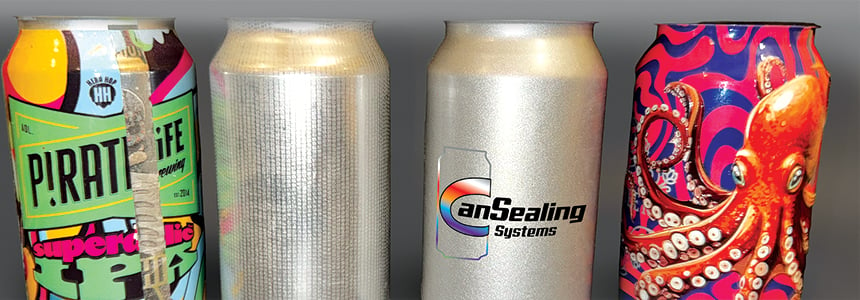
CanSealing Systems’ process converts setup misprints, obsolete inventory, and rejected pre-filled beverage containers into new, printable cans. With traditional processes, misprinted and rejected containers are melted down and recycled before they hold a single drop of liquid, this for a few reasons.
“Redecorating these cans via traditional offset printing is both legally and mechanically impossible. Legally, trademark laws forbid printing over established brand logos. Mechanically, offset printing processes are engineered for cylindrical with straight walls before necking occurs—making this process physically incapable of handling pre-necked, fully shaped cans,” say Stempfer and White.
CanSealing Systems technology allows for this scrap stock to be recovered and transformed into fully formed blank cans to create an ideal substrate for DTO digital printing without the resource and energy loss of the traditional recycling process.
By bypassing the re-smelting stage, Scope 3 emissions is slashed by 84.8 percent per repurposed unit, as cited by research conduced by CanSealing Systems.
“The CanSealing process delivers a major step forward for pre-filled beverage container circularity at the manufacturing level while end-of-life recycling for used beverage cans remains vital and still relies on consumer behavior,” share Stempfer and White.
The new, printable cans are then run on Koenig & Bauer Kammann’s direct-to-shape digital printing technology, which offers dome-to-neck coverage—seamless graphics extending continuously from the dome to the neck; tactile 3D embossing and functional relief—high-build digital varnishes that create raised tactile effects and braille without physical tooling or mold costs; and short runs and low minimum order quantities—digital printing eliminates physical plate swaps, supporting economical low-minimum-order-quantity runs, personalized variable data, and rapid time-to-market.
Goals Achieved
More beverage companies look to create shorter run marketing campaigns that reflect levels of customization and personalization that only digital printing can achieve. An elaborate eco-system of pretreatment, printer, ink, and post process ensures that beverage containers like aluminum cans remain recyclable and meet those design goals.
Nov2026, Industrial Print Magazine