Next-Generation Flooring

By Olivia Cahoon

The decorative laminate market is full of possibilities as manufacturers turn to digital printing technologies. Design freedom, short runs, and quick time to market are some advantages. Smaller run lengths are more cost effective and reduce the need for storing products.

Decorative laminates can be printed digitally using direct or transfer technologies. Both offer advantages. Direct printing is gaining in popularity and here we learn about an early adopter.

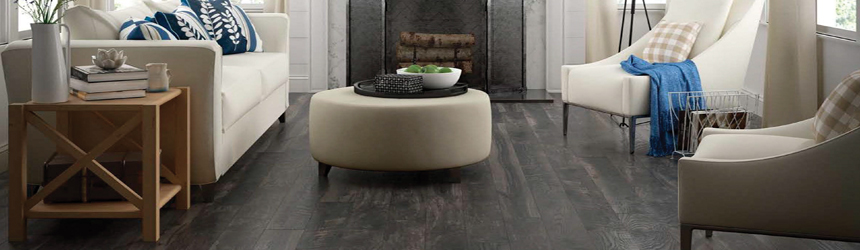
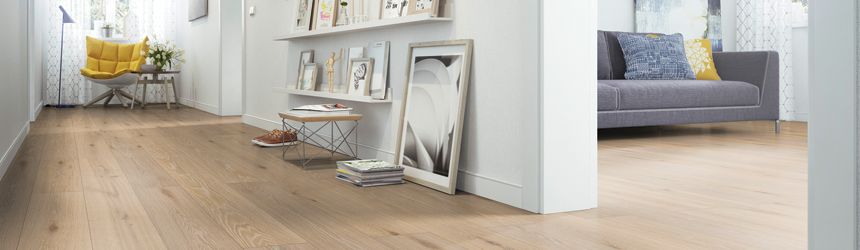
Above: Classen Group uses printers from Hymmen to print directly to rigid board with UV ink and create laminate flooring.

Classen Group Innovates
Founded in 1963 as Baues & Co. GmbH, Classen Group started as a trading company for wood-based products in Kaisersesch, Germany. With two employees, it offered regional wood trade and local distribution in the Rhineland area.

In 1994, the company began producing battens and panels, and later added laminate flooring. In 2002, it transformed production as Classen Industries GmbH in Berlin/Baruth. Today it operates as a producer, supplier, and full-range service provider for natural wood products and wood as well as natural material-based products for interior finishes.

With 1,450 employees, Classen Group runs three production sites in Germany and Poland. At its Berlin/Baruth location, the company produces over 80 million square meters of laminate flooring each year. According to a Classen Group spokesperson, it is the most modern laminate flooring production site in the world.

Classen Group produces and distributes laminate floorings, floor coverings, and environmentally friendly vinyl floorings to 72 countries. Between its three locations it operates in a total of 84,000 square meters.

The manufacturer produces rigid floor based on Ceramin, a composite core material created by Classen Group’s research and development team. This production is exclusively performed in Kaisersesch, Germany, with a capacity of ten million square meters.

As a non-core activity, the manufacturer also offers interior doors and skirting boards out of Rybnik-Zwonowice, Poland.

Single-Pass Laminate
The Classen Group produces high-density fiberboard (HDF) based laminate floorings. Also referred to as hardboard, HDF is an engineered wood made from wood fiber extracted from chips and pulped wood waste.

In 2013, it started to use digital printing in its laminate flooring production process with the Jupiter Digital Printing Line by Hymmen GmbH featuring a production width of 200 centimeters. Digitally produced laminate floorings are currently 20 percent of the company’s output.

When it decided to invest in digital printing, Hymmen was the only company at the time offering single-pass printing, according to the Classen Group spokesperson. The company believes single-pass offers the best cost-effective ratio. The digital printing process enables flexible production, allowing for small and large series of laminate floorings.

Individual décors are custom modified inline for Classen Group customers using color combination variants. The company uses two Hymmen printers in its Baruth location and three in Kaisersesch. Specifically, it uses the Hymmen JPT-C model lines for board substrates that include double rows of inkjet printheads per color.

The Hymmen JPT-C prints boards cost effectively in a single-pass procedure with a maximum print width of 2,176 millimeters. It runs up to 50 meters per minute and offers a 1,000 dpi optical resolution. The system features a UV arc lamp for drying and handles a range of applications on different materials including wood-based boards, glass, metal, fiber cement, and sandwich elements.

Classen Group uses UV-based ink, either from Sun Chemical Corporation or Tiger Coatings GmbH.

After digital printing, Classen Group’s products require finishing. For its laminate floorings, it applies melamine resin impregnation for high load bearing capacity. Rigid flooring requires a lacquer finish. Hymmen liquid coating lines are used for both production finishing processes.

According to the Classen Group spokesperson, the benefits of using digital print technology for decorative surfaces in a manufacturing setting include low capital commitment, quick setup times for changing décor, no stocked décor papers, and the possibility to create individual décors for customers.

Despite its success with digital printing, Classen Group still experiences production challenges including color rejections, color connection, and metamerism. It combats these issues with a productive, knowledgeable staff; the latest equipment; and trade secrets.

Compared to traditional manufacturing techniques, Classen Group believes that digitally printing decorative surfaces takes less time, especially compared with conventional gravure printers. Production steps are saved in the electrical image processing. Furthermore, time-consuming and complex cylinder engravings do not apply, according to the Classen Group representative. Based on internal research, the company saves a minimum of 50 percent on development and the entire cost of cylinder engraving.

Imitating Parquet
Classen Group produces a variety of laminate flooring brands including Classen Home Edition, Extravagant, Videogrande, and Wiparquet. It also serves individual clients seeking customized flooring solutions.

In 2004, a specialized flooring wholesaler and repeat customer approached Classen Group for a flooring project. The customer sells solid wood flooring and wanted a copy of its parquet wood made up as laminate.

For the project, Classen Group developed eight designs within three months. The company started by scanning solid wood planks followed by the development process including creation layout, retouching, and color adjustment.

Classen Group edited the designs in Adobe Photoshop and made color adjustments on a proofing printer and its digital production line. It printed the flooring with the Hymmen JPT-C digital printers. Including production, the project was completed in four months.

The finished flooring featured a structured texture and AC3 laminate. Laminate products with an AC3 rating are suitable for residential use with heavy traffic as well as for commercial settings with moderate traffic. The flooring measured 1,286x194x7 millimeters. It was finished with a fold-down connect system, Megaloc. Each plank in the Megaloc system features a tongue and groove that clicks together, creating a tight lock that holds the planks together.

According to a Classen Group spokesperson, this project stands out from others because the customer runs its own design centers and sets the final product’s expectations extremely high. “The customer was thrilled because the actual parquet and the imitation are so similar in appearance.”

Focused on Flooring
Manufacturers look to digital print technology to boost production and quicken time to market. As this technology becomes more popular, the Classen Group hopes to grow its digitally printed offerings and expand its presence.

Oct2018, Industrial Print Magazine
Digital Print
Flooring
Laminates

Live Artfully

By Melissa Donovan

Founded in 1873 and headquartered in Kohler, WI, Kohler Co. is a global leader in the manufacture of kitchen and bath products, engines and power generation systems, cabinetry, and tile and home interiors.

The KALLISTA division of Kohler recently embarked on a journey with 3D printing beyond prototyping and into production quantities.

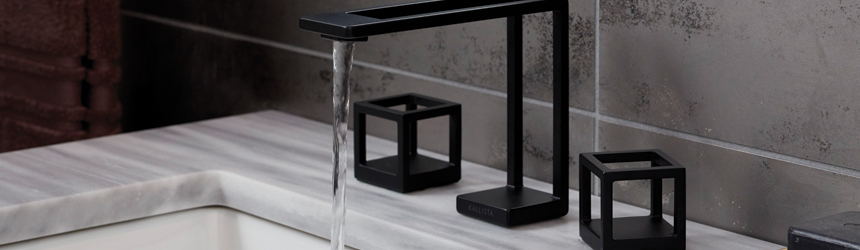
Above: Indianapolis, IN-based 3rd Dimension created the Grid sink faucet for KALLISTA using 3D Systems ProX DMP 320.

Maintaining a Luxurious Feel
KALLISTA kitchen and bath products started in 1979 by two entrepreneurs recognizing the need for luxury bath products and color options in the U.S. Part of Kohler since 1989, the company is one of the three brands under the Kohler Decorative Products Group.

“We are known for the design of luxury plumbing products, offering faucets and fixtures thoughtfully created for tasteful, whole-bath solutions. Precise functionality, purity of form, selection of materials, and superb finish all play a role and testament to our ideal to ‘live artfully’—the foundation upon which KALLISTA has built its brand,” shares Bill McKeone, design studio manager, KALLISTA.

In 2017, McKeone was tasked with designing the “ideal” faucet for the brand. The result, the Grid sink faucet, which is both minimalistic and geometric in style with unique design elements that defy standard requirements of external housing to incorporate internal components. McKeone was inspired by the fundamentals found in the De Stijl movement, which advocated the de-massing of design.

To bring his design to market, McKeone collaborated with metal 3D printing specialist, 3rd Dimension, a premier provider of metal additive manufacturing services and solutions. The two entities had previously met in 2014 at an industry conference. The foray would be the first additively manufactured product for KALLISTA.

In a New Dimension
In business since 2013, 3rd Dimension is housed in a 4,500 square foot production facility with plans to expand in the coming months. The Indianapolis, IN-based company offers metal printing, machining, and engineering consultations.

Bob Markley, president, 3rd Dimension, first heard about additive manufacturing/3D printing on the radio in the early 2010s. “That got me thinking about opening a service bureau. At the time, the metal printing industry had seen some early success, but it was still very new and there was a lot of hype that we had to breakthrough to really provide value to our clients,” he explains.

3rd Dimension runs both additive and subtractive machines. Markley says that in many cases the two are complementary. “We find that most of our additive parts need some traditional machining in order to meet customer specifications. There is no way we could do what we do without having both,” he continues.

It owns a 3D Systems, Inc. ProX DMP 320 system, which features a unique vacuum chamber design with ideal oxygen purity during the manufacturing process. Additionally, the bi-direction feed system, removable print module, robust modular design, and optimized material database make the ProX DMP 320 well suited for delivering production-grade metal parts.

A beta tester, 3rd Dimension was no stranger to the technology, as the ProX DMP 320 was its fourth metal additive manufacturing system. During testing, Markley felt confident the device could be leveraged as a production solution. This was particularly because of the quick turn between builds and a large build area that enables more parts to be run per plate.

“Additive manufacturing allows companies to expand their product portfolio, improve productivity, shorten product lifecycle development cycles, and lower total cost of operation—which gives tremendous competitive advantage,” explains David Cullen, director of application engineering, 3D Systems.

Producing Faucets
During early talks with KALLISTA, 3rd Dimension understood the Grid sink faucet project would take place with a production environment in mind. “Everything from how we set the part up and supported it to parameters and post processing, was planned to maximize efficiency and keep costs reasonable,” says Markley.

The Grid sink faucet was an ideal candidate for 3D printing or more specifically metal additive manufacturing. “When we looked at the geometry of the part KALLISTA wanted to produce, it was quickly apparent that it was not possible through traditional manufacturing methods. 3D printing—specifically metal additive manufacturing—was the only method to produce it,” shares Markley.

To address the need for production quantities, the faucet was created on the ProX DMP 320. Features like the quick turn between builds and larger than normal build volume allowed 3rd Dimension to maximize uptime. Six parts are run per plate in approximately 40 hours. Eight parts could fit, but the run time is longer and finishes at odd hours in the night. This requires multiple shifts, reduces efficiency, and increases cost.

The ProX DMP 320 is equipped with 3D Systems’ 3DXpert, an integrated software solution that allows for the completion of a variety of tasks—all in one tool. These tasks include data import, geometry optimization, lattice and surface texture creation, and build analyzation. This software helps reduce time to final part, according to Cullen.

For filament, 3rd Dimension worked with 3D Systems’ LaserForm 316L (A), a stainless steel 316 powder material that exhibits great resistance from rust and corrosion. Not only is it competitively priced, but it also met the specifications required by KALLISTA. According to McKeone, the greatest challenge of the entire project was ensuring that the process met KALLISTA’s elevated design and quality expectations. Typical products from KOLLISTA incorporate materials such as semi-precious stones, hand-cut crystal, and fine marble.

“KALLISTA is a premier brand with very high aesthetic requirements. To this end we take great care to machine every visible surface as well as go through another finishing process prior to shipping the final parts,” explains Markley.

To Market
KALLISTA premiered the Grid sink faucet at the Kitchen and Bath Industry Show in January 2018. The luxury faucet is considered the first of its kind and available for purchase through KALLISTA.

McKeone attests that his design would not have been possible without 3D printing. “Through 3D printing, KALLISTA was able to develop the sink faucet’s open form and discreet interior channels that allow the water to easily flow through the base. We were able to produce a unique product that couldn’t have been achieved through traditional manufacturing processes,” he explains.

Markley agrees, sharing that the Grid sink faucet is a great example of additive and subtractive technologies coming together to produce an amazing end product.

“With additive manufacturing, designers have tremendous freedom of design—able to produce geometries not possible through traditional manufacturing processes,” adds Cullen.

With the production capabilities of the 3D Systems ProX DMP 320, 3rd Dimension is poised to create high quantities of the KALLISTA Grid sink faucet. All of the benefits of additive manufacturing join together to offer a unique design from a notable kitchen and bath manufacturer.

Oct2018, Industrial Print Magazine
3D Printing

Scratching The Surface

By Melissa Donovan

Printing directly to glass with digital printing technologies is possible with more than one type of ink. Proprietary digital ink sets are offered from vendors, including chemistries made up of nano-particles of glass or frit, pigments, and solvent. These are very specific to printing directly to fritted glass. Frit is a mixture of silica and fluxes fused at high temperatures that makes glass. This article looks at UV ink sets used for direct digital printing on all sorts of glass. UV ink’s chemical base allows for proper initial adhesion as well as remaining intact throughout the duration of use.

UV ink is broken down into flexible or rigid configurations. In addition, it can be segmented as free radical—adhering to multiple substrates or specially formulated for printing only to glass. Adhesion promoters or primers are commonly used. Pre- or post-coating treatments are favored depending on the environment and glass type. Manufacturers considering direct digital printing to glass should be aware of all the options.

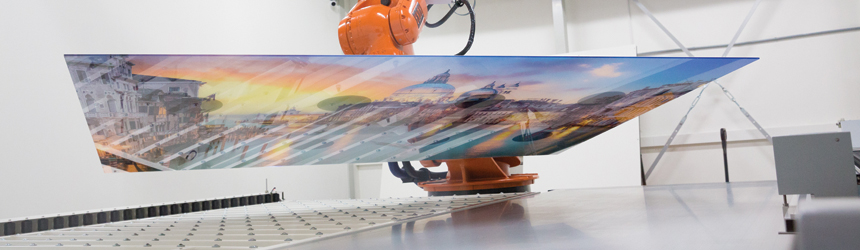
Above: An example of a piece of glass printed on a swissQprint flatbed using UV ink and handled with a robotic arm integrated by GlasDruckManufaktur in Germany.

Deep into Chemistry
UV ink is used for direct printing to glass. The two main reasons for this is, according to Michael Terlizzi, managing partner, ITNH, Inc., first UV ink is designed to cure and bond to the surface instead of penetrating into the glass. Secondly, UV-curable ink sets usually include an opaque white, which maximizes printing opportunities.

Bob Keller, GM, Marabu North America, divides UV ink into two categories—rigid and flexible. Rigid UV inkjet inks offer high reactivity, resistance, and color density, whereas flexible inks offer high adhesion and flexibility. “When selecting raw materials for a UV-curable ink, there is a broad spectrum of monomers from which to choose. Generally speaking, there are tradeoffs associated with these choices. In the case of glass, adhesion and resistance are typically the most important, but are on opposite ends of the spectrum.”

“In general, rigid digital UV inks are preferred for a number of reasons. First of all, you don’t expect glass to flex, so there is no need for added polymers in the ink. This also includes added adhesive properties, though they may still require the addition of a primer,” explains Hugo Gonzalez, senior applications specialist, Mimaki USA, Inc.

Conversely, Stephen Chrisos, marketing manager, Inkcups, argues that flexible UV ink is ideal for printing directly on glass. “In my experience, there is a big difference between a hard and soft ink in terms of adhesion. Flexible ink lasts significantly longer with a higher abrasion resistance. It also passes crosshatch testing opposed to hard ink.”

UV ink—flexible or rigid—that adheres to a range of substrates is referred to as free radical. But, certain UV inks are specifically designed for printing solely to glass. “These contain heat-reactive adhesion chemistry, requiring heating to 200 degrees Celsius for five to ten minutes after printing and UV curing. This provides a higher level of adhesion and scratch resistance,” says Phil Jackman, global product manager – digital, Sun Chemical Corporation.

Diving into ink chemistry even deeper, Mike DeRan, chemist, Kao Collins Inc., further compares free-radical and cationic UV inks involved in glass printing. “Cationic inks exhibit less shrinkage due to the way the polymerization happens during the reaction. Free-radical ink curing usually involves cleaving off a proton from an acrylate, which then starts the chain reaction. Cationic photo initiators instead have a ring opening mechanism that then starts the chain reaction of polymerization.”

Polymerization speeds up when heat is introduced to the post-curing process. Because of how the cationic photo initiators react during this process, they exhibit stronger chemical bonds to surfaces such as glass, increasing ink adhesion. DeRan explains that the improved adhesion is due to the chemical anchoring groups that form during the reaction or are present in the formula.

A Helping Hand
Sometimes ink can’t do it all on its own. In certain cases an adhesion promoter or primer might be required when printing to glass. Application methods include by hand or inline as an ink channel on a printer.

“Glass is notoriously difficult to achieve adequate ink adhesion. For maximum adhesion, it is important the ink dots wet out—or flatten like a pancake—when landing on the substrate as opposed to stating a more dimensional sphere shape. The natural surface tension of some glass does not allow for this to happen on its own,” shares Terlizzi.

Gonzalez explains that adhesion is directly related to a surface’s dyne level—or the measure of surface energy. When a surface’s adhesion ability is measured, it is assigned a dyne level. “Some types of glass have a good enough dyne level to print with good adhesion without the need for primer, but most do require some sort of adhesion promoter,” he continues.

“There are different types of glass, for example, glass bottles for the beverage industry, pharmaceuticals, and glass windows. The surface energy of all these types of glass is different,” explains Mohammed Siddiqui, chief ink architect, InkJet, Inc. “In most cases, an adhesion promoter is required, especially in glass applications. Dry glass requires a silane to anchor the ink to the glass. Similarly, if the ink must adhere to cold filled bottles that may have condensation, a different kind of adhesion promoter is used.”

Free-radical UV inks are more likely to require a primer or adhesion promoter, admits Heather Rockow, business development, Kao Collins. “Most UV and LED inkjet inks are free-radical chemistry, and are easier to formulate, a little less expensive, and adhere to a range of substrates—other than glass and metals,” she notes.

“If the application is subject to extreme environments such as the high heat and humidity associated with commercial and home dishwashers, an adhesion promotor is a requirement,” adds Keller.

Terlizzi suggests applying adhesion promoters by hand immediately before printing. This temporarily alters the surface tension, which allows the ink to wet out properly and achieve better adhesion.

High-adhesion UV inks are often used in conjunction with a wipe-on adhesion promoting primer to enhance adhesion, points out Jackman.

Wipe-on primers are one method, while another is printable primers as part of a standard ink set offered on a printer. These are run in an ink channel and can be selected based on the job. “The big advantage of a printable primer compared to a wipe-on primer is that it is an efficient and clean solution when not printing the whole area of the glass,” says Mike Kyritsi, president, swissQprint America.

“A printed primer is applied in the areas where it is required. This also means there is no wasted primer due to over application. And there is also no additional cleanup after printing to buff out excess areas,” recommends Gonzalez.

Jay Roberts, product manager, UV printers, Roland DGA Corporation, adds that onboard primers are on demand, increasing convenience and often allowing for a more invisible look on the glass.

Coatings Enhance
Additional coatings are required based on glass type. Glass may also need to be pre- or post-treated for reasons including enhanced protection or aesthetics.

“Whenever there is a need to increase durability or adhesion on the glass, employing a pre- or post-treatment helps to achieve the desired results. We often see glass tables post-treated to protect against liquids and chemical cleaners. The clear coat acts as an increased barrier to the glass object,” explains Roberts.

Just as different types of glass require an adhesion promoter or primer, they may also require a pre-treatment. One example is container glass. Jackman says when used with direct digital printing, it is critical this be pre-treated to achieve optimum ink adhesion. “The reason is that glass containers commonly have anti-scuff coatings applied during manufacture. To achieve adhesion, the surface of the glass must be altered,” he advises.

Based on Jackman’s experience, glass surface tension can be changed by two different pre-treatment methods. The first involves spraying an aqueous coating pre-treatment applied as a fine mist and them flame dried. The second option includes applying a flame and a proprietary liquid mix to the surface, which leaves silicon dioxide on the glass and makes it hydrophilic. This technology is available from Applied Surface Technologies, LLC and is referred to as Pyrosil.

The flame involved in Pyrosil removes impurities from the glass. It also applies a fumed silica structure to the surface, which results in a microscopic series of branches that the adhesion promoter and inks can bond, explains Keller.

“We are big fans of pre-treating with flame and chemical inkjet in the flaming process,” agrees Jim Lambert, VP/GM, INX International Ink Co. “It is one of the most reliable ways to gain adhesion on glass. These processes are tried and true, its origins came from screenprinting.”

Free-radical UV inks typically require a pre-treatment to enhance adhesion and durability. “These pre-treatments are commonly liquids wiped on the glass or flood coated on the glass before printing to promote adhesion,” explains Rockow. She likens this type of pre-treatment to a nail polish base coat.

Siddiqui says other pre-treatment coatings used in relation to digital printing to glass include epoxy or polyester.

For post-treatment, coatings like a clear over varnish on the printed area adds durability as well as a desirable look if the finish is gloss, suggests Lambert.

Bonus Advice
Vendors offer other tips and tricks that are important when it comes to prepping glass prior to and after printing to ensure the graphic remains on the glass and doesn’t flake or chip off, smudge, or fade.

Safety first, says Matt Meany, senior application specialist, North America, Agfa Graphics. “Take the necessary safety precautions before even handling the glass. Glass is a heavy substrate. Wear gloves, protective eyewear, and shoes. We recommend using tempered glass, which is up to five times stronger due to a heat treatment that ‘toughens’ the glass. Car windows and shower doors are all tempered glass.”

Surface preparation cannot be overlooked. “It must be clean of all oils, dust, and dirt to ensure adhesion. One of the most overlooked processes is the way the articles are handled and the overall environment itself. It is crucial to be careful and aware of fingerprints, smudges, or dust on the glass before or during the printing process,” explains Lambert.

Recommended cleaning tools include acetone or isopropyl alcohol, applied with a lint-free cloth while wearing cotton gloves, according to Meany. He believes a second cleaning with demineralized water is helpful.

Prior to printing, check that the “float” or “tin” side of the glass is the side that will be printed on to achieve ideal adhesion, advises Chase Pender, marketing manager, Supply55, Inc. To determine the correct side, Pender says illuminate the glass with a black light—the float or tin side of the glass will glow.

Roberts adds that depending on what appearance the manufacturer is trying to achieve, other tactics such as sandblasting or chemical abasing are common. Not only does this increase durability, it also gives the glass a frosty appearance—creating an artistic look without effecting the project’s design.

Once the printed glass is in place, Gonzalez suggests a few basic steps for taking better care of the application. “It should be kept out of direct sunlight. When cleaning, use a water damp, soft cloth. Also, keep the print away from high-traffic areas where it may be scratched and touched often.”

Lastly, Terlizzi strongly recommends testing before any job. “When it comes to printing glass, it is important to remember that with UV-curable inks, there are typically multiple ink types available. We always offer and recommend to test on several inks to see which will perform best for the particular application.”

UV Prints to Glass
UV ink is a blanket term. It can be broken down much further, to flexible and rigid, free radical, or more specifically created UV ink sets just for surfaces like glass. There are many options. Depending on the glass type and intended application, one or more are a fit. It seems we’ve just scratched the surface of digital printing directly to glass.

Oct2018, Industrial Print Magazine

Digital Print
Glass
UV Ink

Natural Beauty

By Olivia Cahoon

Digital printing influences flooring manufacturing as a result of smaller volumes, individualized mass production, and minimized inventory. Traditional technologies for printing flooring patterns for decorative laminates included gravure and flexography. Today, flooring manufacturers have the choice of direct or transfer digital printing. Regardless of method, digital printing is changing the flooring market with increased design options, online ordering, and specialty features like digital lacquer embossing.

Above: METIS scanning technology offers improvement in CGI renders. The scanning program, available through CGS, captures color ,texture, and glossiness all in-register, in a single scan to recreate wooden boards.

Enter Flooring
Digital printing is making inroads into flooring manufacturing environments due to advantages like shorter runs, increased flexibility, and shorter time to market.

Digital solutions offer significant economic and logistical benefits throughout the supply chain including just-in-time delivery, high-value customization, broader design options, and inventory reduction for printed papers, laminated flooring, and gravure cylinders. “Laminators are compelled to challenge the current supply chain and in fact, it is creating a tug of war with printers,” reveals Pattie Smith, VP, business development and marketing, Enterprise Inkjet Systems Division, Kodak.

While many understand the value of digital printing, it also represents an investment for manufacturers to purchase production inkjet presses. However, Smith says if they do not make the investment, they understand that laminators could bypass the printers and establish their own digital printing operations. “As the running costs of inkjet narrow the gap with gravure printing and digital print offers high-productivity solutions, flooring manufacturers take note of digital options.”

According to Dr. Anke Pankoke, head of marketing/PR, Hymmen GmbH, more than 40 million square meters of flooring are digitally printed every year in Europe as a result of digital’s industrial-sized benefits. These benefits include producing small volumes of décor, integrating digital into the décor industry’s process chains, individualized mass production, fast response to market trends, shorter time to market, shorter setup times, lower storage costs, and new design options such as register lengths, color, and visual depth.

By definition, Fernando Tomás, director business development, building materials, EFI, believes that the industrial flooring manufacturing process requires balance in between nimbleness and high productivity to improve the quality, cost, and delivery of such products.

Traditional Printing
Traditional technologies used to print flooring patterns for decorative laminates include gravure and flexography through screens or silicon rollers. “Some current industrial processes may require a hybrid technology approach because of the performance of the material to be applied,” says Tomás.

However, conventional techniques require large volumes to make the printing process cost efficient.

Currently, gravure printing is digital’s largest competitor in the flooring market due to a variety of design possibilities. While it produces fine, detailed images with CMYK, each ink color is applied by its own cylinder and with drying steps in between, requiring more time to complete. Like flexography, gravure printing is often used for high volumes.

“The flooring industry is dominated by gravure printing technology,” explains Smith. “To date, digital has largely been used only for prototyping and sample runs.” As digital solutions operate at speeds of up to 1,000 feet per minute, she believes printers recognize the efficiency of inkjet printing for production-level runs and manufacturers are closely behind. “It is our belief that both gravure and inkjet will always co-exist in the industry as each offers value at different run lengths.”

Direct & Transfer
When it comes to printed flooring, manufacturers have the choice between direct or transfer digital printing.

According to Tomás, direct digital printing offers the highest productivity and the possibility to establish integrated digital printing processes. “Direct printing is the target for digital technology in the flooring space,” he comments.

Direct printing to board also allows floor manufacturers to print the exact number of square meters needed, says Pankoke. Additionally, there is no need to stock intermediate printed material and delivery delays are prevented.

On the other hand, transfer digital printing for flooring offers a more controlled process and the possibility of second tier quality inspection compared to direct printing, shares Tomás. “It is not that transfer digital has a strong advantage, rather transfer addresses some of the aspects that direct printing needs, and is improving.”

In fact, Tomás believes that between direct and transfer, direct printing is a more conducive method to flooring manufacturing environments because it delivers the full digital technology potential in a straightforward process. “Nevertheless, there are some conditions and manufacturing process configurations where transfer seems to be more convenient.”

New Features
As flooring demands increase, print technology manufacturers develop new features that target decorative laminate flooring products.

In this market, ink improvements are designed to be non-metameric to maintain visual color regardless of lighting conditions. Metamerism occurs when colors are viewed in different light sources. For example, a beige flooring product appears warm under incandescent lighting but can appear gray under fluorescent lighting.

According to Smith, this aspect of inkjet ink is a challenge for most digital suppliers. “Our proprietary micro-milling technology produces extremely small and consistent nano-particulates, thus offers reduced light scattering to virtually eliminate concerns for metamerism.”

Tomás sees two new features and technology trends for decorative flooring. The first is the possibility to print alternative fluids besides inks, through innovation on ink delivery systems, electronics, and printhead technology. For example, alternative fluids are used to achieve structure or 3D effects. “The second is the printer connectivity to the rest of the manufacturing processes, to integrate the printer on the industry 4.0 scope.”

Digital Lacquer Embossing
Other new features for decorative laminate flooring include proprietary technology like Digital Lacquer Embossing (DLE). DLE is Hymmen’s response to customer demands for surface appearance and texture that match while also appearing natural. With this technique, which is the subject of several patents granted, Pankoke says a transparent liquid medium is printed into a layer of conventional, non-cured lacquer. This is accomplished with Hymmen’s Jupiter Digital Printing lines. “The deep and unique structure is then brought about by subsequent physical and chemical reactions,” he explains.

DLE takes advantage of Hymmen’s digital single-pass printing method. According to Pankoke, it includes properties such as enhanced flexibility, short setup times, no storage costs, and new design options. “Not to mention the savings resulting from the changeover of rollers or pressing plates,” he adds.

With a width between 70 and 2,100 millimeters including a single digital printing bar, this technology is designed to easily integrate into existing processes. Despite using only a small quantity of the structuring medium, Pankoke says all proven features of the lacquer such as hardness, bonding, scratch resistance, and chemical reliability are ensured. “It is possible to create structures that are embossed in register to the décor of the surface, whether with digital or analog printing.”

To ensure the necessary capacity for the customer trials, Hymmen installed a test line at its pilot plant in Rödinghausen, Germany. “DLE offers an unprecedented extra benefit for surface finishing—seeing and feeling authentic surfaces now becomes a reality thanks to the widespread usage of Hymmen’s industrial digital printing process—including the commercial and technical benefits,” explains Pankoke. “Moreover our patented DLE solves the surface structuring part of the process and can substitute analog technology by a cost-efficient digital solution.”

“We see this technology driven by the chemistry of the material to be applied. Definitely the versatility of digital printing to selectively print lacquer may be a game changer in this process,” admits Tomás.

Transforming Flooring
Digital printing is changing the flooring market as a whole with increased design options, custom online ordering, and short-run capabilities.

“It is easier to go to market with new designs, you have new possibilities and a shorter lead time,” comments Pankoke.

Digital’s ability to shorten and reduce flooring lot sizes creates more online demand for tailor-made products. “Going to the complete digitalization of this business allows flooring manufacturers to eliminate intermediaries and accelerate the response time,” explains Tomás. He believes the connectivity between industry 4.0 with predictable big data information and a strong online sale platform could significantly improve cash flow for companies that transition to digital manufacturing.

According to Smith, digital printing will likely revolutionize the supply chain in the flooring market as laminators consider the economic benefits of in-house printing. Additionally, economically feasible, short-run digital printing solutions allow retailers to offer a wider range of SKUs and high-value customization.

Scanning Software
Part of the process of creating a digitally printed floor involves scanning a piece of wood or granite and then placing those images through a specific design software. The software and scanning technologies used in this process replicate the surface so that they are nearly identical to the real thing.

The design process starts with an idea, which is often to replicate a natural wood floor such as a bright, smooth maple or a distressed, wide-plank farmhouse floor, says Rob Lawrence, business development, METIS Scanners, CGS-METIS. To execute this, he says an original floor model is cut, sanded or distressed, and stained. Then, a scanner photographs the model. The scanned image is imported into desktop publishing/design software to further meet the look and feel of the design objective. According to Lawrence, this step also creates a final image at the size of the final printed dimensions.

Scanners are well suited to reproduce natural products and alter appearance to achieve desired attributes. Some scanners use different lighting techniques to obtain several scans, such as the Cruse Image Stacking program. The separate scans are merged as layers and are combined in different percentages to obtain the exact look needed, says Mike Lind, dealer, Cruse U.S. The selected combination can be saved and printed, and the original scans are kept for new combinations to be made.

“The different lighting techniques or modes are programmed into the scanner so that they are called up and are always constant,” explains Lind. There is no operator setup required to set modes. “When these modes are combined in different layers of different percentages, a multitude of different looks are available.”

Advancements
Recent advancements to scanning technology include better visualizations and improvements to 3D capabilities.

A recurring theme is the need for better computer-generated imagery (CGI) visualizations. According to Lawrence, specifiers, architects, and designers indicate that firms with more realistic product imagery are often selected over alternate products with inferior renders. “With METIS scanning technology, we have seen a dramatic improvement in CGI renders. This is mainly due to METIS’ ability to capture color, texture, and glossiness all in-register, in a single scan.”

Lawrence says other scanners are able to capture reflectiveness rather than glossiness, forcing CGI images to only approximate how the light interacts with the surface. “When working with 3D models, glossiness data can be utilized and leveraged for a more accurate depiction of how light will interact with a surface. Instead of creating how the surface might interact with the light, we are able to experience how it will.”

Recently, Cruse introduced a new 3D scanning capability called Cruse Photometric Stereo (CPS). It uses five different scans to make a 3D map, which are used to directly print in layers or emboss printing cylinders. “The original is placed on the scanner, Cruse CPS program is selected, and then the five scans are automatically done,” offers Lind.

Additional Scanned Applications
Other types of digitally printed applications that utilize scanning software include fine art reproduction, point of purchase displays, and textiles. Additionally, scanners are used in archives, museums, and libraries to scan large, fragile objects like maps and documents.

According to Lawrence, METIS has only started to scratch the surface of what is possible with this technology. In addition to CGI renders and fine art reproduction, he sees it becoming increasingly utilized in the growing production of printed textiles as well as ceramic flooring.

“Textiles are printed more frequently, rather than woven or traditionally produced. Handbags in particular benefit through increased cost savings and durability by printing textures like leather,” says Lawrence. While luxury vinyl tiles are popular today, ceramic tiles utilize texture in new and unique ways as well. For both applications, Lawrence believes the ability to print and reproduce any texture in-register and with color accuracy is crucial for the material’s success.

Custom Designs
Traditional techniques for printed flooring require large volumes to make the process economical. Digital printing, whether a direct or transfer method— can be used in the flooring industry to achieve custom designs and exact replications of natural products.

Oct2018, Industrial Print Magazine
Decorative Laminates
Digital Lacquer Embossing
Digital Print
Flooring

360 Degree Coverage

By Olivia Cahoon

Shrink sleeves provide marketers, craft breweries, and beverage manufacturers with a 360 degree canvas for graphics and content. By investing in digital print technology for shrink sleeves and labels, manufacturers with in-house capabilities offer customizable graphics with the added bonus of short runs for seasonal and promotional packaging. One such company is LabelValue.com.

Established in 2005, LabelValue.com started with three employees as a retailer of Dymo printer thermal labels in a 500 square foot garage located in Tampa, FL.

Today, LabelValue.com operates from two locations with a combined work area of 20,000 square feet and 30 employees. The company manufactures custom and stock thermal labels ranging from shipping and handling labels to cannabis industry regulation labels and retail dot stickers. Its labels are available throughout the U.S. and some parts of Canada with other international clients.

The company also services startups in a variety of industries that value the ability to change artwork as ingredients, sizes, or branding changes. Its largest clientele is the craft beer industry with most breweries located in Southern FL.

Above: LabelValue.com of Tampa FL printed 3,000 shrink sleeves for Brew Bus Brewing’s limited time seasonal beer.

Shrinking to Size
In March 2016, LabelValue.com began using digital print technology due to client demands. “Many of our customers simply didn’t have the volume for it to make sense for them to purchase print plates and run flexographic jobs,” explains Josh Dickinson, marketing and prepress manager, LabelValue.com.
The company uses the HP Inc. Indigo WS6800 label and packaging press. It was purchased for a variety of reasons including speed and the ability to print on any label substrate or shrink sleeve material.

Shortly after purchasing the HP Indigo WS6800, LabelValue.com started offering shrink sleeves. “We primarily focused on expanding our offering to the craft beer industry, as we saw a big opportunity with breweries looking for shrink sleeves for cans,” explains Dickinson. “We have always printed them digitally, as the niche we are serving is shorter run and looking for the quality and versatility that digital printing provides.”

LabelValue.com uses the HP Indigo WS6800 to print shrink sleeves due to its premium white ink, which can be used as backing for the print. It also allows for a variety of web widths and shrink sleeve substrates, which according to Dickinson, print beautifully on the shrink material.

Currently, 15 to 20 percent of LabelValue.com’s work is digitally printed shrink sleeves. “Overall, digitally printed shrink sleeves allow brands to use packaging as a method of acquiring and retaining customers. They provide stunning quality and great flexibility for clients,” offers Dickinson.

Brew Bus Brewing
In April 2018, Brew Bus Brewing in Tampa, FL approached LabelValue.com to create shrink sleeves for limited time seasonal beer cans. Its goal was to create an attention-grabbing, vibrant shrink sleeve for its seasonal beer. The client also requested that the color be as vivid as possible on the cans.

LabelValue.com printed the shrink sleeves on the HP Indigo WS6800 using Avery Dennison Label and Packaging Materials’ Fasson brand 10.5-inch, 50-micron co-polyester PET-G high-shrink material. The film is designed for clarity and reduced contours with a shrink rate of up to 79 percent.

Shrink sleeves were slit and slip varnished with an A B Graphic International Ltd. Digicon Series 3 and seamed with a Karlville Development, LLC K1.

From job submittal to printing, it took LabelValue.com one day to complete 3,000 shrink sleeve pieces. During the project, the print provider had to make a last-minute adjustment to the artwork in

Full Coverage
Digital printing allows print providers like LabelValue.com to produce custom shrink sleeves for a variety of products including baked goods, candles, cosmetics, and drinks. The company continues to offer its customers high-quality shrink sleeves and labels with its HP Indigo WS6800.

Oct2018, Industrial Print Magazine
Digital Print
Shrink Sleeves

Considering Vegas in October?

By Industrial Print Staff

The Specialty Graphic Imaging Association (SGIA) encourages attendees of SGIA Expo 2018 to explore what is on the horizon. At the Las Vegas Convention Center In Las Vegas, NV this October 18 to 20, over 550 exhibitors showcase some of the newest products, solutions, and services in the industry and discuss how they affect the future of digital printing. Here, we offer a compilation from select vendors.

Above: TVF introduces digital textile lines designed for active wear in booth 1848.

Advanced Color Solutions, booths 3649 and 4725, exhibits the Golden Vision Laser Cutter with roll feeder It is ideal for cutting digitally printed sublimated textile fabrics of all shapes and sizes.

AFFORD, booth 3923, displays its complete product range of inkjet inks—eco-solvent, UV-curable, sublimation, and pigment.

Afinia Label, booth 3190, unveils new products. The L501 is a label printer for low- and mid-volume printing. The L701, a mid-volume printer, is Afinia’s lowest initial cost Memjet offering. The Memjet-based L901 boasts speed, quality, and ink economy.

Agfa Graphics, booths 1460 and 1561, debuts the new Jeti Tauro H3300 LED system. It’s a hybrid 3.3-meter UV inkjet printer that produces large format prints up to 126 inches wide at speeds of up to 4,676 square feet per hour.

AGL, booth 2783, showcases its popular Patriot as well as 64I model laminators. These laminators are designed as workhorses for small- to medium-volume markets with AGL’s proprietary nip roll design.

Alliance Technology Corporation, booth 217, exhibits the 36-inch ATC-UV36SD and 52-inch ATC-UV52SD machines, which provide a sheet-fed UV liquid coating solution that produces a high-quality UV coating finish up to two inches thick.

Avery Dennison Digital Ink Solutions and Avery Dennison Graphics Solutions, booth 325, host an exhibit featuring American-made digital inks used on gift cards, labels, and graphics, as well as cut vinyl film engineered for indoor and outdoor signage applications.

Canon Solutions America, booth 2037, demonstrates the Océ Arizona 6170 XT, Océ Arizona 2280 GT, Océ ProCut 1600 XXXL, and the Océ Colorado 1640.

DGS, booth 4975, expands its line of finishing accessories—BOARDers—for rigid boards. The 60 degree—60D—profile connector allows for the creation of triangular structures for unlimited applications.

Duplo USA Corp., booth 4417, showcases solutions that print providers can leverage to create a production finishing environment. The spotlight is on print embellishment.

Durst, booth 1548, debuts the P5 250 HS, part of the P5 Series. With high print quality up to 1,200 dpi and five picoliter droplets, the P5 is the next generation technology printing system for today’s printing industry.

Eastsign, booth 105, introduces the P Series of high-speed, professional laminators. These are roll-to-roll devices that offer laminating speeds of up to 20 feet per minute.

Engineered Printing Solutions, booth 3843, highlights its FJet24 Gen2 flatbed printer. With resolutions up to 1,200 dpi, up to six printheads for full CMYK+WW capability, color RIP software, four UV LED curing lamps, and large bulk ink tanks, the FJet24 handles any project.

Epson, booth 1414, displays a range of printing applications including the new SureColor F2100 direct to garment printer. In addition, Epson shows its new DS Transfer Photo Paper, a dye-sublimation transfer paper for photo panels and other rigid substrates.

Esko, booth 938, focuses on automated solutions such as its automatic roll feed system for rolled goods and take-up unit for non-stop finishing production. These are shown with Kongsberg X24 and Kongsberg C645 finishing tables. Automation Engine QuickStart for Signs is also demonstrated.

Excelitas Technologies, booth 3094, offers its OmniCure AC8-HD UV LED curing system. Ideal for large area curing of inks, adhesives, and coatings, Excelitas’ patented control technology for addressing individual UV LED modules enables tight irradiation across the UV emitting length.

Fisher Textiles, booth 1773, is a leading supplier of fabric for digital printing. At the show, over 150 fabric options are on hand for apparel, banner, flag, home furnishing, silicone edge graphics, tension, and wallcovering applications. Free sample books are available.

Foster, booth 306, exhibits two new innovative products. The Excalibur S3 vertical multi-substrate cutter provides almost all the capabilities of a SteelTraK, at 25 percent less the cost. The All-A-Board Lifter’s design provides ergonomic sheet material handling.

Fujifilm, booth 1119, features a range of wide format printing solutions, including the all-new Acuity Ultra, a high-quality, cost-effective superwide UV press making its North American debut.

GCC, booth 3441, presents its complete range of products including laser engraving systems, cutting plotters, the JF-240UV flatbed printer, and the company’s all-new DECAL LASER digital laser finisher.

GOEX, booth 3018, provides extruding quality custom rigid plastic sheet and roll stock products.

Graphtec, booths 2031 and 2131, demonstrates its full line of flatbed and roll feed cutters. Highlights include the new Optima V250 4×8-foot digital flatbed cutter and the FC8600 Series roll feed cutting plotters.

GTI Graphic Technology, Inc., booth 831, features its family of Graphiclite D50 products. This includes desktop viewers, viewing stations with rolling floor stands, large format viewing solutions, and soft proofing systems.

Heraeus Noblelight America, booth 126, offers individual application-focused UV and IR solutions for cost- and energy-efficient processes. They enhance speed and stability of curing.

INX Digital, booth 2149, encourages attendees to learn about advanced TRIANGLE alternative ink, Prodigy industrial and packaging application inks, direct to object digital printing, and custom integration services.

Joto Imaging Supplies, booth 2591, provides demonstrations on heat presses, laser printers, vinyl cutters, sublimation systems, direct to garment printers, and pretreat machines.

Kaspar Papir and The Mosaica Group, booth 3169, highlight Kaspar’s dye-sublimation transfer paper and the Panthera 1.8-meter high-speed sublimation printer. It prints up to 280 square meters per hour.

Lawson Screen & Digital Products, booths 2976 and 2977, presents various screenprinting and digital output machines for textile, ASI, and graphic printers.

Leister Technologies, booth 553, showcases the HEMTEK ST banner welder. A stationary welder, it is one of the most efficient and affordable banner finishers.

Mactac, booth 2539, offers a first look at the newest products making a debut at this year’s show, including StreetTRAX and M-Dot. INFO# 208
Marabu, booth 2561, draws on more than 150 years of experience. At the show this includes the latest line of UV LED digital inks for glass, the ClearShield line of liquid laminates, and the StarLam roll-to-roll laminator.

Mimaki USA, Inc., booth 2161, highlights a vast selection of digital printing solutions in each industry segment—sign graphics, textiles and apparel, industrial products, and 3D. This includes the newly expanded UCJV300 Series and the Tiger-1800B MkII.

MultiCam, booth 1625, introduces its new suite of Celero digital flatbed cutters and routers. The Celero 7 Series utilizes linear motors.

Mutoh America Inc., booth 900, features its new PerformanceJet 2508UF 4×8-foot true flatbed UV LED printer along with many of its industry leading ValueJets.

Onyx Graphics, Inc., booth 1032, demonstrates its latest version release, ONYX 18 that includes new technologies for color accuracy, consistency, and conformance to standards such as G7 and Fogra.

Polymeric, booth 3197, manufactures a variety of inks and coatings for screen, digital, and flexographic printing. This year, it features some of its most innovative inks and coatings to date.

Roland DGA Corporation, booth 1137, exhibits the newly updated VersaUV LEF series UV flatbeds, TrueVIS eco-solvent wide format printer/cutters, and Texart series printers for dye-sublimation.

Rollem International, booth 3269, features the Insignia6 rotary die cutter. The device not only die cuts but kiss cuts, scores, and embosses.

Sensient Imaging Technologies, booth 3436, showcases its inkjet expertise, especially for regulated markets. It highlights SensiJet SX, SensiJet FSE, and ElvaJet Opal SC.

swissQprint, booth 950, unveils Generation 3. These LED large format printers deliver even more precise and stable printing results, offer an extended variety of applications, and increased user friendliness.

TEC Lighting Inc., booth 2561, is a world leader in the design, manufacture, and distribution of UV coaters, UV equipment, and special energy sources.

Top Value Fabrics (TVF), booth 1848, debuts innovative performance-driven fabrics for soft signage, apparel, and home furnishings. TVF unveils its complete premium lines of digital textiles for both active wear and contemporary apparel and home furnishings for dye-sublimation and digital pigment printing.

UltraBoard, manufactured in the U.S. by United Industries, booth 3481, is a premium line of foamcore board products used in digital imaging, photographic, and graphic arts. Learn about UltraBoard Lite; aggressively priced and cost effective.

Vision Engraving & Routing System, booth 3524, offers the 2550 Series CNC router/engraver, designed for an increase in the variety of custom signage completed in house. Make ADA braille signs, dimensional letters, and print-to-cut.

Zünd, booth 701, exhibits the latest solutions for industrial-level finishing, including the high-speed Over Cutter Camera system, the powerful 3.6kW RML routing system with automatic tool/bit changer, and new, fully automated Board Handling System for high-volume production lines.

Visit us in booth 3937 and pick up a copy of our current issue. We look forward to seeing you at the show!

Oct2018, Industrial Print Magazine

Digital Print

High Precision

By Cassandra Balentine

In manufacturing, every aspect of production counts. To ensure streamlined production of digitally printed textiles, it is essential that finishing be up to par to avoid bottlenecks.

The demand for automated textile finishing is apparent. “Whether in fast fashion, just-in-time inventory, home furnishings, or flag production, there is constant pressure to produce more, better, faster, and with less manpower. Beyond that—especially in garments—customers increasingly look for more personalized, custom products where automation is key to making them affordable,” says Heather Roden, strategic account manager, Zünd.

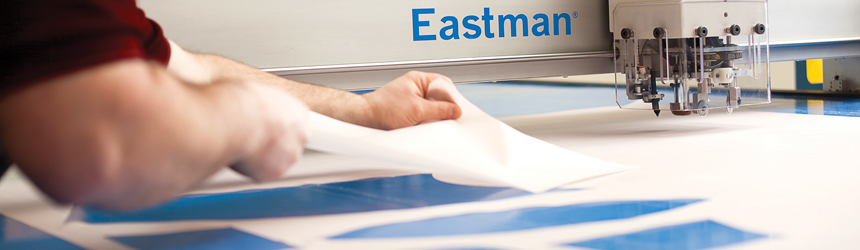
Above: The Eastman Eagle C125 conveyor system is ideal for both single- to low-ply cutting requirements.

The Automated Advantage
Customization, personalization, and shorter runs drive demand for digital print when it comes to production with digitally printed textiles. Therefore, there is a need to automate the finishing—especially cutting—aspect to accompany the new demands digital affords. With an automated workflow, jobs are produced faster with less expense.

Automation allows factories to produce shorter product runs to feed a growing demand for mass customized products, fast fashion, and quick turnarounds for consumers with a “see now, buy now” mentality, shares Leonard Marano, VP, product management and marketing, automation systems, Gerber Technology LLC. These trends aren’t just unique to one particular segment, as he sees similar ones in apparel, transportation, home and leisure, sign and graphics, and packaging.

Giovanni Disanto, sales and marketing, bierrebi, suggests that today, automation is one of the most relevant competitive factors for many manufacturers in different markets, including fashion, automotive, medical products, and home textiles. “In each of these industries, automation is crucial for quality improvement and cost competitiveness. Over the past years, technology has completely changed the nature of manufacturing in many different aspects. Most phases of production are much less labor intensive. Advances in technology have caused automation to become the single most significant competitive advantage for many manufacturing companies, allowing mass production at an incredible speed, with great quality and repeatability. Furthermore, automation can be applied to any phase of production and to any individual process of every manufacturing setting.”

Manufacturers gain time and reduce labor through automated finishing. For example, Steve Aranoff, VP marketing and business development, MCT Digital, says a large fabric print operation can save five to ten shifts per working shift as one person can operate a digital finisher compared to five to ten people hand cutting, plus a reduced need for sewing.

For companies new to automation—particularly in the cut room—Marano says throughput and accuracy improvements are exponential. “Aside from improving performance, manufacturers gain consistency, predictability, and visibility. When selecting an automating solution, it is so important to look beyond the equipment—as a significant portion of the value from automating comes from having an integrated solution that connects to your value chain from planning and design through production.”

These benefits drive the demand for automated finishing of digitally printed textiles used in manufacturing settings.

Automation has progressively affected the textile industry for more than 50 years with the inception of computer-controlled equipment. Marano shares that historically, high levels of automation were found in mass production factory environments where manufacturers produced hundreds of the same product. “According to our customers and several industry sources, the majority of supply chain leaders state that finding and retaining labor is their biggest challenge. This is largely because most millennials no longer want to work in factories. So, in today’s market, automation is providing factories with alternatives to rising wages and hard-to-find labor without having to relocate their operations.”

Elizabeth McGruder, VP, marketing, Eastman, agrees, and suggests automation is pushing those working with antiquated and unprofitable manual processes to make expedited decisions about equipment and software investments. “In order for them to compete in the marketplace, their process—from concept through design and cutting—must be done faster, cheaper, and with fewer people.”

Further, digitally printed textiles represent a big growth area for grand format digital printing companies. “This is partially due to the fact that fabric is ‘greener’ than the heavier materials that came before it, and more technology is being developed to make it easier to use fabrics for banners, and soft signage,” says Aranoff.

System Considerations
Cutting digitally printed fabric requires precision, accuracy, and advanced media handling. Integration is another critical element. In general, cutting digitally printed textiles requires a combined effort of a camera system, software algorithms, and a high-precision cutting system.

McGruder explains that typically, a high-resolution camera system is combined with special software to ensure that the cut path around printed shapes; registration mark detection; or pattern matching for stripes, plaids, and florals is accurate. The camera system scans the surface of the fabric as it enters the cutting system. Together with the software, it identifies the geometry and distortion of printed elements. This type of camera scanning system can be installed on conveyor or static table-style digital cutting systems, both of which are used industry wide for furniture, apparel, sportswear, advertising, and other general industrial fabric cutting requirements.

Looking more into laser and vision tools, Roden explains that due to challenges with cutting/finishing digitally printed graphics—particularly related to stretch, skew, and potential wrinkling—digitally printed textiles require a lot more registration marks printed along with the graphics to ensure accurate cutting.

“The algorithms behind reading register marks with Zünd Cut Center’s (ZCC’s) registration workflows—using an integrated Over Cutter Camera (OCC), guarantee both efficient, reliable capture and cutting accuracy. Since having the beam-mounted camera travel to each mark for capture is time consuming and can potentially take longer than the actual cutting, Zünd now offers the OCC camera system, which captures all registration marks visible in the cutting area in one shot, dramatically reducing overall processing time. This feature alone potentially increases productivity by 30 percent or more,” says Roden.

Marano points out that there are a few reliable options on the market for cutting digitally printed textiles—all with varying levels of throughput and accuracy. “Most systems require some sort of vision equipment or laser to pick up registration marks on the digitally printed textile.”

In Gerber’s case, the ContourVision scan-to-cut system scans the fabric and picks out a border line on the printed patterns. The ContourVision system then generates a cut job based on the location of the border line. This not only eliminates the process of scanning registration marks, but also the need for an operator to bring up a cut file. The fabric is then cut on the GERBERcutter Z1 single-ply cutting system. The border line is added to the graphic pattern in the AccuMark software and sent over to a RIP PC along with an embedded ICC color profile to maintain color integrity in the printing process. This further demonstrates the value of an integrated solution because the setup allows users to control the entire process and seamlessly pass data from design to printing and on through to cutting.

bierrebi targets consistent quality, higher productivity, and time-critical customer requirements through the Crystal system, a solution designed to optimize the cutting process in a range of applications—fashion, furniture, automotive, and medical. Disanto says this single-ply cutting system guarantees a higher manufacturing efficiency, greatly reducing operation costs.

The Crystal system embraces the green concept of lowest power consumption. According to Disanto it does not require suction to retain the fabric on the cutting area. In this way, the energy expense proves to be much lower compared to other cutting systems. In addition, the machine’s cutting area features a special glass surface, which offers less wear and greater flatness than other conveyors. The quality of mechanical components and consumables is brought to a minimum, contributing to further reducing maintenance costs.

Crystal performs a precise cut due to a double blade system. Its two blades separate the material through pressure, without forcing any fibers or pulling the fabric threads, guaranteeing a well-defined cut. It features a vision system that includes hardware and software for image management and pattern matching placements. A high-resolution camera captures the fabric texture and the latest generation software creates the best placement, which is quickly converted to a cutting file.

Aranoff points out how well suited lasers are for this type of work. “A laser is ideal as it doesn’t touch the textiles and can easily cut through bubbles without potentially grabbing the textile and ruining the cut. In addition, when textiles are placed in frames, new methods for compensation are required. Between longer jobs with dye-sublimated textiles in particular, new software tools are also needed to handle the cutting accurately and efficiently.” He says MCT’s TigerVision is developed to handle these challenges well.

An integrated production workflow is another consideration.

According to Marano, an integrated solution that provides an end-to-end value chain connection is part of the appeal automation offers. “This is where industry 4.0, Internet of Things, and cloud management comes into play. Having a connected automation system that receives data directly from CAD or planning software gives manufacturers more control and visibility over what’s going on in the cut room, while reducing time to market by improving throughput and reducing opportunities for human error.”

ZCC offers the ability to support the operator with automated job setup functions as well as a materials library with factory-tested and user-definable cutting/finishing profiles. “These ensure the best possible processing methods and cutting parameters are used for the job and materials at hand,” shares Roden. The benefits lie not just in fast production time, but also in minimized waste of factors like setup time and materials. “As an example specific to fabric cutting, ZCC may suggest its high-speed, blade-based driven rotary tool, alternatively its laser module is ideal for fabrics prone to fraying and applications where simultaneous cutting and edge sealing helps eliminate an additional finishing step,” she adds.

There are other considerations that specialized tools address.

To minimize the potential for stretch and wrinkling, hardware solutions such as the Zünd cradle feeder are effective. “This device controls the flow of the material onto the cutting table with little or no tension, ensuring the material is perfectly spread and laid out on the cutting surface, without any folds or wrinkles that will adversely affect cut quality,” comments Roden.

Another feature of bierrebi’s Crystal is the Slide Away system, which is designed to speed up the production process and increase productivity. “In particular, this new configuration moves and unloads the cut pieces from the cutting area. In this way, the machine keeps working continuously while an operator collects the material just cut. Because of all its features and high performance, Crystal represents a huge innovation in single-ply cutting. Constant research and development (R&D) activity keeps Crystal innovative and always ready for addressing the quickly evolving needs of the market,” explains Disanto.

McGruder comments that a static table cutting system is ideal for rapid prototyping, R&D work, as well as full-volume production. “Many textile cutting facilities utilize this type of machine to ensure consistent repeatability over long pieces or the ability to cut very intricate markers that have little room for error,” she offers.

Eastman’s static table system is capable of cutting, marking, and punching virtually any flexible material at speeds of up to 1,500 millimeters per second. Precision racks and rails on the machine in the X and Y axis and the ability to adjust motor settings help achieve position.

On the other hand, a conveyor cutting system offers identical cutting capabilities to the static table, plus the added ability to continuously convey rolled material goods with consistent speed and control. McGruder explains that a conveyer uses less floor space while cutting pieces that are infinitely longer than the table area. For mass production requirements, Eastman manufactures high-ply cutting systems for compressed material stacks of up to three or 7.5 centimeters.

Investment Considerations
Before investing in an automated cutting solution for digitally printed fabric, it is important to consider several critical factors. While accuracy is often the primary demand of these devices, a variety of other considerations come into play.

McGruder points out that there are demands for accuracy of cut pieces; a reduction of expensive material waste; speed and throughput of cut parts; flexibility to cut many types of materials, thicknesses, and properties on one system; the ability to mark/label parts or identification to reduce post-process operations; fully-automated facility communications from system to system; and robotics for piece collection. “This goes industry to industry from garment manufacturers to furniture or décor products.”

Roden says some shops struggle with the safety issues of hot knives and other manual cutting devices. “We have seen issues as well with workflow inefficiencies—for example when digital printing equipment needs to be taken offline because of a need to make up for piece shortages. Automating these systems and workflow limits the potential for error and ensures process reliability. Greater productivity achieved through piece nesting, registration-mark reading optimization, and potentially even robotic piece picking integration can completely change an area known for bottlenecks.”

Marano believes the demand for custom made, short-run products is increasing. In addition, line speeds for digital printers have grown significantly over the last several years and manual cutting cannot keep up with the volumes coming off the printer. Incorporating an automated cutter into a digital print workflow is essential to eliminating bottlenecks and keeping an operation flowing efficiently and synchronous. “This is true regardless of industry segment,” adds Marano.

Another crucial objective in deciding to invest in textile finishing automation is to meet the requirement of rapidly changing customer trends. “Immediate purchase is more common, a clothing or a homeware company needs to speed up all of its processes related to producing and marketing new products. Online purchasing has created the need for quick, on demand manufacturing. In addition, customers increasingly expect high-quality products at an affordable price point,” suggests Disanto.

Finishing Cut
Manufacturers benefit in many ways from automated finishing in textile production, including a more productive workflow that requires fewer operators, allows for minimal mistakes, and enables shorter, customized runs at a cost-effective price point.

Oct2018, Industrial Print Magazine
Finishing
Textiles