The Ceramic Opportunity

By Cassandra Balentine

From tiles to glass, digital ceramic printing technologies enable direct printing to fragile materials. With this capability, the benefits of digital—fast turnarounds, reduced set up, and cost-effective short runs—expand to new markets.

Ceramic printers are commonly used to decorate ceramic surfaces and tiles. The technology is well suited for applications in architecture and interior décor for items like facades, balustrades, canopies, dividers, partitions, doors, and kitchen and shower glass; automotive and transportation, including digitally printed replacement glass, train windows, buses, and coach glazing; appliances like refrigerators, ovens, glass cookers, tabletops, and cupboard doors and tops; and awards and personalization from custom interior décor to personalized titles for recognition.

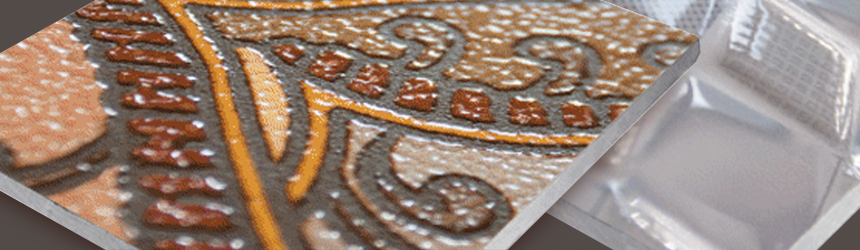
Above: Durst’s eight-color Gamma XD printer series is poised to reinvent ceramic tile decoration. These are samples of possible output from the printer.

Printing to Ceramics
There are several ways to print to ceramic materials, including, but not limited to digital. Both dedicated machines and multi-function UV flatbed printers serve the demand for digitally printed ceramics.

“Compared to an analog process, a digital process eliminates the cost involved in set up for screens or films, making turnaround time quicker and enabling short runs while maximizing revenue return,” shares Josh Hope, senior manager, 3D printing and engineering projects, Mimaki USA, Inc.

According to Norbert von Aufschnaiter, manager ceramics printing division, Durst Phototechnik AG, this lessened cost is also seen at the buyer level. “Customized products are at reasonable prices thanks to things like minimized downtime—designs can change without the substitution of mechanical parts.”

Andrea Annovi, engineering director and Luciano Bastardi, automation engineering manager, System Ceramics, a System Spa division, explain that digital print technology makes it possible to produce original surfaces “capable of imitating the finish of rusted metal, the feel of wood and its natural vein, and nature’s most precious marbles—allowing for unlimited creativity.”

Yuval Nahum, head of marketing, Dip-Tech, a Ferro Company, says the advantages of combining ceramic inks for glass and wide format, vivid digital printing processes include UV durability in outdoor conditions, supreme adhesion, and chemical and scratch resistance. “Ceramic inks can be laminated, bended, and double glazed, and can also be printed first surface,” he continues.

Digital printing allows vivid or single-color design with full personalization and no setup costs. According to Nahum, opaqueness or transparency, light transmission, and see through or privacy can be controlled. In addition, large scale projects can be divided for different glass panels for the ideal match. “It is also easy to match color digitally and to achieve elegant gradients and frost glass effects.”

Traditionally, ceramic ink is printable on flat glass by screenprinting. “Screenprinting may be acceptable and cost effective if no customization is needed,” suggests Nahum. He adds that it is suitable for many one-color applications.

Flat glass can also be printed with UV printing and organic inks, printing in an interlayer and laminated in between two pieces of glass. “However, there are challenges to using these methods. UV organic printed ink can have adhesion issues with the glass, scratchability issues, and UV resistance challenges. This type of printing is therefore mainly used for indoor wall cladding—for example, kitchen backsplashes—where it can be protected with back painting. The installation environment also needs to be considered for environmental durability issues,” continues Nahum.

The challenge for transitioning to digital ceramic printing is meeting requirements for speed, affordability, and compliance with respective industry standards. “But this revolution is already happening as faster and more competitive return on investment solutions are introduced,” says Nahum.

It is also important to educate the market. Dip-Tech is dedicated to training the architectural and interior designer communities around the world to the possibilities of digital ceramic printing. “Educating the market segments is done in different channels, including but not limited to exhibitions for architects and designers, seminars, webinar training, and online activity to expose the advantages of using our technology,” shares Nahum.

On the Market
A variety of digital ceramic printers are on the market today.

Dip-Tech offers digital ceramic printing on glass. The NEra printer features a versatile printing carriage designed to enable a seamless, multi-application process. The printer allows for different high-speed applications without the need to change ink tanks. It offers up to 12 ink channels and a variable drop size. Automated ink recirculation in the printhead, as well as high-power dual-technology drop fixation, automatic fast color change system, and stationary glass printing are additional features.

The company also sells the GPi, featuring variable drop sizes and high image quality. It offers automatic ink recirculation in the printhead. Thermal drop fixation enables high quality and efficiency. It is a modular, flexible solution with a user interface designed to support a simplified workflow. Dip-Tech develops and manufactures its ink.

Durst offers its new eight-color Gamma XD Printer Series. With this press, Durst is intent on reinventing ceramic tile decoration with new possibilities for unique and creative tile design and ultimate production efficiency. The Gamma XD ceramic printer combines high-quality inkjet technology with a unique print engine that is designed to break the barriers to quality and speed, maintaining the required ink amount per square meter. Key features of the Gamma XD include a high uptime/productivity, optional digital material printing technology, high nozzle stability, low customer maintenance, and low printhead costs with easy and fast replacement.

EFI offers its Cretaprint series of ceramic tile printers. Models include EFI Cretaprint P4, EFI Cretaprint D4, EFI Cretaprint SOL, EFI Cretaprint C4, EFI Cretaprint C4 Twin, EFI Cretaprint X4, EFI Cretaprint M4, and EFI Cretaprint P3. With these printers, EFI Cretacolor Inks, and the Fiery proServer color management system working as one, EFI supplies a total solution.

The KERAjet P7 from KERAjet, S.A. offers a range of printheads and digital decoration with 12 colors. Its vertical resolution is 180 to 1,200 dpi and horizontal resolution is 254 to 1,200 dpi. It features a drop size of ten to 200 picoliters. A continuous ink stream provides a steady and active printing system.

The KERAjet S7 features a distributed ink control system and up to 12 inks. It offers continuous ink recirculation as well as an automatic purge and cleaning system. The KERAjet S7 offers conveyor speeds of up to 90 meters per minute, a vertical resolution from 180 to 1,200 dpi, a horizontal resolution from 254 to 1,016 dpi, and a drop size from ten to 200 picoliters.

The KERAjet presses feature advanced digital printing technology for printing with ceramic pigments, soluble salts, effects, solid applications, glazes, and UV inks.

System Ceramics offers Creadigit, a digital, single-pass inkjet printing process developed by the company to enable high-definition decorations on ceramic surfaces. Annovi and Bastardi say it offers advantages and benefits that were “unthinkable not so many years ago.”

The printhead is available in three different versions depending on the native print drop. It offers a resolution of 400 dpi, internal recirculation, high-strength metal plates, and total regeneration capacity. Creadigit digital inkjet printing is valued for the decoration of large ceramic surfaces. The Creadigit XXL and Creadigit BS versions reach printing widths of 1,355 and 1,806 millimeters, respectively. Additionally, the processing electronics inside Creadigit enable high-speed printing to lend a concrete quality to images of all kinds for graphics up to 200 square meters in size, making each slab unique.

Operators can manage a quantity-based printing mode with immediacy of use, which is a sought after factor. “This high-added value principle allows the technician to set the values of the material to be deposited on the ceramics. This is significant as it is possible to modify the quantity of ink without having to change the file that has already been elaborated for the printing process. Unlike the resolution printing process, with this method you can always be sure that Creadigit will deposit the desired amount,” share Annovi and Bastardi.

Creadigit does not produce inks, but performs detailed tests. “More than 1,000 inks and over 1,500 waveform printhead activation electronic tests are studied and tested to obtain optimal drop on demand digital inkjet printing, on account of the fact that the inks are a crucial factor in print quality combined with reliability over time, ensuring the highest level of excellence throughout the entire ceramic production process,” note Annovi and Bastardi.

They explain that the digital printing system is designed to deposit small quantities of ink, thus ideal for printing images. Other printheads, designed with robust native drops to facilitate the application of quantities, are used to obtain special effects like metallic, sunken, opaque, or reflective.

In addition to dedicated ceramic printers, select flatbed printers also support this application.

For example, Mimaki’s UJF Series and JFX Series of UV LED flatbed printers can be used to print flat ceramics such as tiles. “These are multi-purpose printers that print to a variety of surfaces. Depending on the surface, primers are often used to promote ink adhesion. Because it’s a common practice, Mimaki offers a jettable primer for all flatbed printers, enabling users to prepare just the area to be printed. Primer is used for surfaces such as glass, some metals, or ceramic tiles. We also offer a wipe-on primer,” says Hope.

Mimaki provides original inks for all of its products. Primer may be required, depending on ink type and characteristics, comments Hope. In terms of finishes, Mimaki offers clear in many of its ink sets and it is jetted like any other color—inline on the printer.

Custom Trends
Demand for personalization leads to the continued development of digital print technologies. Solutions on the market vary, but all offer quality and durability for printing to ceramic objects like glass and tile.

Apr2018, Industrial Print Magazine
Considering the Alternative

By Melissa Donovan

Many textiles are printed with water-based ink but depending on the chemical configuration water-based ink is also utilized for printing to rigid or semi-rigid materials in the creation of packaging or industrial decoration applications. While UV-based ink is commonly favored in manufacturing settings, water-based ink sets are an alternative. They offer certain advantages depending on the manufacturer and intended use.

Above: Mimaki’s water-based inks are designed to suit specific fabric characteristics ensuring exceptional color reproduction on either natural or synthetic fibers for producing fashion textiles, performance sportswear, interior decor, flags, and banners.

Another Option
Despite UV ink’s multitude of benefits, water-based ink is a strong competitor. This mature ink set is used in traditional printing techniques and also found success with digital printing technologies. In regards to manufacturers, those using digital printing turn to water-based ink for its lower cost and minimal odor, and to satisfy rising safety and health regulations, especially for applications involved with food.

According to Hamid Shirazi, Ph.D, aqueous inkjet ink product manager, Fujifilm Imaging Colorants (FFIC), characterized and safe chemicals—such as surfactants and viscosity modifiers—contributed to the first generation of inkjet water-based inks. However, no inkjet colorants were available, they were borrowed from other industries—food and textile.

“Later a range of novel colorants—dyes and pigment dispersions—were custom developed to overcome some of the shortfalls of the first generation colorants, such as poor water fastness, light fastness, ozone fastness, improved hue, and chroma. Many of these same colorants continue to be used for industrial applications today and more are in development,” continues Shirazi.

Thanks to these advancements, manufacturers adopting digital print consider water-based ink. Demand derives from industrial printing, textile, food, and pharmaceutical industries. “Water-based inks are doing well in traditional paper and paperboard markets. Corrugated, envelope, bags—carry out, and commercial and folding cartons are the providence of water inks,” explains Joe Kelly, VP technical director, INX International Ink Co.

“In textiles, much of the opportunity is driven by increased availability of specialty application fabrics designed for high fashion, performance apparel, and industrial textiles. With an increasing selection of fabrics new and emerging markets are open to this technology,” adds Tommy Martin, product manager, textile and apparel business development and marketing, Mimaki USA, Inc.

Cost makes this ink attractive. “When comparing water-based inks to UV inks, water-based inks are much more cost effective and support higher speeds. However, water-based ink is one of the most expensive liquids per ounce. Given the high demand for printing, there is a need for a low-cost print output,” shares Linda Meyers, press relations, Diversified Nano Solutions Corporation (DNSC).

Dev Sarma, research and development manager, InkJet, Inc., points out that UV inks also require additional equipment, like a curing lamp to cure a substrate, which can get expensive.

“Some UV inks have an unpleasant odor and can be sensitive to the skin whereas with water-based inks, those are not concerns. Also certain industries require water-based ink due to regulations,” adds Sarma.

Clear Benefits
Water-based inks offer advantages such as eco-friendliness, increasing substrate compatibility, and cost effectiveness.

Eco-friendliness is a major benefit. According to Sarma, water-based inks contain low volatile organic compounds (VOCs), meaning they do not feature the odor common with UV. Another “green” benefit is that the disposal of bottles and other waste is easier. “It is safe, odor free, and eco friendly. While UV inks are safe for the environment, they are more hazardous than water-based inks. Water-based ink contains polymers and tends to be safer than UV ink, which consists of monomers,” he continues.

Material compatibility is also changing for the better. “Technology has evolved so that water-based inks can be used for porous and non-porous materials. Previously, there were no binders, so manufacturers could not print on plastic with water-based ink, now they can,” says Sarma.

Cost is another benefit. “Water-based inks provide the lowest cost in terms of color density over unit area. They can be free of hazardous air pollutants with ultra-low VOCs, making for reduced regulatory involvement. Insurance costs are lower as well,” explains Kelly.

Production-level environments use water-based inks because of their cost effectiveness for larger volume jobs. “Water-based inks are commonly used in industries printing on many items requiring large volumes of ink. They are favorable because they sell for a lower cost than other inks and are compatible with applications that require higher print speeds,” shares Meyers.

Looking into Water
Water-based ink sets are available for industrial printing applications.

DNSC’s V- and E-Series water-based inks are low cost and provide high speed print output. Meyers says that in addition to being eco-friendly, these water-based inks are less hazardous to health. Both the V- and E-Series include CMYK, red, green, blue, and custom Pantone options, proving a water-fast ink set compatible with a variety of porous and non-porous substrates. The E-Series is a pigment-based inkjet ink, whereas the V-Series is a dye and dye/pigment hybrid inkjet ink.

FFIC scientists and engineers are key players in the development of the chemistry and purification science of water-based colorants. The company is active in supplying and manufacturing water-based colorants and fluids for all of the above-mentioned applications. Pro-Jet aqueous inkjet inks are custom designed for inkjet printing applications like laminates, flooring, product marking, packaging, and textiles.

InkJet sells water-based inks for high-speed printing presses for both coated and uncoated substrates. Its direct food contact ink is used to create images on foods specified by the U.S. Food and Drug Administration. This includes consumables such as cakes, cones, soft candies, white and brown eggshells, and vegetables, as well as packaging that may come in contact with food.

INX recently introduced its INXhrc High Renewable Content Water Inks, which offer real advantages of bio-sourced materials and reduced carbon emissions. This is also without the compromise of other print/application attributes, according to Kelly.

Kornit Digital’s NeoPigment direct to garment ink portfolio consists of high-density pigment ink engineered for sustainability. The ink set offers excellent light fastness with a color gamut of CMYK, green, red, and gray. In 2017, Kornit introduced pink and yellow neon ink to extend the portfolio’s color gamut.

Mimaki’s water-based inks are optimized for the Mimaki TX300P-1800 Series direct to textile printers. They are designed to suit specific fabric characteristics ensuring exceptional color reproduction on either natural or synthetic fibers for producing fashion textiles, performance sportswear, interior décor, flags, and banners.

Sensient Imaging Technologies offers SensiJet SX ink, ideal for both porous and non-porous surfaces, to offer adhesion without the use of any VOCs or substances causing concern in regulated applications. The ink manufacturer says solutions can be developed to satisfy the requirements of many applications, adjusting parameters such as adhesion, flexibility, de-lamination, or fastness.

H2O Struggles
Water-based inks aren’t without challenges. Some of the chemical compositions of the ink sets are limited, particularly in adhesion to a variety of materials.

“On non-absorbent substrates the challenge of water-based inks is to overcome the very high surface tension—water wants to bead rather than wet the low surface energy substrates. While progress has been really remarkable, for water-based inks to ever compete with solvent packaging inks on wide web, very high speed presses, there is much more to be done,” admits Kelly.

Meyers agrees that one of the biggest barriers to increased adoption of water-based inks for manufacturers is material variety. “Water-based inks require mostly porous, paper-based substrates, which limits applications for manufacturers,” she shares.

Besides substrate compatibility, the printing process for water-based ink is demanding. “The biggest challenges for manufacturers using water-based ink is the open time to the printhead—when you want to print after not printing a while, you won’t get the first few pixels. It also has a slower dry time and sometimes a heater is needed to help the ink dry faster. There can also be a limit to what printer is used because certain printheads are restrictive to solvent-based inks,” explains Sarma.

Another hurdle to overcome is meeting requirements of the applications in question. “For food packaging there is another level of safety requirements and mode of exposure that is of importance. Of course food safety is a very complicated matter. However, the food industry and regulatory authorities have well established guidelines for Good Manufacturing Practice and approved list of food compliant colorants and chemicals that have been tested and are appropriate for direct and indirect food applications,” advises Shirazi.

Just Add Water
Water-based ink is an alternative to UV ink sets used in manufacturing environments. It cost effective for large volumes, and gives off little to no VOCs, offering a cleaner, heathier option for applications where strict requirements are in place. The configuration of water-based ink may have a long way to go to reach adhesion levels of UV, but ink chemists are working diligently to achieve this milestone.

Apr2018, Industrial Print Magazine
A Customized Wardrobe

By Olivia Cahoon

Manufacturers use digital printing technology to offer customers design freedom and expand their decorative products. For garments, digital printing allows manufacturres to use multiple file formats, undergo simpler printer maintenance, and produce short runs with faster turnaround times.

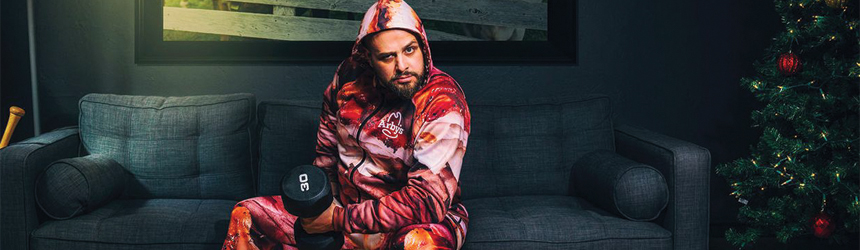
Above: Spreadshirt, with headquarters in Germany, recently purchased Brother GTX DTG printers for all of its facilities.

Create Your Own
Established in 2002, Spreadshirt is a self-expression global ecommerce company for on demand printing of clothing and accessories. The manufacturer offers over 200 base products including aprons, bags, bandanas, hats, hoodies, mugs, phone covers, pillow cases, sportswear, t-shirts, and water bottles.

Customers and designers sell their merchandise and personalized products on the Spreadshirt Marketplace website or in thousands of independent shops. The manufacturer prints customer designs onto a base product and ships it to the end user. Spreadshirt is available in 12 languages. In 2016, the manufacturer printed more than 4.1 million items and sent them to over 150 countries.

With headquarters in Leipzig, Germany, production facilities are located in Krupka, Czech Republic and Legnica, Poland. The company integrated into the U.S. in 2004 and opened business in Louisville, KY. Since then, Spreadshirt has relocated its U.S. headquarters to Boston, MA, and has two U.S. production facilities in Henderson, NV and Greensburg, PA. With its current production facilities combined, Spreadshirt operates in 200,000 square feet of workspace and employs over 500.

“Spreadshirt empowers people to express themselves through creating, discovering, and selling clothing and accessories with messages they want the world to hear. Companies like Snapchat, Facebook, Twitter, and YouTube enable self expression in the digital world, but people don’t have the same opportunities in the real world where the need still exists,” says Jurgen Gauger, COO, Spreadshirt.

The company started with a focus on plot printing. Plot printing uses a vector graphic with no more than three colors. The graphics are manually melted into the fabric using heat and pressure and the plastic backing is removed.

Throughout 2017, Spreadshirt increased its digital direct share to 75 percent worldwide. It plans to increase its digital direct printing share to nearly 100 percent in the future. Now, the company offers print on demand, digital direct printing, plot printing, thermos sublimation, and digital transfer/laser transfer.

According to Gauger, Spreadshirt’s three approaches—create your own, marketplace, and shops—provide limitless opportunity for on-person self expression. “Consumers shop for great designs on the Spreadshirt Marketplace or create their very own product with the help of our design tools,” he says.

Designers earn money by selling designs on Spreadshirt Marketplace or in a white label shop using the shop system, SpreadShop. Spreadshirt Marketplace displays customer designs for over 80,000 daily customers in addition to access to campaigns, Amazon, and eBay.

SpreadShop provides users with a responsive and easy-to-customize shopping system to market their Spreadshirt products. They can create custom shop displays, select which products to sell, and receive the highest possible commission earnings available.

“Everybody can open a SpreadShop for free—all they need are ideas. Spreadshirt takes care of the rest, from printing and shipping to customer service,” offers Gauger.

Digital Investments
Spreadshirt started using digital printing technology to print onto garments in 2007 with Kornit Digital devices. Shortly after, the manufacturer added multiple, different generation Brother International direct to garment (DTG) printers. According to Gauger, the printers offered high resolution, redundancy, and flexibility for production setup.

In 2017, Spreadshirt invested $1.4M into 45 Brother GTX DTG printers. The Brother GTX offers a maximum print size of 16×21 inches and uses water-based pigment inks. It includes two printheads and eight ink channels with a maximum print resolution of 1,200×1,200 dpi.
“We are excited about the implementation of these machines. Customers love the great quality, superior durability, and limitless opportunities for photos and complex graphics now created with digital printing,” says Gauger.

The GTX printers offer unlimited color options and design reproduction, short runs, simplified reprints, and seamless printing over zippers and other difficult garments.

For Spreadshirt, Gauger believes the Brother GTX machines offer notable competitive advantages including availability in multiple file formats, easy printer maintenance handled in house, readily available from the manufacturer for scale up, and the ability to easily move around the machines due to its small and flexible size.

The company currently uses 14 of the Brother GTX printers in its U.S. production facilities in Henderson, NV and Greensburg, PA, and the additional machines in its three European production facilities.

For both its Brother and Kornit devices, the respective OEM inks are used. “We’ve come to realize that if the ink and machine come together, we get the best results,” says Gauger. The finishing process is completed through oven drying. All of this is driven by proprietary software.

Digital Garment Printing
Spreadshirt predominantly prints on 100 percent cotton garments although some of its products have a small percentage of polyester. Because cotton is a natural material, it’s subjected to small variations and special needs. This presents challenges for digital printing in a manufacturing environment.

According to Gauger, every product requires a special pretreatment and settings are adjusted individually by product type or color. “This is one of the reasons why we developed our own premium brand—the Spreadshirt Premium Collection—to guarantee consistent quality.”

The Spreadshirt Premium Collection consists of fabrics optimized for any printing style including plot printing with flex, flock, specialty printers, or digital direct. Clothing sizes are available up to 5X for men and 3X for women.

“We provide consistent colors across our men, women, and children styles so that matching across genders and ages is no problem, such as for team or group wear,” says Gauger.

Spreadshirt sources its materials from only fair and sustainable suppliers and offers a traceable Respect Code on each shirt label for customers to track where the shirt was produced. The Spreadshirt Premium T-shirt is an ultra-durable fabric that weighs 5.2 ounces. According to Gauger, it is the ideal t-shirt weight for durability without excess thickness.

Although Spreadshirt specializes in print on demand for products starting at one piece, the manufacturer still caters to clients with large orders. Its bulk department handles orders of 50 items or more for agencies, associations, and small- to medium-sized enterprises by using the most efficient printing methods.

Ongoing advancements in digital textile printing increase customer sensitivity to quality. With expectations at an all-time high, it’s increasingly important to use technology that guarantees high-quality with every print. According to Gauger, digital production printers allow more flexibility to react to seasonal changes in volume.

Custom Garments
Compared to traditional manufacturing techniques, Gauger believes digitally printing garments is a quick, one-step process that requires less labor. Manufacturers like Spreadshirt investing in e-commerce and digital technology satisfy customers with solutions to design, discover, and sell custom printed garments.

Apr2018, Industrial Print Magazine
Runs of One

By Melissa Donovan

Basing success on one printer can be risky business, but if you make an informed decision and subsequent investment all while believing in the purchase and its capabilities, the results are positive. RAM Group, Inc. of Milwaukee, WI is a real-life example of this. It acquired an EFI Reggiani ReNOIR Compact printer a little over four years ago for dye-sublimation (dye-sub) printing and prototyping of one-off garments.

The company began in 1994 producing technical drawings for manuals. A one-man operation, Rick A. Marino, president, RAM Group, worked out of his extra bedroom drawing motors and couplings for technical companies. In 2004, he was researching customized club sporting team uniforms and was unhappy with the results. For Marino, a whole different type of personalization need was not being met and he set out to change that.

Originally, his process involved sublimating logos, names, and numbers to existing garments, but six months later Marino and another employee realized the efficiency of digital printing for individual garments and switched to printing the entire garment and then sewing it.

RAM Group quickly outgrew its original location and moved into a 600 square foot office with a hand press for sublimation. Soon after, an opportunity to rent a 2,000 square foot space presented itself. The move allowed the company to enter into wide format printing and offer sewing services in house.

Above: RAM Group, based in Milwaukee, WI, used its EFI Reggiani ReNOIR Compact dye-sub transfer printer to print 10,125 square feet of graphics that were manufactured into a sweat suit for special Arby’s customers.

Digital Influencer
Today RAM Group employs 34 out of a 16,000 square foot facility. Designing, printing, cutting, and sewing are all conducted at this one location. Besides the 34 full-time employees, the company also utilizes part-time employees and outside sewing contractors when production requires more man power.

Main services involve producing garments for sports and athleisure. Clients include corporations, teams, lifestyle brands, startups, and private label. It has several websites for private lines including ShirtsandLogos and SluggerCustomUniforms or Ontal, which offers customized high-end golf apparel for men and women. The company is best known, according to Marino, for producing softball/baseball uniforms. It’s worked off field for USA Softball and sponsored the Louisville Slugger Warriors. Since the company is mostly based online, it services clients internationally, for example providing softball uniforms to teams on military bases worldwide.

Marino understood early on that digital printing fit his company’s style. Take for example the design freedom afforded by digital printing. “In the beginning, we were known for our crazy numbers and wild designs. Because of our background, we took designs to the extreme—creating logos and using elements from the logo in the pattern of a shirt or taking little mascots and masking them in and out of numbers on the garment,” he explains.

The group initially worked with an Epson Stylus Pro 9600, which was succeeded by a series of Mimaki USA, Inc. printers. In 2014, Marino’s son went to a trade show and purchased the EFI Reggiani ReNOIR Compact—one of the first in the U.S. for apparel. Both the speed and consistency made it a logical choice. The transfer dye-sub device is set up based on the garment manufacturer’s specifications. Since three quarters of what the company prints is individual garments or runs of one, file manipulation is unique and RAM Group worked with Reggiani—the purchase was prior to Reggiani’s acquisition by EFI in 2015—to create an efficient workflow process.

In addition to a custom printing setup, its finishing process differs from most apparel manufacturers. For example, those using transfer dye-sub commonly place cut parts onto prints for transfer. “Since we had no apparel background, it made sense to print the entire garment and then cut it out after. When we showed the manufacturer, it quickly changed its marketing to highlight our methods,” explains Marino.

This also happened when RAM Group looked into purchasing a digital cutter. “When we first bought our cutting machine, the sales representative advised us not to buy the equipment because it could not cut one-off production. Now the cutting machines are set up for this type of production,” he continues.

Increased efficiency and decreased turnaround times were two main goals when purchasing the EFI Reggiani ReNOIR Compact. Marino says both were achieved and the RAM Group continues to look for new ways to further these goals. One of which is streamlining the front end of the production cycle with a proprietary online ordering system. At press time, the company was in beta testing with a solution that allows the purchaser to choose from over 8,000 SKUs on a men’s shirt, for unlimited versatility and custom designs.

Meat Sweats
While RAM Group regularly completes work for sports teams and other athletic groups, it also has a good deal of business come in from high-end agencies of reputable big brands. Just before Christmas 2017, an advertising agency for fast food chain Arby’s reached out to the garment manufacturer for a unique request.

The Meat Mountain is an off-the-menu item available at Arby’s. When the sandwich was ordered, customers were asked to provide contact information so Arby’s could acknowledge that they conquered the Meat Mountain. The agency hoped to surprise the customer by sending them a sweat suit—Meat Sweats—that featured a pattern of all the meats in the sandwich.

In less than two weeks the RAM Group took an actual image of the meat in the Meat Mountain sandwich and created an ’80s style look using a brand new pattern. It printed approximately 675 linear yards or 10,125 square feet of graphics on the EFI Reggiani ReNOIR Compact, which were then transferred onto fleece. In total, 150 tops and bottoms were created.

“We had no lead time, no proper trims, our contractors were busy, Christmas is a pretty hard deadline, and we had other commitments during the holiday season,” shares Marino. Additional challenges included color correcting the photo to ensure the image accurately portrayed the meat and rearranging the image so the meat was placed appropriately on the sweat suit.

Recipients of the Meat Sweats were more than surprised. According to Marino, the marketing campaign created a social media explosion.

Phenomenal Throughput
99 percent of the work performed by the RAM Group is printed on the EFI Reggiani ReNOIR Compact. With it constantly running, the RAM Group is poised to capitalize on its “phenomenal” throughput.

Apr2018, Industrial Print Magazine
With The Times

By Industrial Print Staff

The label segment is rapidly adopting digital printing technologies to accommodate increasing requests for smaller runs and versioning. It’s up to each label printer to decide when it is time to invest in digital, and to what extent, but inevitably it is where the industry is heading.

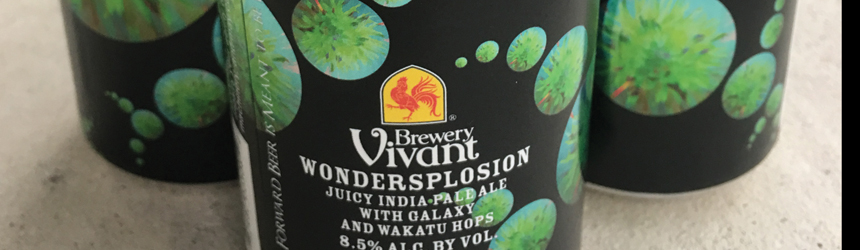
Above: Middleton Printing of Grand Rapids, MI recently printed beer labels for Brewery Vivant’s Wondersplosion IPA.

Digital Journey
Middleton Printing is a print provider based in Grand Rapids, MI. The shop focuses on label applications, offering custom labels, decals, sale stickers, thermal transfer, and cut vinyl.

The company started in 1960 as a general small format commercial printer with multiple commercial sheet-fed presses. In 1972 it incorporated high-speed envelope production, adding flexographic label printing in 1976. Today the shop staffs ten employees and operates out of a 10,000 square foot space.

The company installed an Epson SurePress L-4033AW digital label printer in 2013 to help it transition out of flexographic printing. It made the full move to digital recently with the purchase of the Epson SurePress L-6034VW.

“As the commercial printing market started to break away from analog printing and transition to digital printing as an industry, we took a step back to observe how this trend would affect us and our customers and decided to adopt digital printing as quickly as possible,” comments Steve Middleton, president, Middleton Printing. “This allows us to meet our customers’ growing needs for digitally printed labels and adopt the growing trend in automation that digital offers.”

While the company first installed a digital press five years ago, it began researching solutions in 2009. In 2012 it attended Labelexpo and got a firsthand look at the Epson SurePress L-4033AW and decided to make the jump to digital.

“At this point, Epson already had a reputation for amazing quality and color accuracy, which helped with our decision to purchase the press. The quality of the labels printed from the press is excellent, offers a simple workflow with its automation features, and also meets our needs for short-run label printing,” shares Middleton. “We were also impressed with Epson’s commitment to the market and how they use their own technology in the SurePress,” he adds.

The print provider expanded its digital portfolio in 2017 with the installation of the Epson SurePress L-6034VW in March. According to Middleton, it was one of the final pieces the shop needed to make its full transition into digital printing. “We chose the Epson SurePress L-6034VW because its quality lives up to Epson’s high standards, including its simplicity, durability, and automation. One of the main factors that helped us decide to purchase and install the L-6034VW is its white ink capabilities, as well as our customers who like the look and feel of labels printed with UV inkjet,” he says.

Digital Capacity
With its two digital solutions the company provides UV LED cured ink with the Epson SurePress L-6034VW and aqueous inks with the Epson SurePress L-4033W.

The Epson L-6034VW features an Epson-developed PrecisionCore linehead, center drum system, and digital varnish. It integrates all of the functions required for label production, such as corona treater, white ink, digital varnish, and an additional UV curing unit.

It features newly adopted pinning technology that controls the range of ink scattering and realizes ultra-sharp dots and thin lines. The device offers speeds of up to 49 feet per minute with a 13.4-inch width.

Meanwhile, the Epson SurePress L-4033AW features Epson’s MicroPiezo inkjet technology to create output with smooth gradations and incredible color quality. The L-4033A offers a six-color—cyan, magenta, yellow, black, orange, and green—industrial-quality, water-based ink set, which produces a range of colors for consistent results. The L-4033AW includes a seventh white ink to print a transparent no-label look, as well as metallic-type labels frequently used in the cosmetic and health and beauty markets.

The Epson SurePress L-4033AW also offers substrate versatility. With no pre-treatment or top coating required, a variety of standard off-the-shelf substrates can be used at variable web widths of up to 13 inches wide.

With these devices up and running, 100 percent of Middleton Printing’s label products are produced on digital label presses.

“It is easier for us to use digital label printers because of our set up, which allows us to produce a variety of labels as well as the SurePress’ automation capabilities,” says Middleton.

For jobs that are difficult to run spot PMS color or textured substrates, the shop elects to use the L-4033AW because of its wide color gamut. On the other hand, the L-6034VW has a more durable ink set, including matte and glossy varnishes, which Middleton says are popular with customers that require beer and wine labels.

“Implementing digital print technology has allowed us to be more efficient in our process and expand our capabilities. We are able to produce more products with fewer people and create labels that many flexographic companies cannot. We also tend to run a lot of jobs for label and printing companies that still run flexography,” adds Middleton.

He says the benefits of working with digital printing equipment include the increase in efficient production with reduced prepress steps. “We also have less suppliers to deal with and no longer have the need to purchase inks from other companies.”

One challenge the shop has faced is in regard to software. “Software solutions available to the label printing industry are priced for companies much larger than Middleton Printing and are not exclusively designed for digital label production from the ground up,” admits Middleton.

Craft Labels
Middleton Printing recently printed beer labels for Brewery Vivant IPA, Wondersplosion. The shop used the Epson SurePress L-6034VW to print these labels due to its varnish capabilities, which include glossy, matte, and white ink.

The creative was submitted by the customer and measured 8.2x.125 inches. The design was printed on silver metallized BOPP film with the Epson SurePress L-6043VW then die cut on a METAS 1-Series semi-rotary die cutter.

“There was no way to cost-effectively print the labels without digital technology. The quality requirements for white ink and varnish registrations would’ve been challenging. Thanks to digital, we had minimal waste,” shares Middleton.

2,000 labels were printed on this run, which was a pilot run for a larger job.

“This specific label run showed the Epson SureColor L-6034VW’s strengths with the ability to print white registration and the varnish effects with pixel-on-pixel registration,” says Middleton.

Constant Evolution
Middleton Printing realized early on the importance of digital printing to its success as a label creator. It continues to watch for technologies to stay ahead of the curve.

“Middleton Printing is looking into areas to bolster its ability to support customers and label consumers, which include developing innovative technology and manufacturing hardware solutions, as well as exploring and developing new applications for our digital press,” concludes Middleton.

Apr2018, Industrial Print Magazine
Digital Dresses Up

By Melissa Donovan

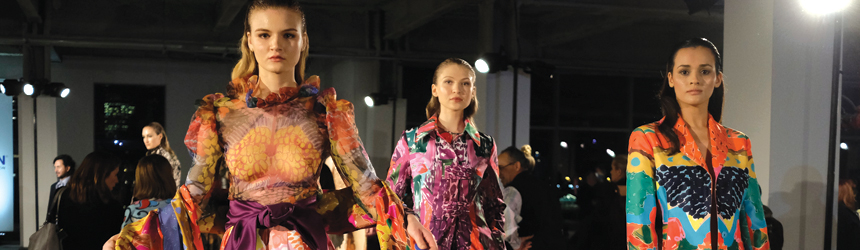
Epson hosted its fourth Epson Digital Couture Project on February 6, 2018 in New York City, NY. The annual event invites designers from North and Latin America to utilize Epson’s digital printing technology to create fashion designs. This year’s theme was Cosmopolitan Couture with Impossible Colors – How Does Your Culture Dress Up? 14 designers worked to create collections consisting of three separate outfits, which went on to be modeled at the event.

Above: These three outfits were created by Ana Maria Gululfo of Peru using Epson digital printing technologies. Photo by Frank Ishman.

Proving its Worth
Prior to the fashion show, Epson held a Fashion and Technology Forum, where influencers shared their insights on how digital printing is affecting today’s apparel production process. Anthony Cenname, VP/publisher, WSJ Magazine moderated the discussion between Anna Fusoni, editor in chief, KS News; Aliza Licht, EVP brand marketing and communications, Alice + Olivia; interior designer Ryan Korban; and Mark Sunderland from Thomas Jefferson University.

Highlights from the forum included a discussion on the benefits of digital printing technology. Topics like catering to fast fashion trends, minimizing inventory, sustainability, and unlimited design possibilities were discussed.

According to Sunderland, designers are becoming more informed about fabrics and what goes into their construction, especially how this affects drape and hand. “This allows them to flip the script on the supply chain—it is no longer linear, but 360 degrees. The process is all about information gathering.”

Digital printing also “flips the script” on the supply chain. “There is no substitute for being able to print to fabric and have it be done in an hour’s time,” continued Sunderland. Cenname agreed and pointed out that in most instances before a fashion show, designers are looking for a quick fix to finish a collection and digital printers are an ideal solution.

Looking to the future of fashion, Fusoni commented that a combination of digital textile printing and sourcing local is ideal for businesses with smaller infrastructures. “Digital print allows for different designs, which makes a designer successful. Fashion is a business and you need an entrepreneurial mind to be successful.”

One of the goals for designers with small- or medium-sized businesses—and many on the panel have already seen this—is for them to come together and pool costs for a digital printer. They can work as a collective in a makers’ space or solution center.

Identifying the benefits of digital and how it’s affected the fashion world is fascinating. “Digital provides a spectrum of color in a fraction of time. It is kind of remarkable how it’s affected the design process,” shared Licht.

A Commitment to Fashion
Epson is dedicated to digital printing’s influence in the fashion world. Keith Kratzberg, president/CEO, Epson America, Inc., was quick to point out what a unique opportunity digital presents for the U.S. in particular, since so much of current textile printing is outsourced overseas.

“Digital is providing an opportunity for entrepreneurs to start a new market, whether it be fast fashion or niche verticals,” he shared.

The Epson Digital Couture Project coincided with Epson’s announcement about its new microsite—Epson Brings Technology and Fashion Together. Accessible at epson.com/fashion, the site serves as an information portal for fashion designers interested in learning more about digital fabric printing. Not only does it offer solution-based guidance on dye-sublimation (dye-sub) and direct to fabric processes, it also connects fashion designers to digital fabric printers to propel the technology forward.

Epson offers a range of digital printing devices. Its newest SureColor F9370 is a 64-inch dye-sub transfer printer. Designed for high-speed, medium- to large-volume printing, it prints at speeds up to 1,169 square feet per hour. The SureColor F9370 is equipped with the company’s latest dye-sub ink technology—UltraChrome DS with High-Density Black.

Through Epson’s acquisition of Robustelli, it now offers the Monna Lisa digital textile printers. The portfolio includes three different printing widths, all equipped with Epson printheads. The printers can be loaded with four or eight colors with either acid, reactive, disperse, pigment, or sublimation disperse ink—allowing for direct printing on any type of fabric.

We look forward to continuing to report on Epson’s commitment to digital printing in the fashion industry.

Apr2018, Industrial Print Magazine