The Sweet Scent of Digital

By Melissa Donovan

Adopting digital print into an organization, whether in their own facility or through a print provider, changes the way a business runs. The technology impacts new marketing channels, opening doors for the introduction of new products. Labels particularly benefit from this.

While analog technologies like flexography are still advantageous for longer runs of labels, brands with variations of one product might look to digital to focus on smaller runs of each type. If this works well, the adoption of digital creates a trickle effect, creating the opportunity for shorter runs, as small as one with even more personalization or customization depending on the request.

Transforming an Original
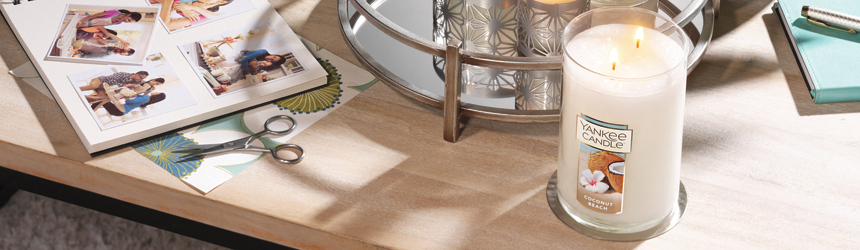
The Yankee Candle Company, Inc., with corporate headquarters in South Deerfield, MA, has been in business since 1969. The company is part of Newell Brands and employs thousands of people worldwide. It offers scented candles, home fragrances, auto fragrances, and home décor through a wholesale customer network of close to 35,000 store locations, with more than 500 company owned and operated retail stores.

Candles come in a variety of jar sizes and fragrance options. In an average month Yankee Candle produces almost 600,000 candles, each of which requires a polyurethane label. The company started testing digital print into its label production in 1998.

According to Dana Springfield, GM of consumer direct, Yankee Candle, the ability to print on demand and avoid plate charges contributed to the attractiveness of transferring its print processes to digital. The technology was finally at a point where it could offer high-quality output at an efficient pace. By 2006, digital was a significant print method in the production of the company’s candle labels.

Direct to Consumer
Also in 2012, in addition to its products offered in the store, Yankee Candle offered personalized votive candles for weddings, birthdays, and other events. The graphics were static—meaning customers could pick from a few select images, and then add text. In response to multiple requests, an employee in the customer service center suggested offering the option of adding photographs to these labels.

Yankee Candle researched digital printers that could match the quality of the labels found on candles in stores, unfortunately at that time, the cost was still too high to commit to a machine of that caliber. Farming out the work wasn’t a favorable alternative. “We didn’t want to outsource these types of requests, as the customers ordering them wanted them quickly,” explains Springfield.

Despite its concerns, the company decided to outsource. It found a printer in Tulsa, OK that was willing to work with them through a once-per-week batch program. Due to the nature of the turnaround, the candle manufacturer only took orders for these requests over the phone and didn’t heavily promote the service. It was up front that the orders would take two weeks and although the customers loved the quality, they became frustrated with how long it took to receive the final product.

Six years later, in 2014, the consumer direct group team revisited possible digital printers for consumer direct orders. This time it found Primera Technology, Inc., specifically the manufacturer’s CX1200 Digital Color Label Press and FX1200 Digital Finishing System. The output mimicked the production environment of the traditional candles at a reasonable cost.

The CX1200 features 1,200×1,200 dpi print resolution at print speeds of 16.25 feet per minute. According to Primera, a user can print up to 1,250 feet at a time, which equals a 12-inch diameter roll. Labels up to 8.5 inches wide are possible. The FX1200 is the ideal complement to the CX1200. The offline finisher offers laminating, die cutting, slitting, and rewinding of finished rolls.

Purchased in early 2015, the Primera CX1200 and FX1200 presented the team with a few challenges, like working with temperatures to get the ink adhesion on the label material just right. By Summer 2015 the product was ready to offer to customers and the company launched its online ordering platform in September 2015. Six Primera systems support Yankee Candle’s consumer direct business today.

The online tool is user friendly. Customers select one of the fragrances available—some are offered year round, whereas others are seasonal options. Then they upload a personal photo and add a unique message. The infrastructure is similar to what was set up back in 2012 for the personalized votive orders.

Personalized candles are offered in price breaks dependent on quantity—one to five, six to 11, 12 to 23, and over 24. Springfield has had orders come in as large as 5,000 for companies looking to gift a customized candle with their logo at a retreat or event. Sometimes orders in that range may get switched over to one of the digital presses at Yankee Candle’s print supplier—Dow Industries, located in Wilmington, MA. Here the labels are printed on an HP, Inc. Indigo.

To the Stores
Business exploded online in 2015 and Yankee Candle immediately began discussions on how to introduce on demand, small run, personalized printing into its retail store locations. Again, it would wait two years until the cost of the printers came down.

“The quality was there, but we needed to print on a poly-substrate, label-like material and still achieve a toner adherence similar to the labels found on the candles purchased in store—all cost effectively,” admits Springfield.

That breakthrough came in 2017, when it found the OKI Data Americas’ C532dn color printer. The device offers the flexibility to print on heavier and larger stocks with a scalable paper capacity up to 1,410 sheets. For Yankee Candle’s retail locations, blank labels—material with a white base and already coated—are mailed in 4×6-inch sheets and pre-die cut to the correct label size. A store employee places the label material in the printer tray and presses print.

In-store label personalization launched in April 2017. At press time, 90 percent of the Yankee Candle retail stores offer the service. Response has been favorable. “We are very pleased with both the sales and positive response from our customers. They are thrilled to be able to walk in with a gift idea and within minutes have a personal and unique gift,” shares Springfield.

Fragrant Success
Yankee Candle succeeded in implementing digital printed labels across its brand, starting at the top with its traditional candle offerings and allowing the benefits of digital to influence its consumer direct side online. From there, the company introduced personalized labels same day, in store and continues to look for new ways to use digital in its product offerings. “We are exploring other products where digital printing technology can apply and are excited about the opportunities to provide unique offerings to our customers,” concludes Springfield.

Aug2017, Industrial Print Magazine

Unconventional Printing

By Melissa Donovan

In addition to printing on media used to create displays and other applications, flatbeds also print to three-dimensional (3D) objects. One method is running multiple items at once by constructing a jig and placing it on the flatbed. These include flash drives, golf balls, and lunch boxes—to name a few. Larger untraditional pieces can also be placed through a printer, like doors and guitar cases.

A flatbed printer allows for large batches of these products to be printed in a short amount of time. It positions a manufacturer to meet quick turnarounds and customization requests. New offerings present another way to profit. Specific features make a flatbed ideal for printing onto multiple items at once or larger untraditional pieces. Advanced ink technology allows for adhesion onto a number of materials, raised heights of printheads accommodate 3D objects, and table beds are designed to accurately hold down complex items.

There are devices that print over 24 inches in width and others considered tabletop flatbeds are smaller in dimension. For the purpose of this article, we focus on flatbeds over 24 inches in width.

Heightened Interest
Manufacturers considering purchasing a printer or using a current flatbed device for printing unique applications recognize the opportunity of a new revenue stream. Customized products are in high demand and buyers spend good money for them.

“Personalizing and customizing all kinds of objects is a huge trend right now. People pay more for these types of products. This is having an effect upon markets in various industries as well as buying behavior. Each person has a natural desire to create his or her look, and UV flatbeds make it simple to transform all kinds of things to suit individual preferences and styles,” explains Jay Roberts, product manager, UV printers, Roland DGA Corporation.

According to Tom Wittenberg, Americas large format market segment manager, sign and decor, HP, Inc., niche markets where large volumes aren’t the standard—school basketballs with logos, personalized lunch boxes, or one-of-a-kind art on a guitar case—are unique in nature, achieving both higher pricing and higher margins. “The key is getting enough of the small volumes to support the return on investment on the printer,” he adds.

Since the cost to personalize a product—or multiple pieces—through digital printing is minimal, says Josh Hope, senior manager, industrial printing, Mimaki USA, Inc., it all comes down to reduced costs and increased profit due to the ease of customization.

Diversifying offerings increases net profitability, agrees Randy Paar, LFS marketing manager – display graphics, Canon Solutions America.

“A lot of print shops incorporate flatbed printers into their shop for add-on purchases. For example, if someone is purchasing a banner for the high school soccer team, they may want an award or water bottle for the players too,” shares Michelle Johnson, advertising and events manager, Mutoh America, Inc.

Offering these services means what was once a rare occurrence becomes standard. “By saying yes to the difficult, unique, one-of-a-kind work, a print provider can get their foot in the door for more attractive and regular program work,” admits Mark Schlimme, director of marketing/product manager – wide format, Screen Americas.

Elevated Requests
With the capability to print onto a range of materials, a number of unique applications can be produced digitally. The variety means a range of buyers request them, from repeat customers manufacturers to newer clients.

Wittenberg lists printed doors, wooden panels for artwork, and decorative tiles for kitchens, to stereo speakers thin enough to appear as artwork on a wall, blank wrapped canvases, and jewelry boxes as examples of unique applications customized by digital flatbed printers.

“At this point, it is anything and everything. Customization of an already premium item can make all the difference in standing out in what can be a very crowded and competitive market,” shares Hope.

Stone blocks, smashed metal pipes, broken recycled glass, refurbished oak planks, lunch boxes, shipping pallets, electrical fixtures, and toilet seats are some of the “craziest” items seen by Roberts.

Javier Mahmoud, VP of sales and marketing, CET Color, suggests anything in the industrial gamut, from skateboards to phone cases.

“Everything from window shades to doors to furniture to lamp shades to advertising premiums such as jump drives, golf balls, and phone cases. Demands for fast-turn prototyping are also driving innovative uses of flatbed printers,” shares Schlimme.

The demand is primarily driven by people in the know about the capabilities of a flatbed, according to Paar. These include graphic designers, interior designers, manufacturers, and entrepreneurs.

Consumers, corporations, schools, and hospitality also look to create unique environments or unique experiences for individuals, says Wittenberg.

“I have heard providers say they’ve received requests from architects, exterior and interior designers, movie and play set designers, advertising agencies looking for odd items, customers who want to create a unique point of purchase, and even artists looking for a new canvas medium,” adds Roberts.

Big-Time Aspects
Specific features found on a flatbed make it ideal for printing onto 3D objects. These include the ink, coatings, or varnish; printheads; and material handling.

Ink sets designed for digital flatbeds offer versatility in a number of ways. For example, white ink and varnish can be used decoratively to draw attention to specific areas, suggests Paar. Layers of ink provide texture, which offers a unique look and feel, according to Wittenberg.

“The ability to match digital inks to the appropriate application is a huge benefit. Digital UV inks are available in a range of flexibility and durability for many applications. Add to that the ability to use clear for special effects and jettable primer for challenging substrates and there is a range of printing possibilities,” says Hope.

Printheads are designed to handle robust, industrial-type objects, while still generating high-quality images. “Drop control is a critical factor in image quality to a variety of substrates. Droplet size, shape uniformity, repeatability, and time of flight control are all factors of an engineer’s ability to address the printheads using the tools provided by the printhead manufacturer,” shares Schlimme.

Built-in printhead height ensures the correct distance between the printhead and material. If too far away, the ink won’t properly adhere, if too close, the printhead becomes damaged. Some flatbeds have sensors, like a laser, while others may use media detection bars. “Making sure the printhead height is ideal for each object is crucial,” cautions Roberts.

Flatbed tables handle 3D objects with minimal room for error. “Some flatbeds feature vacuum beds that offer a reverse air option giving media lift or blow back, which is very useful when working with heavier media that weighs 60 or 70 pounds. The vacuum bed makes it easy to slide media on and off the bed,” explains Michael La Bianca, digital imaging applications specialist, Agfa Graphics.

“One of the most useful features of a flatbed printer is the stationary table. Because the item or substrate being printed onto doesn’t need to move, this allows printing with high precision, repeatability, and quality across all types and shapes of substrates,” advises Paar.

Some flatbed printers are equipped with registration pins, which helps align jigs properly, adds Heather Roden, Acuity product marketing manager, Fujifilm North America Corporation, Graphic Systems Division.

Raised Concerns
While printing to untraditional items like guitar cases, flash drives, and golf balls opens up a new revenue stream, it does come with challenges. Manufacturers should be aware of these prior to taking on a job. Tips and tricks to ensure success include testing and being conscious of pricing.

“Printing onto non-traditional items can require testing, more testing, and testing again. Because the user may be venturing into unknown territory, there is the possibility that things won’t work during the first attempt. Figuring out the secret formula can help in retaining customers and the new revenue gained from the application,” suggests Paar.

Wittenberg recommends thinking through costing and ensuring receiving enough money for the job to profit. “Some of the jobs may have higher levels of scrap or require running the printer very slowly. These can quickly take a job into the red if not taken into consideration upfront. Are you going to need a jig if the items are small and/or multiple up? This is another cost that needs to be captured, especially if this is a one-time job.”

Don’t skimp to save. Using a cheaper base material—flash drive, water bottle, etc.—may end up costing more in the long run. “Be careful in selecting the target materials. A small savings in the raw product can cost you more if the cheaper product does not hold ink as well as a name brand item might,” advises Hope.

One of the biggest challenges when it comes to printing to unique objects is ink adhesion. “Products from different manufacturers can produce different results. If you must use a certain product and the adhesion is an issue there are many primers on the market that can help. Primer must also be tested as the results will vary greatly on different materials,” explains Ken Parsley, flatbed/hybrid product manager, Mutoh.

Keeping an item flat during the printing process can also be difficult. “This controls the quality of the print and helps ensure the end result meets the customer’s expectations. The many different and unusual substrates used require some special handling. Often fixtures or jigs hold items in place and wedges level odd-shaped objects to create a flat printing surface,” shares Roberts.

Unique Opportunities
Buyers from different backgrounds request customization in low volumes. Digital printing is poised to capitalize on these demands and help generate profits. Ink, printhead, and material handling technologies found on flatbeds handle unconventional items as small as a flash drive to as large as a garage door. These advancements present new opportunities for manufacturers willing to become acquainted with the nuances of printing to untraditional objects.

Aug2017, Industrial Print Magazine

Expanding into New Markets

By Industrial Print Staff

Print 17 takes place September 10 to 14, 2017 at McCormick Place in Chicago, IL. The event, run by the Graphic Arts Show Company, boasts the largest gathering of print and graphic communications buyers, decision makers, and suppliers in North America. Over 400 exhibitors are scheduled to showcase their newest products and services.

New this year is the Learning Experience. Based on feedback from past attendees, these educational sessions focus on topics ranging from the design/creative process, packaging, marketing, growth strategies, and emerging technologies. One seminar of note is Digital Packaging – A New Market Opportunity for Commercial Printers. It discusses how printers can expand their services into this new market.

Here we take a look at some of the exhibiting vendors.

ACTEGA North America, booth 3661/3662, encourages attendees to get to know the company. It is an ink, coating, and adhesive expert with unbeatable service. Consistent performance is offeed from reliable products, ensuring repeatable batch accuracy. The company provides customized products with individual service.

Canon U.S.A., booth 1213, showcases the advancements that it is making to push the boundaries in the graphic arts through its broad portfolio of innovative solutions, including the Océ Colorado 1640—Canon’s new 64-inch wide format device that offers breakthrough productivity on a range of applications. Also on display is the latest imagePRESS, imagePROGRAF, PRISMA, varioPRINT iSeries, and Arizona devices.

CGS, booth 631, is a world leader in digital proofing, color management, and 3D packaging software as well as high-quality mockups and proofs. Look forward to demonstrations of the packaging trio ORIS CxF Toolbox, iC3D, and ORIS Flex Pack // Web Visualizer, with new cold foil capabilities. It also showcases ORIS Lynx, now Idealliance G7 System Certified, along with other ORIS solutions.

Duplo USA, booth 1225, spotlights the new DDC-810 Digital Spot UV Coater, its highly viable and design-driven solution. Compact in size, the DDC-810 utilizes 600×600 dpi inkjet technology, UV lamp curing, and camera image registration to deliver production output with texture and depth by applying a gloss varnish to defined areas of the substrate. Its ease of use allows operators to begin producing jobs within minutes.

Fujifilm, booth 2013, features the North American debut of two presses—the Acuity LED 3200R, a superwide format roll press for high-quality displays; and the Inca Onset B1 format press, specifically developed to offer a high-quality, short-run B1 solution for the offset, screen, and industrial printing markets; along with the J Press 720S, the world’s first sheetfed inkjet press; and the Samba printhead, some of the most advanced technology available.

GTI, booth 545, is a leading manufacturer of ISO 3664:2009 and ASTM D1729 compliant critical color viewing systems. It features a range of products, which include desktop viewers, floor stand models, large format viewing solutions, and soft proofing systems. Whatever your print application, GTI offers a compliant viewing system that allows you to view work in a controlled lighting environment. This helps to improve quality, productivity, and shorten review cycles.

The HP Graphics Solutions Business, booth 613, showcases products and applications from its portfolio of HP Indigo, HP PageWide Web Press, HP Latex, HP Scitex, HP PageWide XL, PrintOS, HP DesignJet, and HP Specialty Printing Systems. It provides product and solution demonstrations to event attendees and hopes that visitors have the opportunity to experience what HP Graphics Solutions has to offer to help customers thrive.

KBA North America, booth 213, focuses on its latest press innovations for its core commercial and packaging markets. Come learn more about its press technology and enjoy complimentry beer and brats. Information on the company’s alliances with HP and Xerox are highlighted.

Konica Minolta, booth 2031, demonstrates the latest product solutions and services for commercial print, labels, packaging, and wide format print applications. The Accurio Press C6100 is Konica Minolta’s latest flagship model for 100 pages per minute toner-based digital color printing featuring the new IQ-501 Intelligent Quality Optimizer. MGI Digital Finishing solutions open the doors to digital embossing and hot foil stamping with the JETvarnish 3D and iFOIL solutions.

MBM Corporation, booth 2644, provides innovative finishing products to meet the demands of today’s digital and offset print finishing industries. Its product line includes Triumph cutters, Aerocut digital finishing systems, folders, GoCrease creasers, collators, bookletmakers, and air purifiers. All MBM products are backed by a team of factory-trained technicians, customer support specialists, and one of the best warranty packages in the industry.

Mimaki, booth 4019, exhibits the JFX200-2513 UV LED flatbed printer. It is a 4×8-foot, landscape-oriented model that is small enough to fit into most print shops. With the capability to print onto thick substrates, it offers the ability to produce a diverse range of prints for both indoor and outdoor use. It is ideally suited for applications such as backlit displays, signs and posters, interior décor, and glass and metal decorative panels. White and clear inks are available.

Mutoh, booth 4241, displays its line of ValueJet wide format printers including the eco-solvent ValueJet 1624X printer. It prints up to 600 square feet per hour and features technological advancements that set a new standard for large format printers. Utilizing a state-of-the-art printhead, this new ValueJet provides unsurpassed print speeds for a printer in this price range.

Ricoh, booth 2022, presents the Ricoh Pro VC60000 inkjet platform offering 100,000 letter images per hour; Ricoh Pro VC40000 inkjet platform with speeds up to 120 meters per minute for optimizing complex, data-driven output production; Ricoh Pro C7110X digital printer with 90 pages per minute (ppm) speeds, a fifth color station for clear, white, or neon yellow applications, textured media, and oversized printing; and the Ricoh Pro C9110 color digital printer with 130 ppm speeds and 400 gsm media support, delivering competitive quality and reliability.

Rollem International, booth 845, promotes the Insignia flexo-magnetic die cutter featuring die cutting, kiss cutting, and embossing. Two models in 20×20 and 30×24 inches are available. Three Jetstreams are on display—inline with UV coater slitting and scoring; cutting and collating of poker decks, tickets, or tags; and the CP Bourg feeder inline finishing 25-up business card sheets. Direct mail finishing, plus feeding and delivery options for specific jobs are all possible.

Zünd, booth 4404, showcases a fully configured G3 M-2500, a versatile, multi-functional cutting/routing/finishing system with a cutting area of 52×98 inches. Also on display is the latest version of Zünd Design Center, an easy-to-use Adobe Illustrator plugin for creating packaging and 3D displays from folding carton, corrugated cardboard, honeycomb/corrugated display board, ACM, PP, and PVC. All ZDC designs are ready to be imported directly into Zünd Cut Center, Zünd’s efficient and easy-to-use production workflow.

On to the Show
We hope to see you at Print 17 in Chicago, IL. Visit us at booth 4616 and pick up a copy of the August issue.

Aug2017, Industrial Print Magazine

On and Off the Floor

By Industrial Print Staff

The Specialty Graphic Imaging Association (SGIA) holds its annual SGIA Expo every Fall. This year the event takes place October 10 to 12, 2017 in New Orleans, LA at the Ernest N. Morial Convention Center. Over 540 exhibitors plan to showcase their newest products and services.

In the industrial segment, visitors can look to the educational sessions occurring off the show floor on the Industrial Imaging track. Some highlights include Direct to Container Decoration using Inkjet Technology, The Rise of Digital Technologies in Printed Packaging, and Industrial Printing Directions Panel. Visit sgiaexpo.org to learn more about the sessions and when/where they are held.

Here, we share a selection of vendors exhibiting at the show and their plans.

Agfa Graphics, booth 1929, exhibits the hybrid Jeti Tauro LED, a six-color plus white or primer system, featuring advanced automation and high productivity up to 2,960 square feet per hour. With an integrated roll-to-roll system, the Jeti Tauro LED offers continuous feeding of rigid and flexible media up to 100 inches wide. Using eco-friendly UV LED curing, the Jeti Tauro LED utilizes Agfa’s specially formulated UV LED inks to print on heat-sensitive substrates for increased application possibilities.

Alliance Technology Corporation, booth 2101, showcases two new UV coating machines. The ATC-80RTR roll-to-roll UV coating system is designed for precision mayer rod UV liquid coating. The ATC-UV80RTR caters to fleet graphics, wallpaper, and other roll applications. The ATC-UV36HA UV coating system provides a sheet-fed UV liquid coating solution that produces a high-quality UV coating finish on a variety of inks and substrates up to one-inch thick.

AnaJet, booth 3823, invites attendees to discover the shortest route from design to print with the new Ricoh Ri 3000 and Ri 6000 direct to garment (DTG) printers. The company’s new generation of DTG printers are a culmination of Ricoh analysis, engineering, manufacturing, process, and testing. The printers deliver photo-quality prints directly onto garments in seconds. The Ricoh Ri 6000 prints full-color 12×10-inch graphics on light garments in less than 27 seconds.

Box On Demand, booth 1901, demonstrates machine and software technology that allows printers to quickly and easily make right-sized boxes and trays as needed for standard, kitting, and custom orders. All categories of print from on demand, to large or wide format, cutsheet, and kitting, realize cost saving benefits from making protective shipping boxes on site. The Box On Demand technology helps printers improve shipment quality by mitigating shipping damage with right-size boxes and reducing packing and shipping costs.

Canon Solutions America, booth 2525, promotes its large format print portfolio. With the recently launched Océ Colorado 1640 printer, a 64-inch roll-to-roll printer and the Océ Arizona Series UV flatbed printers, Canon allows print providers with the right tools for seemingly any customer application, no matter how big or small. Learn more about these highly innovative printers and explore a world of new markets, new margin opportunities, and grow your business starting today.

CET Color, booth 119, highlights the K2 Series, which is revolutionizing the large format UV flatbed and hybrid market, boasting a five picoliter drop, resulting in high quality prints. The roll to roll device offers up to a 126-inch width with Kyocera printhead technology featuring 2,656 nozzles per printhead. The Q5-Series hybrid UV printing presses produce high-quality, high-volume results on either roll or rigid media.

Colex, booth 1209, displays the Sharpcut Flatbed Cutter System. The Sharpcut is Colex’s most productive solution for automated finishing of wide format media. It is used for a variety of applications for soft to rigid boards, vinyl, fabric, and textiles. The Sharpcut provides users with one of the best, affordable digital cutting automation systems in the marketplace. Models available in 5×5, 5×10, and 10.5×10.5 feet.

Digital Blanks, booth 1060, is a specialist supplier of printable products and jigs for flatbed digital printing. With over ten years’ experience in digital print, it works with major printer manufacturers to ensure they are at the cutting edge of printing technology and can deliver unrivalled jigs and digitally printable products. Digital Blanks feature exclusive lines designed in house and even offers a custom jig design service for bespoke and specialist jigs.

Dubuit, booth 453, exhibits the 9450 single-pass, semi-automatic digital printer. Its high-quality, fully automatic and semi-automatic screenprinting and digital printing equipment serves markets such as packaging, cosmetics, promotional products, medical, food, and beverage.

Durst Image Technology US, booth 1945, showcases the Rhotex 325, a dual purpose printing system, combining direct to textile with dye-sublimation transfer printing technology in a 3.2-meter platform—all with 24/7, high production output reliability. This is achieved by incorporating Durst Water Technology, producing an exceptional print using water-based dispersion inks.

EFI, booth 1501, highlights advanced printers, along with state-of-the-art digital front end and workflow products for superwide format inkjet production, including hybrid wide format roll/flatbed LED printers, VUTEk roll-to-roll printers featuring seven picoliter EFI UltraDrop Technology, and the EFI VUTEk FabriVU line of textile soft signage printers. The newest EFI Fiery proServer DFE workflow is shown, along with web to print, marketing automation, and end-to-end ERP solutions.

Epson, booth 1301, shows its full line of large format digital imaging solutions. The dynamic offering includes the SureColor S-Series solvent printers, featuring red and optional white or metallic silver ink. The SureColor F-Series dye-sublimation printers leverage high density black ink to create output with improved ink efficiency, tonal transitions, and grayscale for high-quality results. The SureColor P-Series printers leverage the latest imaging technologies to produce outstanding photographic output.

Esko, booth 1321, focuses on automated solutions such as its fast new board feeder and stacker for the most efficient, non-stop finishing production; and automatic roll feed system for increased productivity of rolled goods. Esko’s automated production systems connected to is automated workflow can deliver up to 80 percent greater throughput, reduce labor, and deliver valuable, real-time information to business stakeholders.

Foster, booth 3527, demonstrates the On-a-Roll Lifter Jumbo, the latest in the full line of Foster lifters for moving and loading heavy substrate rolls. In addition, the Foster booth includes many Keencut and Rotatrim manual cutters, trimmers, and accessories for shops producing signs, point of sale, wide format graphics, and displays. Foster experts are available to demonstrate equipment and discuss special needs.

Fujifilm, booth 1529, features the North American debut of the Inca Onset SpyderX, a hybrid UV wide format press; along with the Acuity LED 3200R, a superwide format roll press for high-quality displays; and the Inca Onset B1 format press, specifically developed to offer a high-quality, short-run B1 solution for offset, screen, and industrial printing. The booth also includes the Inca Onset X3, the Acuity LED 1600 II, and the Acuity Select.

GTI, booth 2208, is a leading manufacturer ISO 3664:2009 and ASTM D1729 compliant critical color viewing systems. It features a range of products including desktop viewers, floor stand models, large format viewing solutions, and soft proofing systems. Whatever the print application, GTI offers a compliant viewing system that allows you to view your work in a controlled lighting environment. This helps to improve quality, productivity, and shorten review cycles.

Heytex/BondCote, booth 1563, showcases Digitex Decoflex Opaque B1/M1 (H7380-0975). It is environmentally friendly, 100 percent PVC-free, REACH compliant, free of heavy metals, a blockout material, offers soft drape, suitable for processing with silicone keder, offers bending resistance, foldable if using bubble wraps, and flame retardant according to DIN 4102 B1, NF P 92-503ff M1, NFPA701 Test 1, and EN 13501-1.

The HP Graphics Solutions Business, booth 1029/1045, showcases a range of products and applications from its portfolio of HP Latex, HP PageWide XL, and HP DesignJet. It provides product and solution demonstrations to event attendees and hopes visitors experience what HP Graphics Solutions has to offer to help customers thrive.

Inkcups, booth 3001, debuts numerous new and improved pad printing and inkjet printing technology. This year’s lineup includes an advanced cylindrical machine that quickly prints at unmatched resolutions, one of the industry’s fastest high-resolution flatbed inkjet printers, and a laser engraver that consolidates multi-step plate-making processes into one.

INX Digital International, booth 1919, exhibits new and advanced Triangle alternative inks—UV-curable, solvent, and aqueous—which redefine value added and match virtually every OEM printer and printhead type. The JetINX Printhead Drive & Ink Recirculation System gives integrators powerful and cost-effective inkjet printing systems using Xaar 1003 printhead technology. Prodigy packaging inks for industrial applications open the world to direct-to-object printing using the INX CP100 UV digital cylindrical printer on cans, glass, plastics, and textiles. Evolve Advanced Digital Solutions is the new standard for specialty integration.

Klieverik, booth 2963, presents the GTC 111-5400 fixation calender, designed for extra large format printing. In addition, the Single Piece Transfer printing calender is on display.

Kornit, booth 1617, asks attendees if they know they can print from file to finished fabric in six minutes with just one step. They can with the Kornit Allegro all-in-one solution for direct-to-fabric printing. Whether you’re a home furnishings manufacturer or fashion textile producer, the Kornit Allegro is ideal for printing textiles.

Lawson, booth 413, offers a variety of screenprinting presses, dryers, exposure systems, computer-to-screen imaging devices, direct to garment printers, and related screen and digital items. Featured are multi-color automatic printing, flatbed presses, take-off systems, ultra-violet and hot-air dryers, washout and reclaiming sinks, and automatic screen reclamation systems. Featured textile equipment includes the Trooper Automatic, QZ-Shuttle Flash Unit, and Omega IR/Jet-Air Dryer. Experts are available to answer technical questions. Custom designs and modifications available.

M&R, booth 621, displays the Digital Squeegee, which powers 21,248 nozzles in eight industrial-strength printheads capable of firing up to 30,000 times per second. In less than five seconds, a Digital Squeegee prints a full-size 16×20-inch digital image in one out-and-back pass. It prints on an array of fabrics and is compatible with environmentally friendly screen inks like HSA and urethane inks and water-based digital inks.

Marabu, booth 2119, showcases three innovative ink and coating systems. Engineered for ease of use and high-quality output, the StarLam 1600R is a 64-inch roll-to-roll liquid laminator that delivers a smooth, consistent coating of ClearShield liquid laminate. The versatile fJET UV LED flatbed printer features ideal printability on a range of substrates with Marabu’s UltraJet digital inks. The Tec Lighting UV Coater provides precise performance of Marashield UV liquid laminates.

Massivit 3D, booth 2279, demonstrates how large format print providers secure greater business opportunities and enhance their competitive edge by seamlessly integrating its flagship Massivit 1800 3D printer within their operations. Via a keynote presentation, visitors discover how early adopters of the technology are elevating sign and display applications to a new dimension with maximum visual impact, held October 11, 10:30 am in the exhibition hall.

Media One, booth 3333, promotes the 3.3-meter dgen Teleios Grande H6. With a maximum speed of 1,900 square feet per hour and resolution of 1,800 dpi, the Teleios Grande H6 is a true direct-to-textile printer. Its unique six-color system produces stunning prints and excellent colorfastness through its inline HeatMAN fixation unit. It also comes with a patented textile feeding system and a six-color bulk ink system.

Mimaki, booth 1231, exhibits the Mimaki 3D printer, which offers an unprecedented printing experience with the ability to produce objects with high definition, fine detail, and in full color. Because of Mimaki’s extensive experience in inkjet printing and based on a patented process, the printer uses a full-color UV LED cure method with more than ten million possible color combinations for photorealistic output. Clear ink creates translucent objects. The water-soluble support material is easy to remove, maintaining fine details.

MultiCam, booth 401, showcases the Digital Express and Graph-X-Cutter systems, which are geared towards digital finishing. Both machines more than exceed the industry standard and provide exceptional capabilities to ease the workflow process all while maximizing production throughput.

Mutoh, booth 2545, introduces a new 4×8-foot flatbed UV LED printer. Along with the newest printer, it showcases the most popular wide format ValueJet printers including the new ValueJet 626UF table top UV LED printer that prints up to 5.9 inches thick and the ValueJet 1638X 64-inch eco-solvent printer.

OCP, booth 4316, focuses on its dye-sublimation inks, including new fluorescent colors. It also showcases its direct to garment and pigment inks. Printed samples display the superb quality of the entire line of OCP’s textile inks. The company shows attendees how it designs custom inks for any application with properties precisely tailored to your requirements including color gamut, optical density, drying time, decap time, and edge sharpness.

Onyx Graphics, booth 2435, highlights ONYX Hub, a business intelligence tool with a browser-based dashboard that provides easy-to-understand data across your entire site for better business decisions. It collects data by job, station, and printer, presented in real time, for immediate visibility into your production environment. With up-to-the-minute and historic ink usage and media waste reporting, better understand costs, improve profitability, and diagnose areas to increase efficiency.

Pacific Coast Fabrics (PCF), booth 2445, looks forward to helping bring your design concepts to life. A proud global partner with Georg+Otto Friedrich, Europe’s largest digital warp knit manufacturer, PCF offers premium fabrics for soft signage in wide and grand format. PCF’s textiles for soft signage, apparel, and home furnishings are not only engineered for superior performance and print characteristics but also for consistent quality.

PremEx Solutions, booth 523, provides DuraVibe fabrics including PFP, pigment, dye-sublimation, reactive dye, and latex solutions. The fabrics offer color vibrancy, fabric hand, and durability.

PrintFactory, powered by GMG, booth 263, demonstrates how to save 20 percent ink and even more preparation time by seamlessly integrating GMG color management. It unveils three new products—a cloud based RIP and wide format print automation platform, PrintFactory for Ceramics, and PrintFactory for Textile. PrintFactory showcases turnkey connections with partner products.

Roland DGA Corporation, booth 601, demonstrates its latest digital technologies in action, including new TrueVIS SG series wide format printer/cutters, new CAMM-1 GR cutters, and newly updated flatbed printers from the VersaUV LEF series. Attendees can also check out the company’s advanced Texart dye-sublimation printers; the innovative VersaUV LEJ-640 flatbed; and popular inkjets from the SOLJET, VersaEXPRESS, and VersaStudio families. In addition, Roland conducts live, in-booth vehicle wrap, sublimation, and apparel heat transfer demonstrations daily.

Rollem International, booth 1944, features the Insignia6 sheet-fed flexo-magnetic die cutter featuring die cutting, kiss cutting, scoring and embossing for range of products and substrates. This easy-to-operate machine delivers production-level die cutting on materials including pressure sensitive, plastics PVC, Tyvek, and card stocks up to 24 pt. thickness. Sheet sizes are 20×20 inches with the ability to feed the sheet either portrait or landscape to maximize impositions. Other features include waste removal of the matrix, high-capacity stacker, or inline folding and gluing for folding carton production.

SAi, booth 2749, showcases its added-value platforms. The completely relaunched sign.com network delivers new customers to local print providers and signmakers through its e-commerce site for customized signs and banners. The revamped SAi store offers print businesses access to an extensive gallery of corporate logos and graphics. The new MyFlexi mobile application helps run business remotely.

swissQprint, booth 1253, presents the new Nyala LED model along with Rob, the loading/unloading robot. On a 126×79.9-inch flatbed, Nyala LED delivers a maximum output of 2,217 square feet per hour. Additionally it consumes 50 percent less energy than conventional systems. Rob is the solution for unattended printing. This robot handles extra shifts and takes over repetitive work. Together they produce impressive samples.

Top Value Fabrics’, booth 2155, new line of Latex Performance Textiles is focused on supporting customers in maximizing the beauty of graphics when printed with latex ink technology. The five new fabrics in the Latex Performance line are built on similar constructions of best-selling fabrics in the Direct Print Textile line. The fabrics are called Latex Performance and feature a proprietary coating for HP Latex Inks. Request a sample today and see the quality for yourself.

Trotec, booth 2569, promotes its new SP2000 high-speed laser cutter for large format. Built for efficient production, the laser safety class two system offers functionality that translates into competitive advantages for signmakers—including processing speeds up to 6.5 feet per second, laser power up to 400 watts, a working area of 66×98 inches, and access from all four sides.

Zünd, booth 333, features Zünd’s latest innovations in tooling, software/digital workflow, and automation. This includes the high-powered 3.6kW routing system with automatic tool/bit changer; a fully configured, fully automated Zünd D3 cutting system for ultimate, dual-beam productivity; and ZCC 3, the latest version of Zünd’s user interface and production workflow. Also scheduled for a formal U.S. introduction are the Zünd LM 100W cut and seal laser module and the cradle feeder.

See You There
This is just a small selection of what will be found on the show floor at SGIA. Be sure to pick up the August copy of Industrial Print magazine and use this preview to navigate your way around the expo hall. We’ll be at booth 3615, so stop by and say hi.

Aug2017, Industrial Print Magazine
Opening Doors

By Melissa Donovan

Big box stores are getting in on the action when it comes to personalization and customization. Working with trusted suppliers, these companies recognize the demand for one-of-a-kind products. Customers are willing to pay more for just about anything unique.

When it comes to furnishings, whether textile-based or something more industrial—such as a table or door—digital print is one tool that can make these items standout. The technology allows for runs as low as one to be cost effectively created, while simultaneously offering a quality product that an organization can stand behind.

Cabinetry Launches into New Territory
Borne Türelemente, based in Trierweiler an der Mosel, Germany, is a family-owned company specializing in the production of doors and frames for do-it-yourself stores in Germany and other European countries. Founded in 1956, the business employs a staff of 1,100 worldwide. It owns two furniture factories in Barlinek and Gorzów, Poland. These house 500 employees that exclusively produce cabinet doors, tables, and pictures for Swedish furniture company IKEA to distribute worldwide.

IKEA was founded in 1943 in Sweden and offers functional home furnishings at affordable prices. There are over 392 IKEA stores in 48 countries, including 43 in the U.S.

One of the many products IKEA offers is the PAX cabinet system, which includes sliding doors. Originally they were only available in a limited number of smooth coated colors, but thanks to advancements in inkjet technology, the cabinet doors can now be purchased with designs. All artwork is created by IKEA in Sweden and then sent to Borne Türelemente as a PDF file with exact color samples. Any color combination is offered, in addition to decorative patterns or graphics resembling wood grain such as maple, beech, oak, cherry, or walnut veneer. The image is printed via a flatbed device directly to the cabinet door.

As Borne Türelemente’s largest customer, IKEA influences any new technology implemented in the Polish locations. For over a year, Frank Borne, CEO, Borne Türelemente and IKEA representatives researched hardware with plans to upgrade the company’s existing wide format flatbed printers—a Hymmen GmbH Jupiter single-pass device and an Inca Digital Printers Ltd. Spyder flatbed.

Using samples, Borne Türelemente and its customer vigorously tested the EFI VUTEk GS3250LX Pro. It was of particular interest because of its photographic image quality, printing width of 126.5 inches, and performance. IKEA paid close attention to the high resolution and detail, ink adhesion, accuracy of printing special colors, and the environmental impact of the UV inks. After all of the qualifications were met, the printer was installed in the Gorzów location in January 2016.

The EFI VUTEk GS3250LX Pro device features eight colors plus white and offers resolutions of true 600 or 1,000 dpi depending on print mode. LED technology offers the ability for printing to a greater range of substrates in addition to more eco-friendly printing.

“With the evaluation of the machine, IKEA became convinced of the quality of our printers. And because more digitally printed doors are being purchased, we let the EFI VUTEk GS3250LX Pro print around the clock,” shares Borne. The success of the printer led to adding a second device at the end of October 2016. The additional device has given more capacity to production in addition to serving as a backup to the first EFI VUTEk GS3250LX Pro.

Up Next
At press time, the furniture production company utilized its two EFI VUTEk devices solely for orders from IKEA and no other client. This illustrates the level of demand it is currently encountering when it comes to the personalized doors for the PAX cabinet system.

IKEA and Borne Türelemente are exploring direct printing onto other three-dimensional objects used in décor. According to a representative from EFI, IKEA’s marketing department heavily favors digital printing and enjoys the idea that it allows more creativity with furniture design

Aug2017, Industrial Print Magazine

Crystal Clear

By Olivia Cahoon

Digital print technology allows glass to be directly printed for fast and resilient graphics. Several industries including commercial, residential, and transit stations seek images printed on glass for a clean, durable, and professional look.

Moon Shadow Glass
Founded in 1978, Moon Shadow Glass, based in Sandy, OR, is known for its high-quality decorative glass solutions, customer service, and timely delivery. The shop’s motto is “if it can be done with glass, we can do it.”

Moon Shadow Glass began with one employee in a 400 square foot garage serving the Northwest U.S. The company offered screenprinting but evolved to etched, photo etched, direct print, grooved, and laminated decorative glass offerings. Today, with ten employees, the company distributes glass worldwide from an 8,500 square foot facility.

It scans and plots client designs and offers creative help from an extensive print library highlighted in a showroom and digital database. Designs may be combined, altered, or augmented to fit a client’s needs. Moon Shadow Glass also works with designers to create original art to meet individual and corporate reseller demands. The shop’s computer graphic software allows it to generate custom stencils to reproduce photo-realistic designs onto a photo-sensitive medium applied directly to glass.

The company serves the commercial, signage, and residential industries. Some of its clients include the Oregon Zoo, TriMet—the local transit line, and the University of Oregon. It accepts orders as small as 6×6 inches and as large as 60×130 inches. The finished glass work is crated in house for shipment or onsite delivery to ensure safety.

Graphics to Glass
12 years ago, Moon Shadow Glass first saw laminated printed glass, mostly frit style, at the biannual Glasstec in Germany. Frit ink is composed of superfine ground glass applied to substrates at high temperatures. It produces a clear image on one side.

In 2012, the shop started to create printed, laminated glass. This consists of two or more sheets of glass laminated together with decorative inner layers of polyvinyl. Other materials used for the inner layer include wood, fabric, and metals.

Graphics and photographs may be printed on the inner layer to create unique signage solutions. The decorative process beings with glass printing, followed by lamination to another piece of glass. According to Tim Frasier, president, Moon Shadow Glass, this protects the image from damage and fading over time.

Moon Shadow Glass originally printed on glass using an EFI VUTEk H650 printer with a maximum width of 65 inches. After receiving a large job for the Elephant Land exhibit at the Oregon Zoo, which required life-sized glass murals of elephants, the shop decided to upgrade.

It now uses a 65-inch EFI H1625 LED printer with white ink. “Digital offers us another option for our decorative glass lines where we can do color fills on etched glass, direct printed panel, and two-sided printing. It is now about 50 percent of our overall business,” explains Frasier. “The nice thing about digital is that we get full four-color prints, double sided, at high resolution,” he continues.

Laminated glass is used for restaurant tabletops, office partitions, and space dividers. Architects, designers, contractors, and manufacturers seek decorative glass in the commercial space.

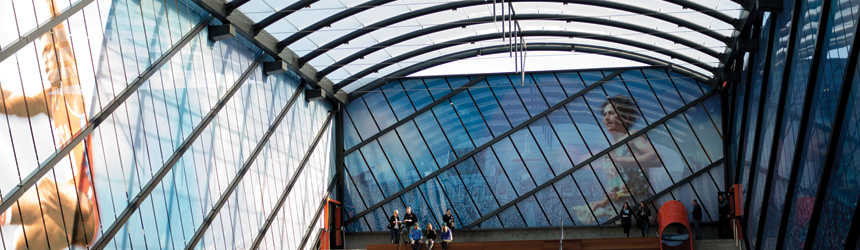
Transit stations also seek glass customization. One trend among transit shelter design is featuring community scenes. Moon Shadow Glass offers etched imagery into glass panels that comprise shelter walls. Etching includes transparent and opaque options. The decorative glass may be displayed at bus stations, dividers in waiting areas, rail stations, mural walls, and train stations.

As printed glass techniques improve, Frasier notices a shift in client demands. In the last several years he says designers and architects have requested two-sided, high-resolution, full-color images with the ability to be completely opaque or semi-transparent. “This allows different amounts of light through while still maintaining image quality,” he adds.

Nike Seeks Glass
In April 2016, Moon Shadow Glass was approached by repeat client Nike, which sought decorative glass for its interior garage at the Nike World Headquarters campus in Beaverton, OR. The corporation requested opaque glass graphics that allowed light into its 1,200 parking space and four-story interior garage.

OldCastle Glass in Battle Ground, WA supplied the glass for the Nike project. Tools included the EFI H1625 LED printer, Adobe Systems Incorporated Photoshop, and SA International’s FlexiSIGN RIP. “The EFI printer allowed us to print a two-sided image with semi-transparency in high resolution all in one pass,” explains Frasier.

After eight months of planning and four months of fabrication, Moon Shadow Glass printed 480 pieces of full-color laminated glass to create 8,000 square feet of wall murals. The graphics depict athletes and the Nike slogan and branding. Encore Glass in Salem, OR handled installation.

Despite the enormity of the project, the shop didn’t run into problems with the size of the graphics, but rather the shape. Frasier says the staff experienced challenges with the need for irregularly shaped cut glass, which was required to ensure the print was correctly aligned.

The project was completed on time despite being on a much larger scale than Moon Shadow Glass’ average jobs. “We received rave reviews from the local media, employees, and senior staff at Nike who commented how great and impressive the murals look,” shares Frasier.

Glass and Graphics
Glass signage is a practical and professional option for high-impact graphics. With the right technology, print providers directly print onto glass to offer double-sided, photo-realistic images.

Aug2017, Industrial Print Magazine
Industrial Operations

By Cassandra Balentine

As the benefits of digital print are realized, customer demand rises across all verticals. The industrial market integrates digital print technologies to suit needs for everything from decorating to building products and more.

This article profiles two very different uses of inkjet technology for industrial applications in manufacturing settings.

One company accelerates its product delivery by handling product decorating in house as part of its overall manufacturing workflow. Alternatively, the other company digitally prints materials for building products like siding and decking. Digital allows both to offer customers unique products.

Decorating with Digital
Located in Huntington Beach, CA, The Forge Design is a fabrication business within the promotional and advertising industry. Its goal is to bring ideas to life through expert craftsmanship using wood, metal, leather, plastic, and acrylic.

Established in 2005, the company recently moved into a bigger production facility measuring 3,800 square feet. This operation employs a staff of eight.

The Forge Design’s promotional products are generally highly customized pieces designed and manufactured in house using a variety of skills and equipment. Luciano Martinez, owner, The Forge Design, says each job is unique and the company isn’t interested in turning customers away.

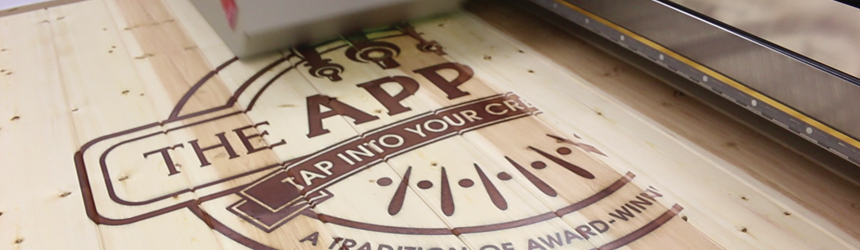
Decoration is a major aspect to the shop’s workflow. Approximately 70 to 80 percent of its work requires some type of decoration, and often inkjet is the right solution. It recently invested in a large format flatbed printer to manage more decorating work in house. Specifically, it purchased the Roland DGA Corporation VersaUV LEJ-640FT UV flatbed printer. The 64×98-inch print bed boasts print speeds of up to 133 square feet an hour.

Since its work is so diverse, this versatility is critical for The Forge Design. The press offers the company the ability to print on thousands of different items, including everything from chalkboards to bar caddies. This is in part due to the ability of the device’s printhead to rise up to handle media as thick as six inches.

Prior to the Roland VersaUV LEJ-640FT, the shop would need to stop manufacturing a product in order to ship it out for decoration by a third-party screen or pad printer. This added days to the turnaround time and made for more materials cost, as it would need to provide extra pieces to the third-party printer to accommodate for errors.

The company decided to bring in digital print capabilities when it took a job last Winter that required the manufacturing and printing of 100,000 multi-tool pieces for a customer.

With the use of inkjet, manufacturing workflow is more efficient. In fact, the printer paid for itself with the multi-tool job. Martinez says he designed the credit card sized multi-tool, created a prototype, got one stamped, and completed the tooling. Then the tools were decorated. “The job had so many parts, we didn’t want to outsource. Digital printing became a really attractive solution.”

The shop installed the Roland VersaUV LEJ-640FT and started production before the Roland technician was even out the door. “We learned as we went. We would get about 800 pieces by the time the printhead reached the end of the table,” shares Martinez. The press ran for an entire month, about a shift-and-a-half per day—12 to 13 hours.

“Decorating is important in the advertising industry,” stresses Martinez. Digital printing is now a major component of the company’s business. Sometimes the Roland printer is employed all day, while other times it is available for a quick sample. The ability to print in house allows the company to save more than 50 percent in turnaround time compared to its previous process of outsourcing, which is now completely eliminated.

Digitally Printed Siding
Founded in 2016 by Michel and Louis-André Gaudreau, Dizal is an entrepreneurial family business rooted in the building industry. With more than 40 years of experience manufacturing building products, the company employs a small staff of ten to 25 employees, located out of its 15,000 square foot facility in Quebec City, QC, Canada.

“Digital inkjet printing is absolutely new to the siding industry,” says Gaudreau. He explains that for years, it was looking for a way to replicate wood grain and achieve the feel of wood. “Inkjet printing allows us to offer a revolutionary product and come up with something never seen before.”

Digital print technology is often used for producing flooring rather than exterior applications, but Dizal saw the potential and decided to invest in a solution to do just that. It uses the technology on exterior siding products—like aluminum—with the help of an exclusive UV coating, Z-Clear, which offers protection against the elements.

Dizal is passionate about the benefits of digital print technology. “The company was founded on digital technology and is dedicated to exploiting it to a maximum,” shares Gaudreau. “It’s even in our company name, as the “Di” portion in Dizal stands for digital.”

A major draw is the endless possibilities it brings to the table. “The amazing thing about this process is that digital allows infinite textures and color possibilities, while offering unrivaled realism,” explains Gaudreau.

To achieve these effects, the company chose an Italian printer manufacturer to create an exclusive custom printer designed for Dizal. The technology is based on the same equipment used in the flooring industry. The machine runs on UV cured inks. “We needed great quality inks that would withstand the exterior use of the product and offer rich, vibrant colors,” he says.

For a typical job, the siding is created by first scanning natural wood planks to create a digital image. The planks are treated with linen oil to bring out all the grain’s richness. The wood is then virtually stained to meet market trends and expectations. Gaudreau explains that the actual scanning process of the wood is outsourced, but all alterations to the original scan are done in house by Dizal.

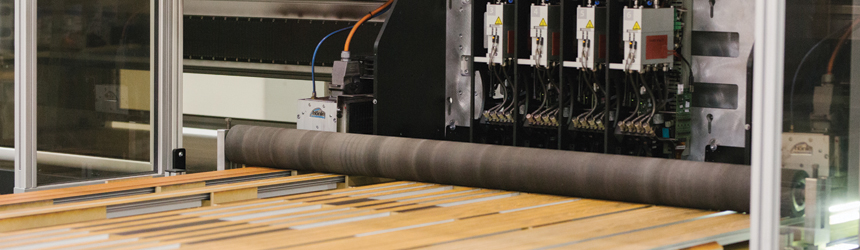
The aluminum is extruded, cut to the appropriate length, and then primed. Fastening slots are punched into the planks and then they are sent to print in the shop’s custom printer. To complete the job, Dizal’s Z-Clear coating is added to the product.

All siding products come in 16-foot long planks and are available in three heights—four, six, and eight inches. The size depends on which of the three available profiles the customer selects.

For Dizal, inkjet technology hasn’t changed the business—it defined it, exclaims Gaudreau. “We started with this technology and we can’t help but to feel proud when we see how it draws attention in trade shows and one-on-one client visits. All we see is amazement at the level of realism and quality.”

Making offerings that truly stand out is an ongoing challenge in every industry. “When people see our product, they immediately understand that they are in front of something different,” offers Gaudreau. However he admits that the benefits come with challenges. “This technology is still very new to the siding industry, so there is a lot of teaching, educating, and introducing,” he comments. “We are happy to do this as we are so proud to bring something new to the conversation.”

So, what’s next for Dizal? Gaudreau says the company is already working on introducing new siding, as well as other building products using inkjet technology. Dizal expects to launch up to three new products in the coming year including decking products.

Digital Workflow
By utilizing digital print technologies in these very different business models, each company offers unique, custom products at an industrial level. As inkjet continues to penetrate manufacturing environments, expectations rise and customer demands reflect emerging trends towards customization.

Aug2017, Industrial Print Magazine
Capturing 3D

Manufacturers use digital scanning devices to capture images…

Categories 3D