Print 17 Takes Over Chicago

By Industrial Print Staff

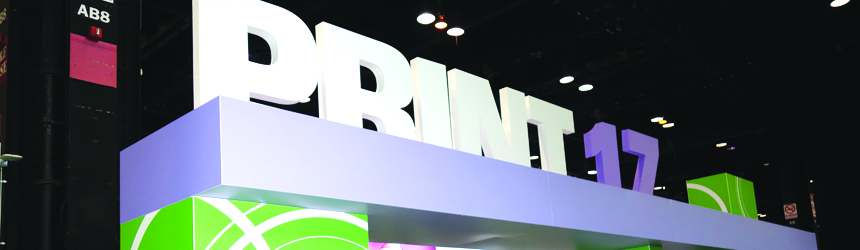
Chicago, IL’s McCormick Place was home to Print 17 from September 10 to 14, 2017. The event is a comprehensive exhibition for printing and imaging professionals. It featured live equipment demonstrations as well as educational sessions and panels.

Attendees to Print 17 were invited to design their own “Learning Experience” at the show. They could do so through sitting in on more than the 50 educational sessions that shed light on topics ranging from the design/creative process, packaging, marketing, growth strategies, and emerging technologies. All of which touched on digital print used in manufacturing in some way or another.

Exhibitor Focus
The main focus of the event was the 450-plus exhibitors showcasing the latest hardware, software, substrates, and services. Digital technologies dominated the show floor.

Canon unveiled its Océ VarioPrint 6000 TITAN Series of sheetfed monochrome production presses. It is planned for 2018 availability. The company also showcased its Océ Colorado 1640 UVgel 64-inch wide format device.

Fujifilm North America Corporation debuted the Inca Onset M B1 format press, developed for high-quality, short-run industrial printing markets. It also featured live demonstrations of the JPress 720S sheetfed inkjet press, which showcased how quickly variable data driven, short-run projects are staged and run.

HP Inc. announced enhancements to the HP Indigo 12000 Digital Press, which now includes new High Definition Laser Array technology, enabling the press to double image resolution up to 1,625 dpi, according to the company.

Komori highlighted its 29-inch inkjet sheetfed UV printing system, the Impremia IS29. The device runs a 23×29-inch sheet, ideal for six-up print production.

Konica Minolta demonstrated a variety of its commercial industrial technologies. It also showcased solutions from its strategic partner, MGI. Products displayed included the Konica Minolta bizhub PRESS C71cf label printer as well as the MGI JETvarnish 3D Web varnish and foil solution. It previewed ceramic printing technology and offered a virtual reality experience featuring the AccurioJet KM-1.

Memjet introduced its new DuraLink digital printing platform, which combines long-life printheads, pigment ink, and flexible modules to provide its OEM partners with a fast and easy way to develop solutions for high-volume commercial, packaging, and industrial printing markets.

Mimaki USA, Inc. exhibited the JFX200-2513 UV LED flatbed printer. It is a 4×8-foot landscape-oriented printer ideal for printing to glass and decorative panels. White and clear inks are available to run in the machine.

Oki Data Americas demonstrated the proColor C942dn printer, which lays down high-density white toner under color in a single pass. It prints to dark colored media in addition to color on white stocks.

Ricoh USA, Inc. highlighted both new and proven solutions for current and perspective customers. The recently formed Commercial & Industrial Printing Business Group took center stage. Several solutions were on the floor, including the Ricoh Pro C7100X five-color digital press, the flagship Ricoh Pro C9100, and the Rioch Pro 8200 high-speed, flexible B&W digital press. Displayed for the first time in the U.S. was the Ricoh Pro VC400 continuous feed inkjet platform.

Rollem promoted its Insignia flexo-magnetic die cutter. Two models are available—20×20 and 30×24 inches. Both feature die cutting, kiss cutting, and embossing.

Screen Americas highlighted recent developments of its TruePress Jet L350UV+LM, a new UV inkjet system designed to expand the ability to print labels for food packages.

Xanté introduced the UV4000 UV-curable flatbed printer, which features printheads that rise up 11 inches, enabling it to print on specialty media and rigid substrates.

Xerox featured the Xerox Trivor 2400 High Fusion Inkjet Press and the Xerox iGen 5 Press, which includes the newly introduced White Ink for its fifth printing station.

Zünd showcased the G3 M-2500 cutting/routing/finishing system. The solution offers a cutting area of 52×98 inches.

Graph Expo 2018
Next year, Graph Expo returns to Chicago, IL from September 30 to October 3, 2018 at McCormick Place.

Nov2017, Industrial Print Magazine

Industrial Minds in a Digital World

By Industrial Print Staff

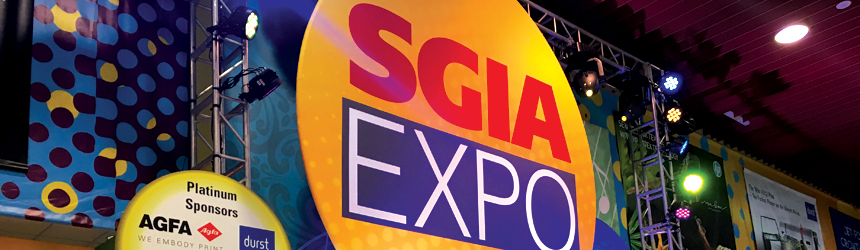
The Specialty Graphic Imaging Association’s (SGIA’s) annual expo took place in October at the Ernest N. Morial Convention Center in New Orleans, LA. Despite the small threat of Hurricane Nate, the show was a success with 19,166 attendees registered. 597 exhibitors showcased some of their newest products and solutions.

Industrial print, specifically digital processes used in manufacturing settings, was a common discussion across the show floor. Many vendors displayed products with the intention of them being used in the creation of anything from packaging, garments, and labels to high-end décor—wood grain finishes for flooring or ceramic tiles.

The Technology
Printers, coating devices, routers and cutters, ink sets, and software solutions were all on the expo floor. Here we provide highlights on some of the technologies with a focus towards industrial print.

Afinia Label shared its L801 Industrial Color Label Printer with attendees. Powered by Memjet, this device is designed for prime and secondary labeling applications. It prints on continuous or die cut stock from two to 8.5 inches in width.

Alliance Technology Corporation (ATC) demonstrated two new UV coating machines—the ATC-80RTR and ATC-UV36HA-L. The first is designed for precision mayer rod UV liquid coating, while the second is a sheet-fed UV liquid coating solution.

AnaJet exhibited its RICOH Ri 3000/Ri 6000 direct to garment (DTG) printers. The Ricoh Ri 6000 prints full-color 12×10-inch graphics on light garments in less than 27 seconds. Both printers utilize water-based inks that provide soft and vibrant output.

AXYZ International promoted its Trident 4010ATZ finishing device. The Trident 4000 Series handles materials up to 60 inches in width and lengths from 48 inches to 50 feet, based on the specific configuration. A CNC router, it is ideal for cut to print using multiple tools for all materials.

Brother International highlighted its GTX line of DTG printers, the company’s newest generation of devices. The print area is 16×21 inches and new ink, Innobella Textile, water-based pigment inks provide a larger color gamut then past iterations of ink.

Canon Solutions America showed a video at its booth depicting its High Flow Vacuum in action on an Océ Arizona 6100. It is designed to handle hold down of porous, warped substrates without using tape. The table features 250,000 air holes for maximum hold down.

Colex displayed the Sharpcut Flatbed Cutter System, which can cut through a variety of materials—from soft to rigid boards, vinyl, and fabric. Specifically, the device can kiss cut certain materials up to .5 inches thick and even one-inch thick acrylic can be finished.

DGI premiered its Fabrijet FT-1908SE with fluorescent ink. The printer is upgraded to include six or eight colors and is ideal for dye-sublimation (dye-sub) printing of textiles. At 74 inches it reaches maximum print speeds of 615 square feet per hour.

Digital Graphic Systems had the DGS V-Pro X5 industrial table cutter in its booth. It can be configured in 4×8- to 5×10-foot beds. The multi-tool digital table cutter processes folding boards, foamboard, corrugated board, PVC, styrene, honeycomb boards, vinyl, magnets, textiles, and paper.

For the first time in the U.S., Durst Image Technology US LLC showed its Delta WT 250 using Durst Water Technology. The printer is designed for corrugated packaging and display applications. Durst WT inks comply with the strictest health and safety regulations.

EFI premiered the EFI Pro 24f 4×8-foot dedicated flatbed. It prints in four colors plus white on materials up to two inches thick. A multi-zone vacuum system eliminates masking. The company also showcased the Reggiani Renoir Flexy with Dynaplast fabric adhesion designed for industrial apparel and décor textile applications.

Engineered Printing Solutions demonstrated the Roto-Jet UV LED printer designed specifically for printing onto cylindrical objects. The device prints and cures, so the object comes off the printer fully ready to use. White, primer, and varnish are all options for placement in the printhead channels, in addition to traditional CMYK.

Epson showcased its newest dye-sub printer, the SureColor F9370, which is designed for millions of garments and not short runs. It joins the existing SureColor family. The 64-inch device handles industrial-level production with speeds of up to 1,169 square feet per hour.

Fujifilm North America Corporation, Graphic Systems Division brought the new Inca SpyderX flatbed to the show, as well as the Onset M. The SpyderX is a combination flatbed and roll-to-roll UV inkjet press. A mid-range inkjet printer, it is available in a width of 126 inches. The Onset M is a B1 format printer designed to offer high-quality, short runs to the industrial print market.

Inkcups exhibited the Helix, a rotary inkjet printer for straight walled and tapered cylinders. The machine is servo-driven and offers resolutions of 1,200×1,200 dpi. Cylinder length ranges from three to 12 inches.

INX International discussed Triangle brand inks, Prodigy industrial and packaging inks, and the CP100 UV digital cylindrical printer with show attendees, who learned more about the JetINX Printhead Drive and Ink Recirculation system.

Kao Collins promoted its variety of solutions. It recently announced the formation of its Advanced Printing Solutions business, with the goal to create eco-friendly, technically superior solutions for industrial inkjet and traditional printing markets.

KBA highlighted inkjet direct to container decoration in its booth. Products of note include the company’s K15 CNC Direct to Shape Digital Printing Machine and the K1 CNC Screen and Digital Printing Machine, which is a hybrid featuring both printing methods.

Kornit provided live demonstrations of its Allegro printer, running for the first time using pink and yellow neon ink. The Allegro is a 70.8-inch wide direct to fabric textile printer that prints onto materials such as natural, man made, and synthetic fabrics.

The M&R Companies’ Novus Imaging showcased the Novus Textura 1800 dye-sub printer. It is designed for unattended roll-to-roll, high-speed transfer printing. At 70 inches wide, the printer is rated to print at speeds of up to 1,500 square feet per hour.
MCT promoted its newest enhancements on the VersaTech2 cutter. One of which is a horizontally mounted laser that achieves a 30 percent increase in speed for fabric cutting and sealing.

Marabu North America demonstrated the fJET UV LED flatbed printer, which prints on a range of substrates and premanufactured materials with Marabu’s UltraJet digital inks.

Massivit 3D discussed the benefits of adding a three-dimensional printer, such as its Massivit 1800 large format device, into an operation. The printer uses the company’s patented Gel Dispensing Printing technology.

Mimaki USA, Inc. announced its new CF22-1225 flatbed cutting plotter. The 4×8-foot device accommodates materials that come right off of a standard flatbed printer. Multiple cutting heads are available that a hold a variety of cutting, creasing, and drawing tools.

MultiCam unveiled the Celero digital finisher. It offers cutting speeds of up to 3,500 inches per minute as well as 12,000 inches per minute maximum traverse speed. Its cutting area measures 3×4 meters.

Mutoh America, Inc. performed a technology preview of the Performance Jet 2508UF 4×8-foot flatbed printer with four vacuum zones. The ValueJet 626UF tabletop UV LED flatbed printer was also on the floor. It allows for printing onto three-dimensional objects up to 5.9 inches thick.

Ricoh highlighted its new flatbed printer, which the company specifically designed for industrial décor. The RICOH Pro T7210 supports substrates up to 4.3 inches thick with a print size of 6.9×10.5 feet. The printer reaches maximum speeds of up to 538.2 square feet per hour.

Roland DGA Corporation’s VersaUV LEJ-640FT was on the floor. It allows users to print directly to rigid materials up to six inches thick and weighing up to 220 pounds. Some materials include foamcore, plastic, wood, glass, metal, USB drives, and smartphone cases.

Rollem showed the Insignia6 sheet-fed flexo-magnetic die cutter. The machine offers production-level die cutting on pressure sensitive, plastics, PVC, Tyvek, and card stocks.

SA International provided attendees with information on its DisplayGenie software, in addition to other products. DisplayGenie assists those looking to design custom corrugated boxes and packages. The solution is equipped with three-dimensional design templates to simplify construction.

Sensient Imaging Technologies shared information on its water-based SensiJet SX inks developed for printing on non- and semi-porous substrates.

swissQprint exhibited the new Nyala LED printer complemented by Rob, the loading/unloading robot. The Nyala LED delivers a maximum output of 2,217 square feet per hour.

Xanté demonstrated the new UV4000 UV flatbed. It allows for printing onto coroplast, clear acrylic, foamboard, wood, steel, and more at 720×1,200 dpi. It also can output onto irregular shaped three-dimensional objects with the ability to accept media up to 11 inches tall.

Zünd displayed its D3 L-3200 cutter with double routing capabilities, as well as another cutter with Laser Module – LM 100W cut and seal for finishing textiles.

Changes Up Ahead
Next year, the SGIA Expo takes place in Las Vegas, NV. It is the last event under the SGIA name, as the 2019 trade show premieres in Dallas, TX as Print United.

Nov2017, Industrial Print Magazine

Inventive and Industrial

By Cassandra Balentine

Manufacturers look to digital print equipment as speed and quality rise and cost comes down. These devices offer the ability to cost-effectively produce shorter runs than traditional equipment, as well as the variability needed to attract new market segments.

Established in 1985, Schattdecor is a surface specialist headquartered in Thansau, Germany. It also has locations in Brazil, China, Italy, Poland, Russia, Switzerland, Turkey, and the U.S., operating a total of 14 production sites worldwide and employing a staff of 2,200.

The company provides customers in woodworking and furniture industries printed, impregnated, and finished surfaces created as wood, stone, solid colors, and custom designs. Its printed surfaces division is an important aspect of the company, as it forms the basis for many of its other products. The printed surfaces are produced using either a rotogravure or digital printing process and then further processed into impregnated or finished surfaces.

Schattdecor’s products and services are driven by current market demands as well as tailored décor production. While of a majority of its work is printed using rotogravure devices, digital print was integrated in 2011 and brought to industrial levels in 2016. As a whole, the company produces approximately 2.3 billion square meters of paper globally.

Digital Inroads
Schattdecor has long understood the potential of digital print, and integrates the technology throughout its operation in several ways, including sample and color matching; a digital line of décor paper, Digital Visions; and most recently, industrial-grade digital print capabilities that can be easily transferred to a rotogravure process.

For sample and color matching needs, the company utilizes digital print within its Digital Printing Labs, which operate within several of its product facilities. Here, samples are created for customers as well as color matching. This provides the opportunity to react quickly to sample requests, utilizing the same inks and décor paper used when the customer decides to place an order printed using rotogravure.

The company further integrates digital print technologies through its Digital Visions line of digitally printed décor paper, which launched in 2011. These are created with the company’s multi-pass digital printers. This product line offers interior designers, architects, and booth constructors the ability to creatively design individual surfaces. Schattdecor supplies Digital Visions to wood products processors, where they are laminated to a substrate.

Customers can use their own designs for Digital Visions décor as well, simply by providing a high-resolution image. The team also works with clients looking to develop an idea into décor.

Digital Visions’ décors are produced with water-soluble printing inks on white 95 g/m² paper. In special cases it can be produced at 70 g/m² following testing. The inks meet lightfastness standard six. Minimum orders start at batch sizes of one and can be produced at any size.

With Digital Visions décor, a variety of creative examples are currently in use by furniture manufacturers and designers. For example, wood processing customer, Cleaf S.p.A., utilizes patterns within this line for exclusive kitchen décor. A tabletop manufacturer, Isotop, works with the collection to produce unique and funky tabletops. Furniture manufacturer, Tvilum, processes Digital Visions patterns as a laminate foil to create playful elements that enhance the look of monochrome surfaces for children’s décor.

Margie Edwards, marketing manager, Schattdecor, points out that while its Digital Visions line provides certain benefits, its capabilities are limited because it can only be produced on a small scale, at a slower rate, and at a higher cost when compared with its traditional printing processes.

Industrial Grade Digital Print
Schattdecor’s digital efforts expanded with the introduction of industrial digital printing in 2016. The goal in investing in a larger scale digital printer was to reach new customer groups—contractors, architects, and interior designers—as well as traditional customers in the wood-based panel industry.

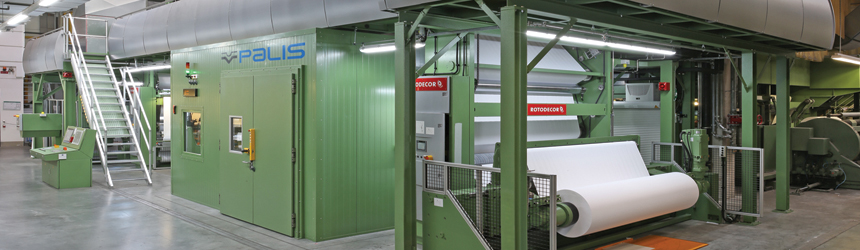
Edwards says the company obtained its first industrial digital printer, the Palis 2250, in 2016. Several reasons led the company to invest in industrial digital printing equipment, including increased customer demand for smaller orders, high inventory costs—for both customer stock and cylinders; long changeover times; and makeready waste. “Digital printing allows for quick responses to changing market trends and individuality,” explains Edwards.

Schattdecor sees its industrial digital capabilities as a complement to its rotogravure printing, creating even more décor design opportunities for larger quantities.

The Palis 2250 is a single-pass press that produces up to 162 meters per minute—1,744 square feet per minute; with a printing width of 2.25 meters—seven feet wide. It also offers more than 80 water-based printheads that jet 25.5 billion color droplets per second at 1,200 dpi resolution. It processes up to six gigabytes of data per second. One Palis 2250 is installed at the company’s headquarters in Germany.

Because the goal is to easily move digital jobs over to rotogravure presses, consistency in ink and ink laydown is critical. The inks are the same product the company has used from the very beginning. They are produced from natural materials of water, casein, and organic pigments.

The pigments are identical to those used in rotogravure printing. “Both procedures create identical optical décor images,” says Roland Heeger, CTO, Schattdecor. “The differences are only recognized with technical devices and are not visible to the naked eye.”

Heeger adds that the machine works with four colors—red, yellow, blue, and black. The printer is configured so that a fifth color can be added if needed.

The paper is also the same used in the rotogravure presses, but features a primer to prevent natural bleeding from occurring. “In both printing styles the same colors and base paper are used. Therefore, customers in the wood-based panel industry can process digital printing products using their standard methods,” says Heeger. Additionally, pre-impregnated products can be digitally printed and followed up with common lacquering procedures.

The company finds that digital printing doesn’t limit a design to the circumference of a cylinder, meaning there is no restriction for repeat length. This leads to new opportunities especially in the wood and stone industry. Digital also eliminates challenges with color variations and mixing patterns. “Now we have the chance and the challenge to develop digital printing designs that are easy to use,” shares Claudia Kuechen, head of marketing/design and corporate communications, Schattdecor.

Digital also offers the ability to produce ultra large planks, oversized décor repeats, utilize a mixture of different materials, and create photo-realistic layouts.

When it comes to its industrial digital capabilities, the limitation is creating special effect colors such as white, gold, or pearl. These are currently unachievable due to pigment size and need to be created with the rotogravure process.

Digital Trends
With a variety of printing styles to choose from, Schattdecor is in a position to determine what products are best suited for multi-pass digital, industrial digital, or rotogravure.

“The technology of industrial digital printing is rather new and therefore we are simultaneously working on many projects for our customers to demonstrate the capabilities as well as the seamless integration in all existing post-processing technologies,” says Heeger.

He suggests the average order size for digital prints has to be looked at from both a technological and application aspect. “We print depending on order sizes on both multi-pass printers, where a typical order size is around 1,000 square feet, and the Palis 2250, where the orders are around 30,000 square feet. The larger quantities are dominated by wood grain or stone images. The multi-pass prints in smaller quantities are mainly Digital Visions décors with individualizations,” he explains.

Investment in Innovation
Schattdecor presents an example of the possibilities digital print offers manufacturers across a variety of industries. As a provider of décor papers, the company provides fast samples, varied colors and patterns, custom designs, and moves from smaller digital runs to industrial volumes without skipping a beat.

“We are ready to expand our digital print offering at our locations around the world together with the increasing demand of our customers for new décor features,” notes Heeger. With its investment in an industrial digital printer, Schattdecor has an edge over competition and innovates without limitation.

Aug2017, Industrial Print Magazine

Think Ink

By Olivia Cahoon

Printed textiles are increasingly popular in apparel, home décor, and signage. As digital print technology advances to keep up with demand, so do industrial ink solutions. Industrial inks must withstand production environments and produce consistent color. Inks are offered as acid, disperse, pigment, and reactive. Here, we compare industrial ink manufacturers that create consumables for textile printing.

Heavy-duty Inks
Industrial ink manufacturers provide inks for different types of print solutions. Transfer printing and direct-to-textile printing offer a range of sizes from 29 to 126 inches wide to handle apparel, décor, displays, and signs.

Industrial ink types include transfer and direct dye-sublimation (dye-sub), reactive dye, acid dye, and textile pigment. While dye-sub ink is mainly used for polyester fabrics with heat transfer, pigment inks work with pre-coated fabrics and heat set. Acid dye is generally for nylon, poly blends, silk, and wool. Reactive dye works with cotton, poly blends, and silk. Both acid dye and reactive dye require steam set, wash, and dry handling.

Tommy Martin, product manager, textile and apparel business development and marketing, Mimaki USA, Inc., says printers compatible with industrial inks are purpose-built to improve the production and quality of textile printing. “If there is a disadvantage, it could be that these models are not built for any other purpose, such as solvent banner printing,” he adds.

In textiles, several key drivers lead to strong growth forecasts. “The design and color flexibility of digital textile printing enables more customization and personalization as well as economic short runs and shorter delivery times with no need to hold large stocks,” shares Tony Cox, business manager, Sun Chemical Corporation.

Pedro J. Martinez, CEO, Afford Inks, believes that in industrial applications, the ink system must be stable enough to run trouble free in 24/7 environments. “This means that ink design stresses much more about consistency,” he continues.

“Textile industrial inks are made to be used in printing machines 24 hours a day, that means thousands of printed meters every day. So the ability to run reliably for a long time is essential,” explains Antonio Tricomi, business development director, EFI Reggiani.

While industrial print encompasses printing manufactured goods, Hamid Shirazi, Ph.D., global technical promotions manager, Fujifilm Imaging Colorants (FFIC), finds digital inks also used by customers pushing industrial ink applications into areas for pure communication purposes—at a much lower frequency relative to industrial applications.

According to Cox, the key areas where digitally printed textiles are popular include apparel and fashion, home furnishings, sportswear, direct to garment, and soft signage such as flags and banners.

Afford Inks
For some industrial ink manufacturers, color is the most important quality for signage applications. “In my opinion, color is the king,” says Martinez. He believes the ink system used for industrial applications must be stable enough to run trouble free 24/7. This includes resistance to chemicals and UV.

Afford Inks’ primary goal is to develop an industrial ink that produces a consistent product and is capable of continuous operation with minimum printer maintenance. This is especially true for constant working scenarios.

According to Martinez, industrial inks should provide the best equilibrium of mechanical and chemical properties. “Being a small company, we can customize inks for specific applications.”

Afford Inks is currently developing new pigment water-based inkjet inks for textile applications. According to Martinez, the benefit of water-based pigment ink is that it provides adhesion on almost any textile. However, he says the inks don’t yet offer the best chemical resistance or the strongest color when compared to reactive or sublimation inks.

EFI
EFI Reggiani Aqua Premium is a water-based reactive ink compatible with Kyocera printheads. It can be used on most varied substrates of plant and animal origin—cotton, silk, viscose, and wool. According to Tricomi, the ink set’s wider color gamut allows for great results on any substrate.

EFI offers an individual service for customers using Reggiani Aqua Premium ink. It supports the customer with special testing and printing samples—something most users would not be able to handle on their own. The service is used throughout preparation, finishing, and file resolution-—before and after the sale.

FFIC
FFIC invents, makes, and sells aqueous colorants and inks for digital applications. The manufacturer hosts research and development (R&D) centers in Japan and the U.S. “At FFIC, our product differentiations stem from unique innovation and commercialization strategy,” says Shirazi.

He believes both R&D facilities are equipped and capable of producing innovative technology that defines the next generation of aqueous digital products for textile printing.

FFIC communicates across commercial and R&D boundaries to define short- and long-term development targets to create products. “Be it a neutral shade deep black for fashion and apparel in our digital reactive inks or a high-performance pigment solution for home textile in our digital pigment inks with dry printhead fixation,” says Shirazi.

FFIC industrial inks are available for Fujifilm printheads, Samba and StarFire. They are mainly used in apparel, fashion, and home textile applications. Shirazi says FFIC’s customers are particularly pleased with the Pro-Jet TX130/TX120 black for its deep neutral black. It maintains its shade neutrality over a range of print densities. The set is available in eight colors and was launched at ITMA Milan 2015.

The Pro-Jet TX431/TX421 is a six-color pigment ink set with an extended gamut. It is used with and without pretreatment in the textile market. Shirazi says it’s primarily found in home textile applications but also for adjacent applications for fashion and apparel like printing on natural leather.
According to Shirazi, FFIC differentiates itself from competition by offering high-quality, lot-to-lot reproducibility, and reliability.

Mimaki
Industrial ink manufacturers offer inks to embellish any size and type of textile for markets including soft signage, interior décor, active wear, and fashion apparel.

Direct-to-textile disperse dyes are used with industrial textiles and heavy laundered textiles. Mimaki offers Dd400 disperse dye ink with eight colors, released in June 2017. The ink supports nylon, acrylic, acetate, triacetate, and polyester. Martin says other fabrics are tested to guarantee performance and to determine the post-curing process.

“Dd400 inks are one of the newest direct-to-textile inks available for Mimaki textile solutions with the largest available color selection,” explains Martin. He says the inks produce rich color, a wide gamut, and a high fastness performance.

Direct-to-textile reactive dyes should be used with fabrics that are cellulose-based materials like cotton, hemp, flax, linen, some silks, and bamboo. In April 2017 Mimaki introduced Rc400 reactive dyes. These have less metamerism, improved fastness and color gamut, and better density.

On untreated fabrics, textile pigment inks work best with cotton and natural cellulose-based materials. Martin believes pretreated fabrics work with most types and blends due to the nano binder that improves ink performance.

In April 2017, Mimaki launched the Tp400 textile pigment inks with an expanded color selection, better colorfastness, and fabric diversification capabilities. “Tp400 ink’s overall high performance and less post processing make this ink solution a necessity for most applications,” says Martin.

Roland DGA Corporation
Roland features the Texart SBL3 inks for textiles and sublimated apparel. The inks are formulated to print with Roland’s Texart RT-640 and XT-640 and feature high dye content. “A little bit goes a long way,” admits Lily Hunter, product manager, textiles and consumables, Roland.

Hunter believes Texart SBL3 inks are ideal for a range of sublimated apparel and textiles. “Another advantage is the wide color gamut—they’re offered in CMYK, Lc, Lm, Or, Vi, and new fluorescent.”

Fluorescent inks are available in pink and yellow to broaden gamut results and create hundreds of fluorescent hues while the rich Black Texart SBL3 ink helps improve gray scale and gradations. Light Cyan and Light Magenta are used for subtle flesh tones and Orange and Violet offer vibrant colors.

Roland Texart SBL3 inks were released in July 2015 and the fluorescent inks were released in June 2016. The inks are $99 per liter for standard colors and $119 per liter for fluorescent colors. In addition to high dye content, Hunter says the inks also dry fast and the high dye concentration reduces ink use while retaining vibrancy.

Sensient Imaging Technologies
Sensient provides a vast array or products including water-based sublimation and pigmented inks; water-based acid, reactive, and disperse dyes; water-based industrial inks for nonporous and semi-porous substrates; and water-based edible inks.

According to Adam Stack, product marketing manager, Sensient, the primary benefit the company delivers is proficiency across many digital inkjet printing markets. “With an expertise in water-based, eco-friendly solutions, we bring the ability to work with our partners to develop a solution for virtually any printing need. And it’s our expert technical support that helps bring these solutions to fruition.”

Sun Chemical
Sun Chemical, a supplier of pigments and colorants, offers SunTex inkjet textile inks for improved ink consumption. They were released in March 2016. Cox says they are specifically formulated to enable reliable, high-speed jetting on longer print runs and deliver improved ink consumption compared to leading competitors.

SunTex Sonata DTE is a transfer dye-sub ink series for Epson DX 4/5 printheads. It is compatible with polyester sport garments with a minimum 80 percent polyester. Other applications include pretreated rigid materials, promotional advertising, and interior décor. Sonata DTE includes CMYK and fluorescent pink and yellow.

SunTex Sonata DDE is a dye-sub ink for direct print to polyester fabrics like flags and banners. For double-sided flags, strong colors and high print through must deliver color reproduction on the fabric’s reverse side. Cox says SunTex Sonata DDE offers excellent wash and bleed fastness, which are critical features for outdoor printed fabric applications.

The ink manufacturer also offers a pigmented ink formulated to deliver improved color vibrancy and maintain wash and wet-rub resistance. “Sun Chemical’s SunTex Encore PDE pigmented ink is the result of many years of R&D,” explains Cox. SunTex Encore PDE prints directly onto natural and synthetic textile fabrics like cotton, viscose, silk, and polycotton. Polycotton is often used for interior decoration and home furnishings.

According to Cox, Sun Chemical understands the complex relationship between pigments, resins, and additives. The manufacturer conducts extensive jetting tests on Sun Chemical inks to ensure maximum print performance with the latest printheads and printing equipment.

Textile Printing
Industrial inks provide a consistent solution for continuous operation in 24/7 work environments. Options include direct dye-sub, disperse dye, reactive dye, and textile pigment. Inks should be chosen based on application for the best possible results. A great selection of industrial ink solutions are currently available.

Aug2017, Industrial Print Magazine