Diving into Digital

By Olivia Cahoon

As digital print advances, brand owners consider the technology for manufacturing. Large corporations and designers approach fabric manufacturers to turn their designs into custom printed products for short run specialty substrates.
In the textile printing market, custom fabrics are increasingly popular.

Designers and large brands see the opportunity to evolve their business models with digital print as they produce customized applications at a reasonable turnaround and price point.

Industrial Custom Printing
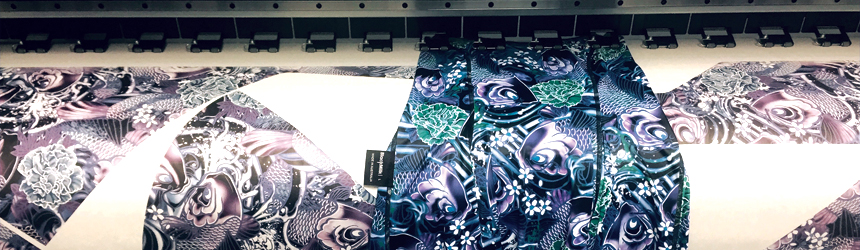
In 2014, FabFad began as a digital industrial fabric manufacturer in Los Angeles, CA. The custom fabric manufacturer offers several services including digital sublimation printing, direct to fabric, fabric cutting, sewing, and textile supply. With their digital sublimation printing, FabFad offers customized polyester, nylon, and blend fabrics with any artwork or photo that is provided.

The company’s direct to fabric capabilities deliver customized printing with cotton, rayon, and silk fabric. Its textile supply has more than 100 different fabrics in stock, ranging from quality domestic to imported.

The process begins with customers uploading their designs. FadFab then prints the designs at a rate where designers can use it to produce products and make money.

In 2011, Sean Saberi, founder/CEO, FabFad, bought the company’s first piece of digital printing equipment from DigiFab, solution distributor of Mimaki printers. FabFad runs four Mimaki JV33 series printers and one JV300 printer. The Mimaki JV300 is a high-speed, wide format inkjet printer available in 54- and 64-inch widths. Featuring quick-dry SS21 inks, it offers nine colors and eight ink channels. The JV33 series has a compact design and a maximum width of 103.6 inches and a resolution of 1,440 dpi.

The company prides itself in its ability to handle a range of fabrics and customizable designs. “This could be the future, you have no limits, you can basically build anything at any minute,” says Saberi.

FabFad works with DigiFab to upgrade and add printers as production rates increase.

When Saberi first began digital printing, it wasn’t always a smooth process. He says the technology was limited and it was expensive, explaining that it cost $35 per yard to digitally print fabric while regular production rates were $5 a yard. 500 yards of digital printing wasn’t possible for most customers who needed large quantities of fabric.

By 2014 FabFad was in full swing with four Mimaki printers. But the company still had difficulty with managing its designs in terms of workflow and color management. For workflow, they used CDs to send files and often ran into issues. Saberi says there was also a huge void in the industry regarding the understanding of color.

To help address these challenges, the company soon developed its own internal software suited to its specific needs. Saberi says the software handled half a million yards of digital print last year.

“There are no limits to color, design, or anything,” says Saberi. The company’s pricing is now as low as $2.50 a yard which includes transfer. “With that kind of a pricing, we now offer the same prices as traditional manufacturers, but we have no limits. Our motto is any print, any fabric.”

FabFad has a seven-day turnaround for 1,000 yards of fabric.

The company serves large brand names including Fruit of the Loom, Harley Davidson, NBC, Petco, Sabra, Under Armour, and Yamaha. They offer digital printing overseas and handle 2,000 to 3,000 digital customers a week.

Months after opening, the company had seen nearly 3,000 jobs. “We are on our way to possibly tripling that by 2017 because of the demand, and we haven’t done any advertising yet,” says Saberi.

FabFad anticipates customer growth as they begin investing in marketing campaigns for 2017.

Sew Much Fabric
FadFab offers hundreds of fabrics for customers to choose from. “Fabric is an important part of the process, it’s more important than the printing—it’s what’s going to touch the skin,” explains Saberi.

Since the company began, they have created a network of fabric suppliers, knitters, and importers to offer diverse fabric options. FabFad doesn’t purchase any of its fabric from fabric stores. Instead, the company has direct lines to knitter houses either directly or indirectly to maintain the same fabric quality.

Since beginning in 2014, the shop has run millions of yards of fabric, predominantly activewear made from poly spandex.

They have more than 200 different types of fabric including fabric for home furnishing accessories, apparel, banners, and advertising. “As long as you have a fabric, we can print it. No vinyl customers provide their own fabric,” says Saberi.

FabFad has domestic and international partnerships. Two of its knit houses are based in Los Angeles and one is on the east coast. They also work with mills in Brazil, China, Vietnam, and two in Korea.

Its fabric is knitted and printed in Los Angeles and then shipped to El Salvador where it is cut and sewn.

Designer Demands
Digital textile printing is a steady market that keeps FabFad busy. With recent advancements in media and print technology, the equipment to handle these textiles are improving. Saberi notices digital printers evolving to better serve industrial needs through faster speeds and lower costs. Ink and paper costs are getting lower. “Paper has dropped 35 percent while ink has gone down 15 percent. It looks like the technology is becoming more reliable and industrial,” he offers.

Customer demands are forcing this change. Consumers want faster and lower priced custom engineered printing. “They want a pair of leggings with a certain placement on the legging. With our software and equipment, we can do that,” says Saberi.

The company uses a 3D model system to digitalize patterns on its website. With it, customers are able to see their prints in 3D. Using a drag and drop feature, pictures and images are dropped onto the fabric for manufacturing. Saberi says it turns the customer’s vision into an actual product.

The 3D design model 4.0 will be released by FabFad in March. Currently they use the 3.0 version which allows customers to pick from a large selection of united fabric collections from the U.S. and Germany. The software has an advanced search tool to find fabric and prints from over thousands of options. “Customers basically think about the fabric they want to have, whether it’s based on weight, cotton, or country, and the website will search the database and give them that exact fabric,” says Saberi.

Making a Splash
Designers are looking for custom prints to create unique products. FabFad caters to several designers, ranging from big brands like Under Armour, to smaller companies with specific needs.

Linden Wolbert, owner, Mermaids in Motion, is a PADI master scuba diver, free-diver, professional mermaid, and the designer of the Mermaid Linden designs. In 2005, Wolbert quit her “real job” and became known as Mermaid Linden. “This is when I designed and created my first silicone prosthetic mermaid tail and began ‘merforming’ around the world for kids and adults,” says Wolbert.

She travels the world for different types of performances that she calls “merformances,” like ocean shoots, commercials, and aquarium swims. She also films YouTube videos.

“I love the unpredictable nature of my work. One day, I could be granting a wish for a child, the next diving 50 feet below the ocean with sharks, and the next day be on a Hollywood film set,” she exclaims.

Wolbert has traveled worldwide, generating news coverage in more than 50 countries and 15 languages around the globe. She says Mermaids in Motion is mainly comprised of her, plus some occasional contractors, assistants, and mermaid wranglers. Through her company, Wolbert educates children about ocean conservation through live performance and school presentations.

In 2013 Wolbert collaborated with Body Glove International, a provider of water sports apparel and accessories, to co-create a line of mermaid inspired children’s swim products including monofins, mermaid tails, float suits, towels, goggles, rash guards, bikinis, and bathing suits.

In November 2016, the company introduced Mix and Match Mermaid Tails that work in tandem with children’s monofins to turn a child into a mermaid or merman. “They are made to mix and match like a swatch watch. The monofins and lycra tail skins can be interchanged to make countless fun looks and color combinations,” says Wolbert. Lycra is an elastic polyurethane fabric for swimsuits and sports clothing.

During the development of the monofins and tail skins, the company made the decision to go the digital print route. Wolbert explains that there are many advantages with the digital printing process like the speed of order processing, photographic quality, and fade resistance of the sublimation process, and bright colors. “This is especially important when, like us, your product will be used in chlorinated pools, salt water, and all manners of sunshine. We also love that this method features a zero-waste printing process,” she explains.

Mermaids in Motion was referred to FabFad. Wolbert was immediately impressed with the print provider’s capabilities as a one-stop shop, offering expertise in the design process as well as production capabilities including printing, cutting, sewing, and packaging.

At the start of their relationship, Wolbert approached FabFad with a patent-pending mermaid tail design, which she says they aided in digitalizing and perfecting with sample and sizing runs during product testing. “They produce large quantity, high-quality products with big name clients and offer wonderful customer services,” she adds.

Using the FabFad website, a digital file of the design is uploaded and FabFad’s design team members review the file, edit it within the design template, and produce a sample. Once the clients approve the sample, it is printed, cut, and sewn. Before the product is sent to stores, the designer is sent a sample of the product in each size, which is visually inspected, tested, and approved. After approval it is sent to manufacturing and then shipped to retailers.
Wolbert says she is really pleased with FabFad’s work and the decision to go digital. “For expediency and quality-control purposes, it is tremendous. For building a good relationship with our manufacturer, it is amazing. For boosting the local economy and supporting local business, it is wonderful. Everybody wins,” she says.

Wolbert explains that the nature of digital printing helps keep costs down so that the company produces large and small quantities of mermaid tails domestically at a competitive price and speed compared with overseas manufacturers. For Wolbert, this was her first experience with digital printing. So far, she hasn’t come across any challenges and says it has been a fun and easy procedure. “Being able to sign online and immediately see what steps our printing orders have gone through in our account is perfect. It seems that the sky is truly the limit with what we are able to dream up, materialize, and produce with this method of printing,” she boasts.

Big Waves
Boutique designers like Mermaid Linden utilize digital industrial fabric manufacturers for custom printed designs, as well as manufacturing and packaging needs.

FabFad is an example of one company that takes advantage of the opportunity digital print technology brings to the apparel market. With it, the company produces thousands of yards of custom-printed fabric at reasonably low prices to suit emerging needs from designers.

As customer demands become increasingly specific in regards to both design and cost, the ability to offer custom printing capabilities at industrial levels is certainly making waves in the industry.

Jan2017, Industrial Print Magazine
Molding to Form

By Melissa Donovan

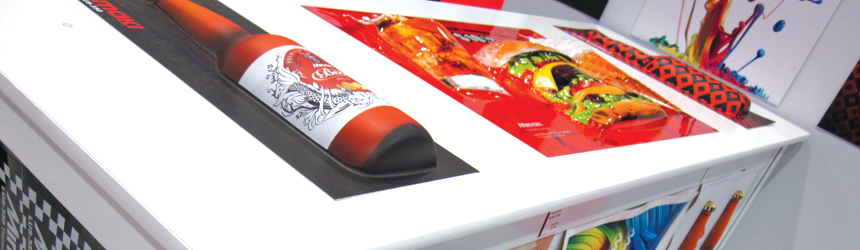
UV ink formulations continue to evolve. Many vendors offer products that not only work with traditional wide format flatbed devices for graphics printing, but also thermoforming applications. The process of thermoforming involves a plastic sheet placed in a thermoforming device—a vacuum forming heat machine—that stretches and molds to a desired shape when heated.

Thermoforming is used to create signage, but it is gaining popularity in industrial markets like building and construction, automotive and transportation, and medical. Part of this evolution involves some of the newest UV ink sets, which can be used for both traditional and specialty applications. Essentially, these inks are now flexible or stretchy enough to be placed in a thermoforming device after being digitally printed to the plastic sheet. With this advancment, cracking or distortion is minimized—if not eliminated—ensuring a quality finished product.

New Opportunities
The signage industry is no stranger to thermoforming techniques. According to research conducted by analyst firm I.T. Strategies and published in its 2013 report Research on Emerging Print Markets: Thermoform Signage Markets, a sign is sometimes screenprinted before thermoforming, but is usually painted or vinyl graphics are applied after the process is completed.

While screenprinting inks used in this capacity have been available for quite some time, the ability to eliminate distortion and the high costs associated with this trial-and-error process prohibit many from decorating prior to thermoforming. Decorating after thermoforming also presents its challenges, for example exact replicas of a product are difficult to achieve.

Digital changes this. “If thermoform manufacturers digitally print a sheet with the distortion precisely measured, then vacuum form the sheet, they eliminate the time consuming second step of painting or the application of vinyl graphics. Digital printing also allows for more customization and photographic images, which is not possible with painting,” says the I.T. Strategies report.

Ken Hanulec, VP, inkjet, EFI, provides an example of how inkjet-printed thermoforming saves time. “Using a conventional thermoforming process, it might take seven and a half hours of labor to produce two 13.5×4-foot vacuum-formed signs. Using digitally printed thermoforming technology, 34 of the same signs can be produced in the same seven and a half hours,” he explains. This is a reduction of 93 percent in labor costs and a productivity increase of 95 percent. With conventional processes, the same 34 signs would take three and a half weeks to produce, according to Hanulec.

Approximately four years ago, sign makers began testing the ability of UV printers with thermoforming plastics, states Jay Roberts, product manager, UV printers, Roland DGA Corporation. “That’s when it was discovered that these inkjets were capable of printing full-color, high-fidelity images onto plastic to create beautifully formed objects used in signage, advertising, and directional signage,” he continues.

UV ink for digital inkjet technologies offer “improved adhesion, better abrasion and chemical resistance, and superior consistency and reliability. UV curing also conveniently eliminates the need for solvent evaporation or any special layers upon printing substrates and it does not involve volatile organic compound emissions,” explains Mario Villanueva, applications project manager, Agfa Graphics.

“The availability of inkjet inks suitable for thermoforming allows for the development of short runs offering high quality at affordable prices. These days, it is becoming popular, especially in the Americas, for point of purchase (POP) applications and vending machines, where new effects are achieved,” says Pedro Martinez, CEO, Afford Inks.

According to Josh Hope, senior manager, industrial printing, Mimaki USA, Inc., digital UV ink influences thermoforming by giving users the flexibility to produce short run and one-off custom designs while maintaining profitability. “This opens up a new niche for advertising that can be versioned and personalized to any market or region. It also enables low-cost prototyping that shows both design and form.”

These characteristics help other industries realize the opportunity. The potential to create digitally printed thermoform pieces in industrial markets is large and could be even bigger than signs and displays, according to I.T. Strategies, especially in regards to parts related to decorative functions, including in applications like vehicle dashboards or overhead automobile storage.

“The concept of beginning with a sheet of plastic and ending with a thermoformed, three-dimensional printed product is remarkable. As a result, this dynamic partnership between thermoforming and UV inkjet has begun to thrive, and will likely continue trending in a positive direction moving forward. It is also important to acknowledge that thermoforming is not limited to automotive, construction, and decorative retail applications, but it also serves a functional purpose within the food and medical industries as well,” shares Stephen Buchanan, research and development chemist – energy curable inkjet, Kao Collins Inc.

Multi-Purpose Ink Demand
Digital UV ink created for acceptable use in thermoforming applications more often than not can also be utilized for more conventional signage. Many print service providers (PSPs) look for consumables with multi-application usage.

“The demand for a multi-purpose UV ink comes from the emergence of diversified applications that customers are discovering are achievable with UV inkjet printing. Print shops need to be able to exploit different characteristics of their UV inks to produce traditional and non-traditional applications alike,” suggests Villanueva.

Buchanan agrees, citing efficiency as the driving force. “It makes a lot of sense for print providers to prefer multi-purpose UV inks to satisfy their unique customer printing demands when possible.”

Packaging and sign manufacturers are one of the largest groups demanding a multi-purpose ink, based on Roberts’ experience with Roland customers. “However, we are also seeing significant demand from advertising and marketing agencies exploring new avenues for POP and unique signage. Marketing agencies love to employ different methods and unique advertising looks, so having thermoforming capabilities can be useful for these firms.”

For shops hesitant to invest in a dual-action ink set, “a multi-purpose UV ink offers print providers the undisputed convenience of confidently taking on both conventional and specialty jobs without changing out the ink. In terms of actual production, the switch over between the two kinds of jobs is seamless and can be done on one printer,” says Villanueva.
“Frequent ink changeovers can be a time consuming process, and within printing, extended periods of downtime cut into profits. Providing multi-purpose ink solutions effectively minimizes downtime through negating the time needed to complete unnecessary ink changeovers,” shares Buchanan.

According to Martinez, “the major benefit comes from the versatility of offering a unique process that renders higher profits. The ink is also ideal for those applications necessitating folding, such as POP and rigid board-based furniture.”

Price shouldn’t be a deterrent. The cost of a UV ink designed for both thermoforming and traditional applications versus one just recommended for conventional graphics projects doesn’t differ greatly, if at all. For example, Mimaki’s thermoforming ink is the same price as its traditional UV ink.

Heather Roden, product marketing manager, Fujifilm North America Corporation, Graphic Systems Division, points out that the price point for Fujifilm’s thermoforming ink is also the same as its general purpose ink. She adds that the one difference is the additional cost associated to white ink in the thermoforming offering.

Roland’s thermoforming ink is priced closely to the company’s traditional UV ink, according to Roberts. Per cartridge, it costs less than ten percent more than traditional UV ink.

“In general, the cost of UV inks designed for thermoforming applications should be relatively similar to traditional UV inks used only for standard graphics applications. Ultimately, the resulting cost of the final ink product always fluctuates in accordance with the printing application requirements and the respective raw materials used within the ink formulation,” says Buchanan.

Stretch and Release
UV ink contains certain features making it ideal for thermoforming. These include resistance to scratching/cracking, elongation, and substrate adhesion.

During the thermoforming process, according to Villanueva, the ink and plastic are “married” to each other. “Both the ink and plastic endures aggressive forces such as stress, compression, bending, shear, and torsion. The UV ink must withstand all of these forces with no instances of cracking.”

A high elongation factor is necessary. “During the forming process the UV ink becomes thermoplastic, elongates, and finally cools to its original properties. It needs to tolerate the necessary amount of heat for the media to form without any cracking, flaking, or whitening,” shares Roden.

“With any UV ink, adhesion is the key. The substrates range from PETG and acrylics to CPVC and polycarbonates. Thermoforming inks tend to be somewhat softer before forming, but are very durable after forming due to the heat working as a final curing process,” explains Hope.

At EFI, the company focuses on color pigmentation by “augmenting inks to develop process colors that don’t change under heat and don’t fade or thin when stretched,” shares Hanulec.

Buchanan points out that in traditional graphic arts applications, the final printed product is not exposed to elevated pressures and temperatures, therefore the chemistry of traditional UV ink does not need to withstand these conditions.

“For thermoforming producers, printing to thicker plastics and creating signs with heavy curves, bends, and bulges without cracking the ink is imperative. Without this stretchability, cracking or elongating can greatly distort graphics and text,” advises Roberts.

New Moves
Thanks to the latest advancements in the chemical composition of UV ink products, the characteristics of certain ink sets enable high levels of flexibility and adhesion, making them suitable for thermoforming a digitally printed piece of plastic.

This capability not only opens the door for new ways to create thermoformed signage, but also introduces a new application for the possibilities of digital print technologies in industrial markets.
Digital printing and finishing technologies continue to be used for new applications, with thermoforming being one of many.

Jan2017, Industrial Print Magazine
Label Me

Labels represent a large segment of the overall packaging industry. Digital print is disrupting label production, addressing the latest demands for short runs and personalization. Research firm Smithers Pira indicates that in 2016, labels produced worldwide on digital presses were worth $9.46 billion. The firm says the market is expected to grow 10.2 percent year-on-year through the end of the decade.

What is Industrial Label Printing?
Industrial label devices are designed for durability, enhanced support, high production, quality, and robustness. Many digital label systems meet these demands.

“Industrial digital print systems are designed for higher duty cycles and production levels to support nearly continuous production in 24×7 operations,” says John Hennessy, senior business manager, Jetrion products, EFI. He adds that industrial print systems must be able to robustly accommodate a wide variety of substrates and applications, so that owners and operators can adapt to changing requirements and industry trends. “Because industrial-grade systems most often require a higher capital investment, idle time on the equipment must be minimized to assure the business receives the ROI as projected.”

Russell Doucette, assistant product marketing manager, Konica Minolta Business Solutions U.S.A., Inc., agrees. “The ability to run job after job, shift after shift, and week after week is imperative and expected in these types of devices,” he says.

Other vendors look to a product-based definition for industrial and consider it to be those sold primarily through business-to-business (B2B) channels and support more diverse substrates.

Amber Miller, product manager, Primera Technology, considers industrial label production to include, “a durable case or cover, and a cover that locks tight enough to block out dust and debris.” She says industrial labels often require inks and materials that withstand harsh weather conditions.

Ray Dickinson, marketing and business development VP, Mark Andy, points out that color and quality requirements during an industrial process are more sophisticated compared to commercial segments. “In fact, everything about industrial machines is dedicated to creating more products at faster rates.”

Digital Drivers
The push to digital label production for industrial purposes comes from a variety of needs across many industries.
For example, Mike Atkins, national sales manager, Afinia Label, says companies that produce food, nutritional supplements, and chemicals immediately see the need to produce labels digitally.

In these industries, many products with a small run of each individual product are in demand. He points out that managing the purchasing and inventory of many different pre-printed labels is both frustrating and costly. “These industries often purchase more labels than needed to achieve a certain price point, and discard those labels if there is a packaging change,” says Atkins. Digital label printing helps shops print on demand and in house.

Doucette sees the food, beverage, and nutraceutical markets surging into the adoption of digital labels. “The biggest advantage they have with digital production is the ability to customize, localize, and personalize a message for a particular group of consumers,” he says. Using digital label printers, these companies experience faster time to market and expand their sales opportunities.

Product and equipment identification labels also benefit from digital. “They demand the ability to print to a variety of substrates without priming or coating and they demand a finished print that is durable with or without coating or lamination,” says Mark Schlimme, marketing director, Screen Americas.

Sherry Land, software engineer, Neuralog, believes the adoption of label production printers is fueled by government regulations in large and small chemical, pharmaceutical, and consumer products. “We see activity in a variety of markets—cleaning chemicals, paints, supplement and vitamins, even electronic cigarette makers are now affected,” she says.

While it’s clear that many vertical markets utilize traditional label making processes, some see digital as the new norm. “Starting in 2014, more digital label presses have been sold than traditional analog presses. Converters and brands demand gravure-matching quality and the flexibility to address a wide spectrum of applications,” offers Brian Cleary, category manager, HP Indigo Label Solutions.

Technology Options
Digital label systems utilize either electrophotographic (EP)- or inkjet-based technologies. Both offer great benefits for label printing, depending on the needs of the job at hand.

Hennessy points out that EP presses were commercialized more than 20 years ago and were adapted to work in the label space before inkjet technology was advanced enough to compete. As inkjet evolves—including the introduction of higher resolution printheads, faster speeds, and advances in single-pass applications—the differences in the printed output are more subtle and usually require a loupe to discern, “so competition is fierce,” he suggests.

EP printing uses electrostatic charges, toner, and light from either a laser or LED to beam an image onto a drum and leave a positively charged replica. The image is then fused using heat and pressure to adhere to the paper.

This equipment features dry- or liquid-based toner options. Dry EP technologies feature toner particles and a thicker layer that fills in textured substrates when fused. It has a shiny appearance unlike flexography and gravure. “Once fused, it is unable to shrink or stretch without cracking so it is not suitable for shrink sleeves or stretch applications,” cautions Cleary.

Liquid EP can stretch and shrink. Cleary explains that HP Indigo ElectroInk can lay on the substrate in a thin layer and conform to textures without filling.

Doucette says that EP devices are suitable for about 80 percent of the pressure-sensitive labels today and daily maintenance is generally less intensive than inkjet solutions. He says for this reason, it may be a better option for a company to enter the market and explore digital printing benefits.

For PSPs that intend to print on shrink sleeve material, inkjet-based label production equipment is a good choice because it doesn’t rely on a heated fuser for image transfer.

Atkins explains that fuser operating temperatures place limitations on synthetic label material due to low melting points with polypropylene, polyester, and vinyl, leading to color matching difficulty in humid climates. “Inkjet is more accurate and repeatable because it is not affected by the ambient temperature and humidity of the production environment,” he says.

Speed and productivity is also a factor. Dickinson points out that inkjet-based label production equipment not only has long cycles but also produces at higher production speeds and productivity four to seven times greater compared to EP. It is also upgradable with minimal press replacements. However, he warns that inkjet inks have a thicker lay down and may also be brittle when cured.

Olaf Walter, president, mprint LLC, says inkjet label presses reach speeds up to 246 feet per minute (ft/min) whereas EP equipment prints at speeds near 98 ft/min in four color modes.

Inkjet is capable of being stopped and started during printing. Juan Kim, CEO, Valloy Incorporation, says it’s also easier to handle, especially because the printing environment is room temperature. “However, specifically coated media needs to be used for water-based dye pigment inks which are very weak against water and sunlight,” says Kim.
Hennessy suggests that EP-based systems may have the advantage when it comes to reproducing the smallest graphic features and text, but inkjet is shown to print on a wider variety of commercially available substrates without special primer or treatments, and UV inkjet technology provides added benefits including durability without overlaminate/overvarnish, higher print speeds, and lowest cost per print.

Color Considerations
One concern traditional converters have with digital production presses is reaching the color gamut they are used to. Luckily, the latest tools in RIP, RIP software support, and color matching help to ease their minds.

Gernot Schneider, digital products product manager, Nilpeter Europe, says color gamut capabilities should be tested from case to case because it depends on the product and the machine. He adds that Nilpeter works with a special color calibration software and an extended color gamut to reach more than 90 percent of the PMS colors. Color calibration software eases traditional converters into the idea of digital label productions.

Thomas Jensen, product director, Trojanlabels, agrees, pointing out that extensive ink formula development and use of excellent color management products are a safe solution for traditional converters. “Of course, for CMYK there is a natural limit in reaching the full Pantone range,” he adds.

“Time and labor savings along with the ability to print many different jobs in the same amount of time will often more than compensate for the slightly different color you may see in a CMYK workflow,” says Doucette. To achieve a closer match to their current labels, companies should be trained on the creation and use of ICC profiles and spot color matching.

Converters should also work with manufacturers to test the total color gamut and the ability to manage and match specific LAB values. “Expanded gamut colors, such as fourth and fifth orange or violet or light cyan and light magenta can expand a presses ability to reach hard to match colors but can come at a cost to productivity as well as added running costs,” says Schlimme.

Most digital machines allow for 85 percent match of the PMS gamut using the basic CMYK plus white setup. “This can be increased by adding orange, green, and violet to about a 98 percent match. The remainder is usually covered by spot colors,” says Walter.

Software RIPs help create label stock-specific color profiles and the ability to dial in and replace spot colors without alteration. “We strongly recommend this option for anyone who is required to reproduce pantone colors on label material. This RIP also allows for output profiles allowing the digital press to mimic the output of other offset or flexographic presses,” adds Atkins. He explains that dye-based aqueous inks produce a higher range of colors for process printing at affordable prices.

Speedy and Robust
Traditional converters also require speed and robustness from their digital selections. In an industrial environment, efficiency is everything. Traditional converters want assurance they can meet existing duty cycles.

Just as important as the quality of the labels, run length is another consideration. “The breakeven point compared to flexography is currently 5,000 impressions or 100,000 labels,” says Schneider. Digital label production printers work best in short runs, unless they are being used for personalization that isn’t capable on a traditional label printer.
Miller believes traditional converters should separate jobs based on size and use digital presses for shorter runs to fill the gap of short-run labels that are too small to run on flexo machines. In this way, traditional converters ease into digital label production.

Atkins advises print providers to look at construction and costs. Converters who only run flexographic presses and want to move into digital should begin with a small digital press that is versatile and doesn’t require a large capital investment.

Traditional converters can also ask manufacturers for multiple reference sites with similar production environments to ensure the press meets their specific production needs. Cleary adds that traditional converters should evaluate the manufacturer’s service capability to discover if they own the imaging technology or integrate licensed technologies.

It is also important to consider finishing needs. Walter comments that it is rare to find a digital label press that offers “true inline converting, such as laminating and die-cutting.” He adds that these functions usually require a secondary process and, therefore, increase the required investment.

Industrial Environments
Several different industrial vertical markets adopt label production printers because of their ability to customize, localize, and personalize messages for specific consumer groups. The food, beverage, and nutraceutical markets are early adopters of digital label production printers.

According to Cleary, in 2014 more digital label presses were sold than traditional analog presses due to demands by converters and brands for gravure-matching quality and flexibility for a wide spectrum of applications.

Companies that produce a lot of products but small amounts of each individual product benefit from digital label systems. This can be items with different flavors or variations of one product, like wineries. “Many require requests of short run jobs with vivid color saturation and differentiated touches,” says Kim.

Miller shares that globally harmonized system of classification and labeling of chemicals color regulation changes have forced chemical manufacturers to label their chemical drums with specific color coding and information. “Most demand a label printer that prints full color and has labels and inks that have passed BS5609 testing,” she says.

Mislabeled
While digital label press adoption increases, there are still some challenges to consider.

Kim says that computer and software skills are the first barrier. Quality issues can happen any time, but he believes developers should focus more on digital print’s flexibility rather than microscopic quality analyses.

Doucette says that one major challenge slowing down the adoption rate of digital label presses is the initial cost of acquiring the equipment. “As the costs come down and better ROI and customer success stories emerge, more industrial companies will entertain bringing digital label production in house,” he predicts.

Finding substrates that are available and cost effective to compete with conventional non-digital substrates and media is also difficult, according to Schlimme.

Navigating inherited legacy infrastructures of analog finishing equipment are also a challenge for label converters adopting digital technologies. Kevin Abergel, marketing and sales VP, MGI, says, “digital finishing is a whole new frontier and the last mile for digital penetration. The traditional methods of label finishing typically involved many different types of specialized equipment and this prevents true straight-through processing and seamless workflows.”

Hennessy admits there are many factors hindering the adoption of digital in industrial label environments. However, “indecision can play a large role here.” He says that frequently, traditional shops stick with what they know, find new ways to shave off a little more cost in their process or take on additional activities like managing their customer’s inventory to help bridge the gap between cost effective long runs and cost effective short runs. “In addition, there are many new digital print systems on the market to sort through and evaluate, and most print producers have their own mix of jobs and production workflows that must be accommodated by the new technology, so the due-diligence burden is not trivial,” he suggests. “Strangely enough, many decision makers involved in capital and equipment planning may not have accurate information about their true costs of production, so may not be compelled to seriously evaluate new digital technology or learn how it can save cost and generate new revenue.”

Labeling the Future
As the landscape of digital label production presses develop, we asked digital label press vendors what they think the industrial label market looks like.

Schlimme points to wider widths and adds that speeds will likely improve. “Developments in ink technology will drive digital into flexible packaging markets as well as consumer product goods that require labeling and packaging with low migration inks and protection against contamination,” he says.

Kim sees pigment, latex, and UV inkjet dominating the market in the future—rather than toner-based technologies.
Doucette adds that digital embellishments like spot varnish, digital foil stamping, and 2D and 3D texture mapping is expected in the future.

Dickinson believes that hybrid technologies, fully integrated inkjets with SMED, converting, and decorating, will have a secure place in the label market. In addition to the development of ink sets, software systems, and workflows, he says that MIS and file management solutions will become more powerful, empowering converters who integrate these systems to become more productive.

“Once brand owners and consumer packaged goods providers—as well as their marketing teams and advertising agencies—realize the creative power of digital label finishing, the market will become dynamically energized with more attractive, eye-catching, colorful, and memorable products on the shelf,” predicts Abergel.

Label Printing
As label production technology advances, we see digital presses earning their keep in the industrial segment. Label presses serve a wide audience from food to pharmaceutical packaging. With the ability to handle the robustness expected for these applications, label converters overcome challenges hindering digital label press adoption and look to the future.

Jan2017, Industrial Print Magazine
Floor Decor

By Cassandra Balentine

Providers of digital print technologies are just scratching the surface of what their products can do for the manufacturing space, and a few companies are succeeding with digital. The décor space is one area well suited for digital intervention.

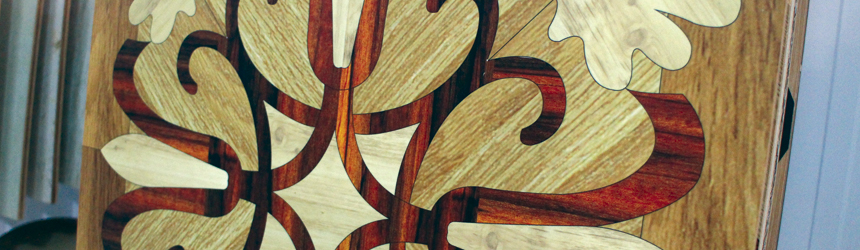
Digital printing technology enables the decoration of wood laminates, by either printing directly to board or to paper to produce wood decorations.

The market is large. Grand View Research, Inc. estimates the global wood and laminate flooring market to reach 92.64 billion USD by 2020.

The research firm’s 2015 report notes technology advancements have led to the development of new products and installation techniques that have “widened the scope across residential as well as commercial flooring applications,” according to the firm.

Digital Disruption
You can bet that digital has a stake in future innovation. Already, manufacturers known in the digital inkjet space have shown interest in this market. KBA and Kodak are among the vendors offering demonstrations of inkjet technology in use for the industrial market at the 2016 drupa. In the wide format space, companies like EFI tout customers doing this type of work regularly.

Digital print technology brings its usual benefits to the table in this industrial application. Bruce Richardson, national sales manager – web presses, KBA North America, Inc., says digital printing of floor laminating surfaces enables shorter runs when compared to flexography or gravure technologies. “This allows a floor laminate manufacturer to produce material as needed, with lower inventory and reduced storage costs,” he explains. “New print designs can also be tested and optimized faster for delivery to consumers.”

Gillian Ewers, director of marketing, Xaar, says in addition to specific benefits offered by Xaar, which are detailed below, inkjet printing technologies offer generic benefits such as printing to the edge of the substrate, printing large designs without pattern repeats that are more life-like compared to analog processes, and the ability to quickly respond to changing market demands.

Specifically, vendors provide digital solutions that are designed or suited for industrial applications, including floor laminate decoration.

KBA’s RotaJET VL series of industrial presses can be used for printing laminate flooring paper substrates with high quality and resolution. Richardson says this provides a real wood, tile, or other décor pattern look to laminates.
“Digital inkjet printing delivers a high quality, fine detail finish, making it easy to create designs that are faithful to the original, and patterns that are virtually indistinguishable from wood and other materials,” comments Ewers.

Xaar provides printheads suited to this application. Its 1003, 2001, and 2001+ printheads serve this sector, and the 1201 and 5601 will soon be on the market to serve the decorative laminate flooring space. The 1003 is used for direct-to-board laminate applications.

Industrial Focused
For industrial printing, users require durability and stamina of their digital production presses.

Richardson notes that the RotaJET, which is used in the book, commercial, and packaging print markets is successful in industrial applications because it provides a high tolerance web tension throughout the web path, allowing precision ink droplets to be printed on the substrate. The company can fine tune inks for décor printing, and its pre-coating technology provides the capability for high density production.

Additionally, KBA’s RotaJET VL series industrial presses have the ability to digitally load files and print with water-based polymer KBA RotaColor ink with fast changeover for the efficient and cost-effective production of short-run work, including sample work and smaller inventories.

Richardson suggests that the RotaJET is cost effective in the two to three ton range of material production. “Future applications may include printing on synthetic/plastic materials as well,” he offers.

Ewers feels the image requirements for laminate applications are “quite challenging,” especially when printing complex patterns such as mixed woods or patterns with mixed grain directions—or with combinations of wood and graphics. To address this, she says the fine drop size of the different GS6 varieties of Xaar printheads—the Xaar 1003, 2001, and 2001+—are ideal for this application. She adds that white inks used by companies printing laminate flooring are highly pigmented and require a printhead where true recirculation of fluid takes place directly behind the nozzle. “This is the most reliable method used to keep the ink pigments in suspension and prevent nozzle blocking and the technology is unique to Xaar.”

Further, laminate producers benefit from the ability to vary drop sizes between the printbars in their printers. “The Xaar 1003 and 2001+ printheads, which deliver different drop size ranges—GS6, GS12, and GS40—have a common footprint within the range. Xaar 1003 variants are the same size, as are the Xaar 2001+ variants. This makes it easy to vary the printhead and therefore the drop size across different printbars, offering greater flexibility for different applications including those needing color or high laydown varnishes to create a digital structure for the life-like representation of wood.”

The Xaar 1003 as well as the Xaar 2001 and 2001+ printheads are produced using tuned actuator manufacturing, whereby individual nozzles are micro-milled to extremely precise tolerances to ensure each printhead performs similarly, explains Ewers. “Thus, color is consistent across all of the printheads in a printbar. This is essential, particularly when using many printheads across a very wide swath. An example is Hymmen—a German manufacturer—whose Jupiter machine, which uses Xaar 1003 printheads, can print up to 82.7 inches wide for a variety of products such as laminate flooring, skirting boards, doors/gates, and decorative paper and finishing foils.”

Hymmen industrial digital printing lines enable users to print the surface of roll or board products on demand. According to the company’s website, the Jupiter Digital Printing Line allows for printing substrates in the required length with the respective digital template—including wood, stone, or fantasy design—as needed.

All standard models of the Jupiter Digital Print Line are supplied in a solid, user-centric machine design suitable for industrial purposes and are available in different working widths up to 2,100 mm for both roll and board materials.

Technology Demonstrations
A few vendors demonstrated the capabilities of their product offerings in industrial settings at drupa 2016.
KBA showcased the capabilities brought to life by its client, Interprint, in its stand. The company demonstrated laminate flooring printed on a KBA RotaJET 168 by Interprint in Arnsberg, Germany.

Interprint Group produces décor worldwide for the furniture industry. The company utilizes industrial digital printing capabilities of the KBA RotaJET 168 to produce high-end décor on conventional paper. The print array design enables optimal color precision and repeatability. Additionally, RotaColor decorative inks provide color fastness and light resistance.

Kodak demonstrated how its Kodak Stream Inkjet Technology is able to print laminate substrates using an efficient digital inkjet process that competes with gravure printed substrates. Kodak’s laminate décor solutions, which are driven by Kodak Stream Inkjet Technology, print across a range of substrates to produce laminate flooring and furniture, wood grained cupboards, and stone-designed countertops.

At the 2016 drupa trade show, the company showcased the “This is Inkjet! Loft,” which featured a pseudo apartment decorated with Kodak Stream digitally printed products including laminate flooring, countertops, furniture, wallpaper, napkins, and water bottles.

In a blog about the demonstration, the company stated that, “the ability to print customized designs in short runs, eliminating inventory with just-in-time printing while achieving the durability and robustness comparable with gravure printing, will change how home décor and other wide format printing is delivered in the future.”

Innovation Below
As digital print technology evolves, so do the markets it serves. Industrial environments look to digital’s ability for customization and shorter runs to innovate offerings. The laminate flooring market is one area that benefits from this technology.

Jan2017, Industrial Print Magazine
Beyond Common

By Olivia Cahoon

Print service providers (PSPs) generate high gross margin business when printing on unique substrates. Specialized materials go beyond what is used every day in print shops and tap into specialty elements like yoga mats, tree round slices, window shades, and bulletproof vests. The ability to print on these materials offer clients an edge over their competition.

Top of the Line
PVS In-Store Graphics is a retail graphics manufacturer based in Portland, OR, providing consulting, design, engineering, and project management for 2D and 3D printing including large format, vinyl graphics, die cutting, finishing, and fulfillment.

The shop began in 1991. 25 years later the company specializes in packaging production for world-renowned athletes and creates theatrical experiences for retail. With 38 employees, and a work space of 35,000 square feet, PVS serves large brands worldwide.

Wes Shinn, co-owner, PVS, shares that the PSP prints 40 percent of its work on unique substrates like plywood and plank wood. He says these are popular in retail environments. 60 percent of its work is considered superwide—more than 96 inches in width.

The PSP uses media products from an array of vendors. “Our media comes predominantly from 3M Commercial Graphics, rigid substrates from 3A Composites USA Inc., and for roll stock, a lot comes from Sonoma Graphic Products or Aberdeen Fabrics, Inc.,” explains Shinn. Specifically, the shop uses 3A Dibond, Gator, and Sintra; 3M Wrap Film Series 1080; and Aberdeen 1515 and Heavy Knit 8064.

Since 2005, PVS has housed EFI VUTEk products. Its had the EFI VUTEk GS3250LX Pro for three years, the EFI VUTEk HS100 Pro for two years, and recently it purchased the EFI VUTEk FabriVU 340. Using EFI VUTEk printers, PVS has printed on garage doors, gold plates, shoe parts, and pretty much anything it can get into the machine.

ACX Plywood
Recent trends in printing to 
unique substrates influence PVS. Customers develop creative ideas for printable products. “This causes us to push our limits, or stay ahead with new ideas for treatments, applications, and more,” says Shinn.

There are challenges associated with printing on specialized materials. Shinn shares that custom projects don’t leave much room for error. When the shop is printing a unique piece, it generally only has one shot to print on it. Custom built parts can be as expensive as $10,000, further impacting the pressure to get it right the first time.
“Not all objects are meant to be printed on, so we have to figure out where the settings need to be to achieve the right effects,” he explains.

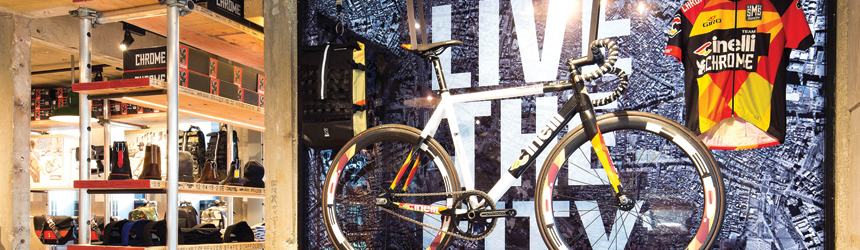
PVS serves repeat customer of seven years, Chrome Industries, a global manufacturer of messenger bags, backpacks, footwear, and cycling apparel for city living. “Chrome is all about durability for the hardest-core bike riders—professional messengers, fixed freestyle riders, and urban commuters—people who live and ride in the city,” says Shinn.

Recently, Chrome requested a display to showcase its products in multiple retail environments including its Tokyo location. “When we started, we wanted a look that was rough, but cool and innovative,” shares Shinn. The shop used unique substrates—specifically ACX plywood—as one of the elements to achieve this goal. Printed and fabricated fixtures, aluminum tubing, reincorporated LED lighting, milled and beveled wood, and several traditional print processes like magnetic and stretch fabric light boxes were all incorporated into the final piece.

The company had a week from job submittal to put the finished products into a container for shipment to Tokyo. PVS used an EFI VUTEk GS3250LX Pro printer. A combination of finishing equipment from Esko, Kern Laser Systems, ShopBot Tools, Inc., and Zünd were used to complete the project.

“Finishing was challenging due to the various substrates and processes required to complete the complex assembly,” explains Shinn. However, the company pulled through to deliver an appeasing display. “Chrome is particularly excited about the Tokyo project because it is the company’s first venture into Asia,” he adds.

Printing to a specialized material like ACX plywood added a fun element to the overall design and provided the message Chrome hoped to convey to Asian bicyclists.

Unique Substrates
The definition of what constitutes a printable substrate continues to change as the demand for printing on different materials increases.

Print providers like PVS push boundaries and print onto a range of media including plywood and plank wood to meet these specific requests.

Jan2017, Industrial Print Magazine

Just in Time Labels

By Cassandra Balentine

The label opportunity is apparent in digital. Shorter runs and the need for multiple SKUs within them drives business by default to digital. Additionally, more choices on the market, declining costs, and advanced technology make digital label systems attractive to three primary prospects, traditional label converters, digital printers looking to expand service offerings, and brand owners that want to take label production in house.

Those looking to invest in digital technologies must consider the specific needs of their business, as well as the total cost of ownership, which includes auxiliary requirements such as finishing and software. For traditional converters and brand owners, this investment is weighed against challenges facing the overall label industry, many of which are addressed by the inherent capabilities offered by digital.

Mark Vanover, VP, sales and marketing, Allen Datagraph Systems, Inc. (ADSI), notes that the trend towards shorter runs prompts business to digital, whether it is due to larger brand owners that are either personalizing product/packaging or creating many new brand extensions, or the presence of smaller companies that are now able to take advantage of cost-effective digital printing.

Private labeling also supports the demand for digital printing. “Of course, the question is, what came first the chicken—the digital system, or the egg—the demand for digital. We do know that when cost-effective runs were not available, smaller brands could not look like the bigger brands on just 1,000 boxes and bags as they can now,” says Vanover.

As new entrants come to market, the cost of digital declines as well as a more widespread realization of the value it offers—presenting a big opportunity for adoption by print providers and brand owners alike.

Stephen Emery, VP/GM, Jetrion and ink business, EFI, points out that for a long time, cost was the defining challenge for digital. “Brands know they have to carefully scrutinize their cost per label as part of their overall supply chain costs. In many cases, it meant you could only use digital printing for very high-end, high-profit products that could absorb the click charge that comes with process color impressions on electrophotographic digital presses,” he explains.

The availability of inkjet solutions and advancements to electrophotography diminish many of these concerns and eliminate barriers of entry.

Investment Considerations
Making an investment in a dedicated digital label system involves many questions, especially in regard to the output capacity needed. The benefit and challenge of serving this market is the fact that nearly every product needs a label. This includes everything from small, home-based Etsy shops selling custom products to Proctor & Gamble, a company with 23 brands boasting annual sales of $500 million to more than $10 billion.

Within this vast range of prospective labels, digital print capabilities play an important and growing role. Opportunity exists from the smallest in plants with a need for a few hundred labels a month to print shops with production-level equipment needs to service big brands.

“The requirements for these two are very different,” points out Randy Rickert, director, iSys Label. “One may use the printer on a weekly basis and the other may have it running for eight hours a day.” When selecting a print system, it’s best to determine the overall volume as well as the applications it will be used for before purchasing, he suggests.

Determining a level of investment includes basic factors, such as system costs and existing demand. “Crunch the numbers to find an acceptable ROI. Of course, there are fixed equipment costs based on the hardware investment. You also have a consumables running cost. These will deliver a different ROI depending on how well you are able to maintain capacity. The question is, ‘how much work does a specific machine need to be profitable?’ Different machines offer different results,” says ADSI’s Vanover.

For in-house organizations, decision criteria is based on more than investment cost. “There is greater demand for flexibility, shorter runs, customization, and fast turnaround times,” says Rich Egert, VP, global new business development and GM, strategic technology provider business group, OKI Data Americas.

Brand owners and marketers considering bringing labels in house want greater flexibility and customization options, and the ability to do short-run jobs. “It’s not about ROI, it’s about increased convenience and capability,” offers Egert. He suggests that, “the entire world has gone to immediate gratification.” By bringing these printing capabilities in house, users fulfill a range of opportunities, which continue to expand.

Print providers outside of the traditional label space, as well as established converters, are also looking for ROI when it comes to an investment in a digital label system. “With these devices, they can compete without a major investment. Output—including variable data, digital die cutting, and lamination—can be done quickly, efficiently, and affordably to create marketable output,” says Egert.

Those new to label converting often get their start pursuing short- and medium-sized runs and multi-SKU jobs, but may be more likely to include modular, inline finishing components over the more established competition. “They might not have those capabilities elsewhere in their facility. Having all the components inline provides tremendous labor savings,” comments EFI’s Emery.

Established converters look for systems that provide a more profitable avenue for short- and medium-run work as well as multi-SKU orders, which would normally require a larger number of plate changes. Emery points out that if the facility already has offline finishing for its flexographic work, those customers can often take digitally printed rolls over to an existing finishing platform.

In terms of capabilities, Michael Pruitt, product manager, SurePress, Epson America, Inc., suggests those looking to add digital label technologies should look at the minimum investment necessary to achieve the best total cost of ownership versus the highest quality level and flexibility. “A principal measurement for most is speed, but what really is important is productivity,” he says, outlining a formula for success, “productivity = speed x up time x % perfect product x ease of use.”

Further capability considerations are important, including material compatibility, finishing and converting, spot color, varnishing, and the need for white ink, suggests Mike Barry, product marketing manager, digital solutions, Fujifilm North Americas Corporation, Graphic Systems Division.

Taylor Buckthorpe, global account manager, Colordyne Technologies, summarizes that companies looking to add digital label technologies want faster ROI, so in terms of capabilities, they want solutions that help eliminate inefficiencies in label production, waste, and lead times. “Overall, the level of investment is determined by the size and scale of the company, what products and markets they currently serve, and what areas they are looking to expand or improve upon.”

Driving Digital
Brand owners and label converters face many industry challenges, many of which are addressed with digital technologies.

“On a macro level, factors driving digital adoption include SKU proliferation, the need for just-in-time delivery, and the value-add digital printing provides with variable data capabilities to target specific demographic groups,” says Andy Dwivedi, director of marketing and sales support, North America, Xeikon. Increased personalization is expected, enabling brand owners to “emotionally connect” with their customers, he adds.

Run length is a primary driver of digital demand, which includes the need for shorter runs, as well as the need to incorporate more SKUs in a single run. “Just-in-time production requires shorter runs, often driving more reprint jobs. Increased SKUs, reduced inventory, and just-in-time production are moving the label market into the digital comfort zone, with quick changeovers; accurate, repeatable, and consistent color performance; and efficient handling of a high number of jobs per day,” says Brian Cleary, category manager, Indigo Label Solutions, Hewlett-Packard (HP).

Juan Kim, CEO, VALLOY Incorporation, suggests that there are many limitations in analog label production, which are addressed with digital, such as in-time delivery, stock waste, and customization capabilities. “A digital press and finisher can provide additional attractive features and flexibility, but digitalization does not mean replacement of analog,” he stresses.

“Converters are stringently assessing their current production processes, which involves looking at their true manufacturing costs, including setup time, waste, plates, tooling, dies, and even inventory carrying costs to identify how digital printing can make them more efficient and competitive,” states Emily Kroll, business director, label and specialty packaging, Durst Image Technology US LLC.

“Converters are also looking at digital for long-term goals. Digital printing can offer sustainable growth by allowing the development of new marketing opportunities,” she adds.

Dwivedi notes that brands compete for awareness from customers bombarded with marketing messages. In addition, customers want more product variety, so there are a wider range of SKUs as goods, producers, and manufacturers create more variation in the products they sell. He also notes that products have shorter lifecycles and relatively, so brands need the capability to test new products and maintain smaller inventories of products. “In turn, they’re demanding shorter turnaround times on the part of the label converters so that they can bring products to market more quickly, and they need run lengths to be shorter and more cost effective.”

Amber Jechort, product manager, Primera Labels, suggests flexibility as a challenge facing the label industry today. “Converters don’t want to turn away small jobs for current customers. Manufacturers need the option of running customized or even seasonal labels.”

Digital addresses these limitations by enabling label converters to produce high-quality, shorter runs without the cost of makeready. Additionally, they provide the ability to create customized labels and provide protective measures against counterfeiting.

“Labels are becoming more complex in design, run length, and regulations, challenging converters to invest in more flexible equipment, improve changeover efficiency, and implement better planning practices,” points out Cleary.

“From a design perspective, customers are demanding a wider variety of substrates, higher quality, complex embellishments, and a no-label look,” he explains, noting that digital addresses these challenges. “Brands are looking for an increased number of shorter runs, more repeat jobs, and faster turnaround times, while also addressing increasingly strict regulations. Digital offers a high degree of automation with a streamlined end-to-end workflow as well as non-UV, low migration inks to meet regulatory demands,” he continues.

Increased production and automation are required to make short-run printing profitable. “Increasing the integration of finishing processes and lower operation costs is possible with digital presses as more capabilities are added inline to the printing process,” says Aftab Aftab, product manager, INX NW210 digital label press, INX Digital. “The future of digital is that every label can be different, including different digital finishing options like die cut or gloss/matte finishing. Shorter average runs with quicker turnaround and personalization is the new norm. Digital printing answers this demand,” says Aftab.

Digital Obstacles
While digital print technology provides a solution for many concerns facing analog label production as market trends evolve, it comes with its own challenges. One of the biggest obstacles is simply a resistance to change.

Primera’s Jechort suggests that an operational shift is apparent in terms of digital versus traditional flexographic printing. “The types of employees needed to successfully run digital presses are quite different than a lot of really good flexographic operators,” she notes. “Strong computer skills are a must, no matter how the printing and digital die-cutting software is designed. Knowledge of software such as Adobe Creative Suite is essential to success. At the same time, mechanical aptitude is still required to run the press and die-cutting equipment. Sometimes it is a challenge to find both skill sets in the same person, so some of our converters have a two-person team assigned to their digital presses.”

Epson’s Pruitt points out that as work pace increases, the art/expertise in flexographic/analog printing will now be located in the digital front end of systems. “However, the skill set to operate these digital presses will be different. Emphasis in managing a workflow from brand owner, to designer, to shop floor, is critical. More of the operations, such as foiling and embossing, will need to be integrated with digital systems,” he adds.

Quality concerns, longer runs, media compatibility, as well as the need for a complete system are other issues challenging digital adoption.

While digital solutions may fit the budget for many small and medium players, VALLOY’s Kim warns that commercially acceptable quality is essential. “It is the most important issue in the market—provide an affordable solution of professional quality at acceptable speeds.”

Long production runs are a challenge for many digital label presses. “The challenge with digital is to offer increasing speeds and lower production costs. Digital consumable costs are decreasing and waste is being minimized as the presses head toward continuous production and on-the-fly changeover between jobs. Long production runs are the biggest challenge as digital printing competes with traditional flexographic technology. Digital press speeds are increasing as newer, faster printhead technology is introduced to meet this growing demand,” says Aftab.

Another challenge is finding a complete system to best meet demands. “One of the biggest challenges for label converters today is to find a complete digital label production solution that fits their production requirements. The digital press is just part of the total solution,” offers Xeikon’s Dwivedi.

Durst’s Kroll points out that the industry overall could benefit from having less pre-treatment requirements for media, which are addressed as vendors take steps towards inline treatment units as well as developments in ink sets and curing processes.

The challenge is different for those looking to bring labels in house. OKI Data’s Egert says it is the issue of converting end users to producers. “Many people have the need for labels, but not all are inherently capable of producing labels themselves.” Digital also has an advantage in this scenario, as the technology is often easier to master compared with traditional methods. “We’re converting users into producers without having to train them on what is normally a fairly complex process. We’re making our devices extremely user friendly so that end users can print fully customized, color labels easily and on demand. The process is simplified, integrated, and automated for ease of use, and that’s what people like and are embracing about our cost-effective, end-to-end solutions,” says Egert.

More on the Horizon
Digital label production is certainly a topic that keeps heating up, however the trend is far from peaking.

“Although digital printing is a proven technology for short-run today, its capabilities have not reached its fullest potential,” points out Durst’s Kroll. “Future demand for shorter runs will not diminish or be stagnant,” she predicts. “We all know the lifecycles of products are getting shorter, therefore, digital can help brands to be more competitive by enabling them to have shorter go-to-market lead times and strategies.”

Traditional converters looking to invest in digital have a mindset challenge to overcome, but must consider the potential opportunity and risks of not offering digital alternatives. Meanwhile, print providers looking to get into the label game must consider the total cost of ownership and the level of investment their unique situation requires. The third prospect, brand owners and marketers, consider the cost and time benefits of having immediate access to prototypes and production in house instead of—or in concert with—a third party specializing in the product.

Jan2017, Industrial Print Magazine
Flatbeds Expand Business

By Olivia Cahoon

Digital wide format flatbed inkjet printers enable printing directly onto rigid substrates. With the ability to handle output on a variety of materials, these devices are used in creative ways, which allow print service providers (PSPs) and manufacturers to create unique products and enjoy high profit margins.

When using a flatbed printer, personalization of smaller accessories like speakers, USB drives, and power packs are possible with the help of a jig. In addition, the footprint of a wide format flatbed enables the production of large batches of these products in a short amount of time. Businesses that utilize flatbed printers are uniquely positioned to meet customer demand for quick turnarounds and high levels of customization with inkjet.

Promotional Product Supplier
Established in 2001, iClick is a promotional products supplier to the advertising industry, specializing in mobile and computer technology, USB flash drives, and high-quality pens. The company reaches customers worldwide from its two offices in Boulder, CO and Seattle, WA, with a work area of 23,000 square feet and 60 employees.

“The highest quality and superb products for our customers make us the leading choice of over 35,000 distributors worldwide for their customer marketing and advertising needs,” says Daniel Kaufman, warehouse engineer, iClick. In the wake of rising success, the company is constantly looking for new and efficient printing solutions that cater to its market.

In the mobile and computer technology industry, product suppliers generally silkscreen, pad print, or digitally print. Kaufman explains that digital tends to be the quickest, easiest, and most efficient method—which led the company into purchasing digital flatbed printers four years ago. The ability to print on different shapes, sizes, and materials was a driving factor.

“Precise product placement for high-accuracy imprinting is key to our production environment. We utilize both large and small flatbed areas to create many forms of fixture jigs that enable us to achieve those results,” shares Kaufman. iClick prints to mobile phone accessories, USB swivels and drives, speakers, mobile power packs, and other items that are manufactured in factories overseas and sent to its U.S. facilities.

The company was even more inclined to pursue flatbed printing after learning that UV LED ink dries faster, uses less material, and is more efficient. It first purchased three UJF-3042FX printers from Mimaki USA, Inc. Most recently, the company obtained a Mimaki JFX200-2513 flatbed.

“The price point of these printers combined with the versatility and speed matched perfectly with what we needed out of a flatbed printer,” admits Kaufman.

The Mimaki UJF-3042FX desktop flatbed UV printer was chosen for its ability to output in a variety of resolutions and pass counts in a small format. Printing onto substrates up to two inches thick, the Mimaki UJF-3042FX uses three types of UV-curable ink. The UV LED system relies on small amounts of energy, which enables printing onto media that otherwise could be damaged by high heat.

The Mimaki JFX200-2513 wide fomat UV-LED printer features a printing area of 98.4×51.1 inches. It uses LED curing and images are printed directly onto rigid media or promotional products. iClick was impressed by its size and ability to imprint mass quantities of mobile accessories and various styles of USB drives. “We imprint quantities anywhere from a single promotional sample to hundreds of thousands of pieces,” says Kaufman.

Imprinting USB Drives
Customers rely on iClick for fast production and quality prints. Among those is Ed Lazaruk, founder, BestFlashDrives.com, a client of six years. BestFlashDrives.com specializes in providing custom shapes, custom printed USB flash drives, and offers personalized custom designs to its clientele. Outsourcing some of its print work to iClick, it expects high-quality imprints on USB drives in quick turnarounds and repeatability.

iClick uses its Laguna USB drive for BestFlashDrives.com’s jobs because of its style and it can be printed on with the Mimaki JFX200-2513. It takes two hours to complete the job from the time it is submitted. Utilizing the flatbed’s large print area, 520 of these USBs are printed in one run—held in a custom made jig to further efficiency.

Kaufman says that Lazaruk is happy with the print quality of the Mimaki JFX200-2513 and believes the photographic images offer a lot of detail.

Equally important is that the USB drives are printed in less than half the time as before. “This enables us to take rush orders,” says Lazaruk.

Big Sellers
Digital wide format flatbed inkjet printers handle a range of substrates while offering customization opportunities.

Jan2017, Industrial Print Magazine
Cutting Edge Technology

By Olivia Cahoon

Digital print advancements in wide format output drive the development of a full range of substrates. As the need for fast and durable equipment rises, industrial-grade flatbed routers and cutters are more prevalent. The ability to handle larger volumes, finish at higher qualities, and remain durable help define these devices against more lighter duty models.

What is Industrial Print?
To better understand the term “industrial” in terms of printing and finishing, we asked finishing vendors how they would define it in regards to router and cutters.

“The nature of industrial printing is printing that is done during a manufacturing process, but this can range from product prototyping to short-run benchtop UV production via superwide format UV flatbed work, up to fully automated production lines,” explains Josh Hope, senior manager, industrial printing market, Mimaki USA, Inc.

Greg Stewart, product marketing and strategy manager, Esko, believes that industrial print relates particularly to wide format and corrugated printing. As inkjet printers become faster, the need to quickly finish products becomes more urgent. “Because of variable printing, perspective has changed from how fast many thousands of one job is completed to how to deliver five to 10,000 units of different jobs,” shares Stewart.

Others believe that industrial-grade finishing equipment isn’t so different from traditional equipment. “Industrial print may deal with a few additional substrates, such as domed logos, but both industrial and traditional finishing still revolves around materials that are up to two inches thick,” says Steve Aranoff, VP sales and marketing, MCT Digital.

It appears that no matter what the definition is, industrial print includes two key qualities—the applications and the volume. “Structural display applications including store fixtures, trade show, and outdoor displays where heavy MDO, MDF, thicker acrylic, alumicore products, and heavy-duty corrugated board are used, would be considered industrial or heavy-duty applications. On the other hand, industrial print may also refer to the volume—in other words, medium to long runs as opposed to short runs of prototyping,” adds John Cote, North American sales manager, Zünd.

Volume, Quality, Durability
Industrial-grade routers and cutters are designed with volume and value in mind. To achieve this, vendors incorporate features to ensure that end users receive the best quality. “There are three keys to industrial cutting—volume, quality, and durability,” suggests Gary Greis, national sales manager, Inpro grand format cutters, Graphco. These features qualify industrial grade routers and cutters for industrial usage.

Industrial finishing equipment handles oversized substrates, the tables are expected to be large. Aranoff points to growing requirements for ten-foot wide cutters.

Some vendors, like ARISTO, offer machines with a work area up to 5,200×7,200 millimeters.

Width isn’t the only concern for industrial markets. Dana Goodale, product management director, Gerber Technology, explains that a pull-through capability allows material to be cut into sections. This works well for long substrates that otherwise need to be cut down separately and then applied to the router or cutter for proper finishing.

Industrial routers and cutters are also made with thick material in mind for keeping up with demands to finish heavy-duty substrates. Most industrial finishing equipment can handle material up to four inches thick. A handful of vendors offer high-torque systems. “Spindle horse power and torque at high RPMs allows routing standard thicknesses of high density plastics, wood panels, and aluminum in one pass with excellent quality finish,” advises Dan Bussey, marketing manager, MultiCam Inc.

To ensure accuracy, some industrial finishers have camera systems like ARISTO’s AutomaticEye. Andreas Kretschmer, market manager, ARISTO, shares that cameras detect and correct distortions and imbalanced printed materials. This process eliminates wasted time from finishing errors.

Joe Hillman, strategic development manager, Universal Laser Systems, says optical registration uses a camera to locate registration marks or other printed features, and then adjusts the cut path to compensate for misalignment or stretching of the material. “This ensures accurate cutting for every piece, even if they are not identical.” The camera automatically adjusts for small material placement differences to improve efficiency and quality.

Cooling and Finishing
Cutting metal tends to generate high heat. To combat this heat, Goodale says most industrial-grade routers and cutters feature cooling methods like mist coolant or cold-air guns. Other features for advanced cooling include tables equipped with super-strong, water-cooled milling spindles. “The spindle revolves fast enough that it requires advanced cooling, particularly for working extensively with heavy-duty materials such as thick sheets of acrylic, wood, or MDF, and aluminum composite material,” explains Stewart.

Because industrial environments serve high volumes, routers and cutters are made to work fast. “Depending on machine type, size, and tool heads it is possible to reach a maximum cutting speed of 2,300 millimeters per second with a maximum acceleration of 2G,” says Kretschmer.

Roberto Rodriguez, president, Digital Graphic Systems Inc., believes that speed and automation increase productivity for finishing processes to keep up with high-scale printing runs. Industrial routers and cutters should match a printer’s pace as closely as possible to keep production constantly moving.

Because industrial cutters are usually busy with production runs, some end users look for prototype cutters to test new designs. “A dedicated prototyping cutter can be placed into a office environment giving a designer the ability to interface the cutter directly from the design software,” says Hope. While the main machines are in full production, the time between concept and working prototype is minimal.

“The best industrial grade routers and cutters offer print service providers (PSPs) the ability to precisely match tool configurations, material handling, and workflow automation to their particular needs,” says Cote. End-to-end workflow software provides the setup and cutting parameters needed for industrial production. With the right workflow, the entire production moves quickly and efficiently.

Other industrial considerations include creasing qualities and waste removal. Steward says that downforce is crucial for corrugated materials, especially to crease, which can only be made with a specialized wheel. Goodale shares that a grounded chip-removal system is an ideal feature because it safely and effectively removes potentially high volumes of statically charged chips and cutting debris.

In addition to handling heavy-duty substrates, industrial-grade routers and cutters are also built to last. Maureen Damato, sales dealer and account manager, Colex Finishing, Inc., suggests typical lifespan is at least 15 years. Features such as racks and pinion drives should offer reliability, long life, and cost-effective maintenance.

With the ability to cut materials like leather and wood, it’s vital industrial equipment is durable and features the correct tool sets. “Since cutters typically last from ten to 15 years, having one that can advance with the needs of an ‘industrial’ printer is immensely important for growth and continued competitiveness,” says Aranoff.

Crossing Industries
With such a range of features, industrial finishing equipment is used across industries for many different applications. Robert Boyes, senior product line manager, Coherent Inc., says that its products are utilized for clothing labels and signage. Applications like athletic lettering and signage are satisfied by industrial routers and cutters. “These systems are commonly used in research and development labs, military development labs, and universities in addition to industrial applications,” adds Boyes.

Bussey points out that custom packaging, point of purchase (POP) displays, retail displays, furniture, and indoor and outdoor signage benefit from industrial equipment. He says users tend to look for machines that are versatile for future productions. “One application may require routing dense materials where a more powerful spindle is required to achieve the smooth finishing cuts, and another application may require using a knife system to cut through materials such as vinyl and fabrics,” he continues.

Hillman believes industrial users are looking for equipment with high reliability that doesn’t depend on continuous repairs, adjustments, or part replacements. He shares that industrial grade routers and cutters are especially useful for cutting materials like acrylic, card stock, fabric, foamcore, and mat board.

In addition, Rodriguez says that cardboard packaging companies, large sign shops with high levels of material processing, and large dye-sublimation print providers that require cutting textiles up to 126 inches require routers and cutters. “Industrial grade machines have to be prepared to run 24/7 with minimum interruptions and at above average productivity levels,” he adds. Applications like aluminum, backdrops, channel letters, custom cut out magnetic signs, cut out signs, engraved signs, labels, metal plates, stickers, theater sceneries, trade show booths, TV sets, and wood are all suitable.

“The user needs to be ready for a variety of applications, requiring versatility in the router/cutter because they never know what job will come through the door. Industrial users want to match that versatility with production speed,” explains Damato.

Industrial users are also looking for quality automation and proper training. Cote shares that automation in every phase of production should be efficient and include tools like automatic file retrieval via barcode or quick response code, automatic tool setup, calibration, and tool changing. Assistance in accessibility, after-sale support, proper training, and workflow integration also helps businesses run smoothly.

Considerations
Now that we know what users in industrial settings want out of industrial grade routers and cutters, it’s time to look at the equipment features PSPs should consider before making a purchase.

“PSPs need to take a close look at their entire production process to find the industrial cutter or router that will most easily integrate with what they already have, while providing the level of capacity and automation that best meets their current needs but is also adaptable down the line to keep up with changing demands,” recommends Cote.
Goodale suggests PSPs consider the equipment’s cutting depth to see if it is deep enough for thicker materials and if it can 3D rout for industrial applications.

“Heavy-duty knife solutions are necessary for thicker material that can cut significantly faster than the material can be routed with the proper strength,” shares Aranoff.

Pricing depends on the types of routers or cutters and the equipment’s capabilities, features, and size. For example, with laser-based systems, Boyes says that there are three tiers. Low volume and power applications are generally offered below $40K and most aren’t intended for factory floors. “Ours are in the mid-range, between $100K and $300K, where the differentiation is driven by power up to 1kW. Higher power lasers start in the $250K range and with high end or very specific handling can be priced at or above $1M,” he adds.

Hillman shares that “laser systems that support print and cut, range for around $10K for a system to $50K for a fully featured system with a large bed size.”

PSPs should also consider how they will operate the finishing equipment—with experienced operators or beginners that need a simple process. “The best piece of equipment in the world will go unused or drastically underutilized if the workflow is too difficult for the users to grasp,” admits Goodale.

Characteristics like rigidity, performance, and versatile options that include automatic tool changing, laser pointing, and vision should also be considered.

Industrial Finishing
Industrial-grade routers and cutters are made to be fast, durable, and efficient. They cut through heavy-duty substrates like aluminum, metals, and wood and are also fast enough to run in factory settings. These routers and cutters handle a range of applications like furniture, labels, POP displays, outdoor signage, and labels across multiple industries using a number of different features.

Jan2017, Industrial Print Magazine