Exploring Digital Print

By Industrial Print Staff

The International Sign Association (ISA) throws one of the biggest parties of the year for print professionals every Spring. This March 21 to 24, 2018 the ISA Sign Expo makes its presence known in Orlando, FL at the Orange County Convention Center, South Hall. Digital print technologies for industrial applications are prevalent, from textiles to promotional materials, graphic overlays, and label and package printing.

Making its debut at the show this year is the Print Fabric Pavilion where attendees can learn about the entire textile printing process and some of the tools and solutions available. This is ideal for manufacturers looking to adopt digital textile printing solutions into their workflow.

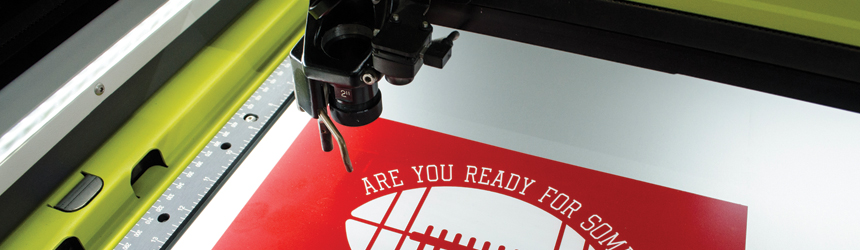
Above: Gravograph showcasese the LS1000XP large format laser in booth 817.

Open Floor
The trade show floor opens to the public on March 22, 2018. Here is a look at what vendors plan to bring to the event.

Advanced Greig Laminators (AGL), booth 3827, exhibits its heavy-duty Patriot and popular Compadre laminators. The Patriot is widely used in high-volume fleet applications as well as solving problematic silvering with flatbed UV and latex printing. The Compadre complements the moderate duty needs of sign shops looking to offer roll-to-roll vehicle wraps to second surface mounting applications. Machine prices start at $13,500 and all are made in the U.S.

Agfa Graphics, booth 2611, brings its Jeti Mira HS LED with roll-to-roll and varnish capabilities. At 8.82 feet wide, the moving gantry flatbed printer is designed for optimal flexibility. Featuring print and prepare functionality; speeds up to 2,669 square feet per hour; six color, white standard, highly-pigmented Agfa-made UV inks ideal for indoor/outdoor applications; and two rows of Ricoh inkjet printheads, the Jeti Mira’s UV LED curing technology prints on heat-sensitive substrates.

Alliance Technology Corporation (ATC), booth 5611, showcases two UV liquid coating machines. The ATC-80RTR roll-to-roll UV coating system is designed for precision mayer rod UV liquid coating for roll-to-roll operation. It caters to fleet graphics, wallpaper, and other roll applications. The ATC-UV36SD UV coating system provides a sheet-fed UV liquid coating solution that produces a high-quality UV coating finish on a variety of inks and substrates up to one-inch thick.

AnaJet, booth 4620, invites attendees to meet the RICOH Ri 6000 direct-to-garment (DTG) printer. Imagine printing vibrant, custom graphics directly on apparel with a setup process that takes minutes, not hours. Change how your business fulfills orders with the speed to print a 12×10-inch graphic in as little as 27 seconds. See it in action, as well as the company’s brand new Ri 100, an entry-level DTG printer for under $5,000.

AXYZ International, booth 2604, displays two CNC routers. The heavy-duty Pacer Series is engineered to provide the highest combination of quality and precision and offers the ideal platform for high-speed, vibration-free processing. While the Trident Series, purpose-built for sign making applications, includes a twin-knife head and heavy-duty routing spindle for taking on the broadest projects. Focusing on innovation, customization, and exceptional service, AXYZ has a CNC router to suit any project.

CET Color, booth 1423, is a U.S.-based manufacturer of both UV printers and flatbed cutters. These UV printers come in both hybrid and flatbed models ranging from 63 inches to 16 feet. The company’s flatbed cutters can go up to 5×10 feet in size.

Coastal PRO, booth 1846, features one of the industry’s leading turnkey textile printing solutions, the Epson SureColor F9370 dye-sublimation printer. The DGI Fabrijet 64- and 120-inch printers are also key elements of Coastal PRO’s textile manufacturing focus. These printers feature print speeds of up to 200 linear yards per hour and widths from 64 inches to ten feet wide. Coastal PRO doesn’t just sell printers—it sells the process.

Colex, booth 4635, debuts the newest model in the Sharpcut Flatbed Cutter System. The Sharpcut is Colex’s most productive solution for automated finishing of wide format media. The newest model is used for a variety of applications including cutting soft to rigid boards, vinyl, fabric/textiles, foamboard, coroplast, PVC, and acrylic. It provides users with the best affordable digital cutting offering versatility, speed, and price.

CutGuru, a unit of MCT, booth 4928, supports more than a thousand users of cutting tables, providing true telephone application support for blades, bits, cutting underlays/conveyor belts, and maintenance supplies. CutGuru.com provides easy ordering and quick delivery of products for all popular flatbed cutting tables. Specializing in printed graphics, CutGuru buys in volume and passes on savings to its customers. Specialty products and custom tools to specifications are also available.

Epson, booth 2635, demonstrates the 64-inch Epson SureColor F9370 dye-sublimation (dye-sub) printer, which delivers proven, precise, industrial-level production with speeds up to 1,169 square feet per hour. Ideal for high-speed, economical, medium- to large-volume dye-sub transfer printing, the SureColor F9370 leverages dual PrecisionCore TFP printheads and Epson’s latest dye-sub ink technology—UltraChrome DS with High-Density Black. The printer features an integrated, highly accurate roll-to-roll media support system with advanced automatic paper-tension control and Wasatch SoftRIP TX and ICC profiles.

Esko, booth 4200, promotes the Kongsberg C66, which runs at up to 100 meters per minute. It handles either manual multi-zone production of large 87×126-inch sheets or single-zone production of large 98×189-inch sheets. This makes it well suited for the production of protective packaging, and corrugated containers made from HD double-wall or triple-wall corrugated. The Kongsberg C66 also processes other materials, including foam cushioning materials.

Foster, booth 2727, believes that if you handle rolls of print media, fabric, flooring, or any other roll material, it has an On-a-Roll Lifter for the job. Lifters simplify workflow and make shops safer for employees. Also shown, a complete line of Keencut and Rotatrim precision cutters and trimmers for wide format, sign making, display graphics, and fabric production

GCC, booth 3823, encourages attendees to witness the innovative GCC JF-240UV flatbed printer. It comes with high throughput, standard dual UV LED lamps, one liter bulk ink, CMYK, and optional varnish and white color to offer outstanding printing quality for short runs and on demand printing. With specially developed ADA and ink layering printing technology, the JF-240UV enables the production of various personalized and creative products in small quantities, ensuring high rates of return on investment.

Gerber Technology, booth 3120, is a world leader in the development and manufacture of computerized sign making and specialty graphics systems, software, materials, and accessories. Proven start-to-finish digital design, printing, and production products are carefully integrated to provide sign shops and graphics professionals with comprehensive engineered solutions for durable vinyl cutting, digital color printing, and dimensional signage needs, as well as quality aftermarket materials. The Gerber EDGE FX design-print-cut system and aftermarket is on display in the booth.

Gravograph, a brand of Gravotech Inc, booth 817, highlights it large format laser the LS1000XP and large bed rotary engraver the IS8000. The LS1000XP CO2 laser features a 48×24-inch marking area and can cut up to one-inch acrylic. The IS8000 streamlines the creation of ADA-compliant braille signage. The company also displays its material and software solutions.

Leister Technologies, booth 5221, features the HEMTEK ST banner welder. The stationary welder is an efficient and affordable banner finisher. Capabilities include hem welds, pole pockets, and hems with rope. Quickly weld promotional banners or tarpaulins from corner to corner with ease. Whether sitting or standing, the HEMTEK ST can be used at almost any work table.

LogoJET, booth 639, introduces its newest printer, the UVx40R, which achieves print speeds up to 33 percent faster thanks to the incorporation of industrial-strength components and three high-performance Ricoh printheads. With a customizable combination of CMYK, white, primer, and gloss inks, the UVx40R produces full color and textured imprints on a variety of substrates, up to 18×18 inches. Automatic height adjustment accommodates products up to 4.72 inches thick, and interchangeable printing trays make it easy to switch between products.

Massivit 3D, booth 629, demonstrates the versatility of its large format 3D printing technology. Utilizing the flagship Massivit 1800 3D Printer, sign and display print providers can produce a range of applications, including advertising campaigns, retail displays, and bus wraps. With the ability to quickly 3D print large and complex objects, print providers add a new dimension to business, shave weeks off production methods, and enjoy greater design freedom. For intricate, customized, and repeated campaigns, print providers also have the option to 3D print moulds for vacuum forming.

MCT, booth 5835, promotes its VersaTech2 all-in-one flatbed cutter for router, laser, or knife creasing with full conveying and automation for all materials. TigerVision software is improved with special compensation for stretchy fabric, an accurate jobs-longer-than-the-table capability, new quick response code job automation, and software for shaped nesting, estimating, and parametric modeling with full RIP integration is demonstrated. See also 5kW routing and laser cutting of fabric and acrylic plus etching.

Mimaki USA, Inc., booth 4011, offers the UCJV Series UV LED cut-and-print devices with inline cutting capability and models featuring white ink to enable four-layer printing. Two models are available—the four-color UCJV150-160, and the UCJV300-160 to accommodate up to seven ink colors. Each produces a variety of print-and-cut applications. The four-layer printing available on the UCJV300-160 model offers an enhanced print capability allowing designers to build layered, transformative graphics for backlit applications.

Mutoh America, booth 2017, announces the all new 4×8-foot UV LED flatbed printer, the PerformanceJet 2508UF, as well as other favorites from the company’s line of ValueJet printers such as the 1624X, 1948WX ultra-fast four printhead dye-sublimation printer, and the 626UF UV LED printer that is capable of printing on cylindrical items with its optional rotary attachment.

Novus Imaging, part of The M&R Companies, booth 1006, shows the ULTRA 3200 large format roll-to-roll industrial inkjet printer. Designed and built in the U.S., ULTRA 3200 offers innovative features and an industry-leading price-to-performance ratio. It’s designed for multi-roll printing on substrates up to 3.2 meters wide and delivers four-color CMYK and true four-level greyscale printing. M&R’s Novus ULTRA large format dedicated UV LED flatbed printer and Novus TEXTURA 1800 large format dye-sublimation printer are also displayed.

Onyx Graphics, Inc., booth 5213, focuses on its ONYX Hub software—a business intelligence tool with a browser-based dashboard that provides easy-to-understand data across a print service provider’s entire site, enabling better business decisions. It collects data by job, station, and printer, presented in real time, for immediate visibility into the shop’s production environment. With ONYX Hub software, users gain insight using trend reporting to optimize workflow and better manage business.

Roland DGA Corporation, booth 4017, invites attendees to see its newest TrueVIS series eco-solvent printer/cutters, as well as advanced VersaUV flatbed printers for printing directly on unique dimensional substrates and dye-sublimation printers for textiles and hard goods. The company also showcases its popular CAMM-1 cutters, VersaEXPRESS and VersaStudio printers, and next-generation 3D mills. In addition, booth visitors can pick up useful tips at Roland’s daily live vehicle wrap, sublimation, and apparel heat transfer demonstrations.

SA International (SAi), booth 2417, welcomes attendees to join the new sign.com network for increased business as well as enjoy the flexibility of software subscription as low as $19.99. Also showcased, SAi’s feature-rich Flexi and EnRoute software solutions. The company hosts free, on-stand informative workflow classes every half hour throughout the show.

Summa America, booth 5438, unveils a new format of the Summa F Series flatbed system—the F1832. It offers the ability to cut roll-to-roll vinyl up to 72 inches and rigid boards in sizes up to 60×120 inches with precision. In addition, a rotary tool offers the ability to cut fabrics up to 72 inches wide. The previously announced Twin Workflow is also displayed.

Supply55, Inc., booth 1413, brings its NEPATA converting equipment and Guardian dye-sublimation (dye-sub) calenders. NEPATA converting centers deliver precise material cuts and highly accurate rewinds allowing for quick delivery times across a range of media, while avoiding waste, inventory shrinkage, and roll shortage/overage problems. Guardian calenders are affordable, easy-to-use rotary heat presses for all dye-sub paper transfer and direct-to-fabric applications.

swissQprint, booth 5642, presents the new Nyala LED model. On a 126×79.9-inch flatbed, Nyala LED delivers a maximum output of 2,217 square feet per hour. It is versatile when it comes to applications and thanks to cool LED curing, even heat-sensitive substrates can be printed onto easily. The Nyala LED consumes 50 percent less energy than conventional systems.

Top Value Fabrics, booth 4438, exhibits its complete line of printable textiles by Georg + Otto Friedrich, including Heavy Deko-Stretch 8488GFS. Heavy Deko-Stretch is a market-leading solution for event and retail applications where a stretch fit is required. This fabric is engineered with equal four-way stretch in width and length. The resulting dimensional stability alleviates installation issues traditionally associated with stretch fabrics since the fabric doesn’t wrinkle or skew after installation.

Trotec, booth 2024, demonstrates the SP2000 laser cutter for large format materials. Built for efficient production, the laser safety class 2 system offers functionality that translates into competitive advantages—including processing speeds up to 6.5 feet per second, laser power up to 400 watts, and a working area of 66×98 inches.

X-Rite and IT Supplies, booth 2845, showcase solutions to help wide format printers match color from device to device, substrates, inks, and coatings. Experts discuss best practices for managing color from design through prepress, production, and quality assurance. Demonstrations of PantoneLIVE—a cloud-based solution for digital color specification, i1 Display for on-screen color accuracy, eXact handheld spectrophotometer, and ColorCert software to manage CMYK, Expanded Gamut, and Spot Color workflows are held.

Zünd, booth 5030, exhibits the Zünd LM 100W cut and seal Laser Module developed for no-fray cutting and finishing of polyester fabrics. Other highlights specifically designed for industrial print service providers aiming for superior productivity include the latest Zünd Cut Center ZCC 3.0 features, such as the OCC Over-Cutter Camera system and Dashboard, as well as the high-powered 3.6kW routing system with automatic tool/bit changer.

See You There
Industrial Print magazine is in booth 5906 with its sister publication, Digital Output. Be sure to stop by and say hi, or pick up a copy of this issue.

Mar2018, Industrial Print Magazine
Awarding Customization

By Olivia Cahoon

Promotional materials advertise brands, events, and products while retaining customers and increasing traffic to the business. Products include accessories, apparel, office supplies, and technical gadgets. For these applications, digital print technology offers personalization and fast turnaround times.

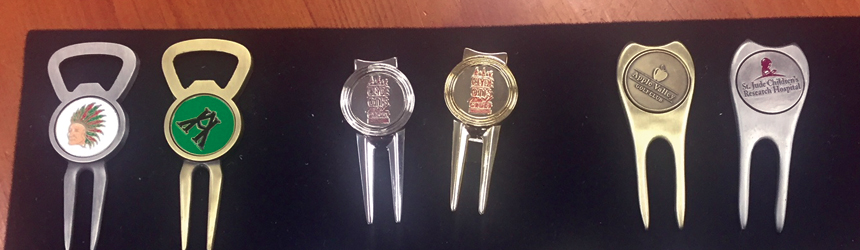
Above: Heritage Bay Enterprises works out of a 4,000 square foot workspace in North Kingston, RI printing promotional materials with its Mimaki JFX200-2513 flatbed UV printer and DCS 1024UVMVP6.

Heritage Bay Enterprises
Founded in 2008, Heritage Bay Enterprises started with one employee in North Kingston, RI. The company originally offered printed golf products, hat clips, and ball markers to ten states from a 500 square foot garage.

“The golf industry has a huge cross over into the promotional product industry,” says John Mitch Centracchio, national sales manager, Heritage Bay Enterprises.

The company now has five employees and offers its solutions to the Bahamas, Bermuda, Canada, Dominican Republic, Europe, and the U.S. From a 4,000 foot workspace, it offers anodizing, digital and screenprinting, epoxy, powder coat, and plating services.

According to Centracchio, a majority of the shop’s business is labels. However, it prints on a variety of promotional products including acrylic, bag tags, bottle openers, coasters, coins, cuff links, key tags, and poker chips.

In May 2015, Heritage Bay Enterprises began printing with a Direct Color Systems (DCS) 1024UVMVP6 UV inkjet printer. The DCS 1024UVMVP6 features a printing area of 10×24 inches with a maximum substrate height of six inches. It prints 4,645 square inches per hour in color. The press features three-dimensional prints, cylindrical and bottle printing, and prints on acrylic, aluminum, ceramic tile, foamboard, glass, metal, promotional products, polyester, stone, and wood.

“It’s a small format printer that paid for itself in about a year,” offers Centracchio.

In February 2017, the company purchased a Mimaki USA, Inc. JFX200-2513 flatbed UV printer. The JFX200-2513 features a maximum print area of 98.4×51.1 inches with up to two inches in media thickness. It prints at 269 square feet per hour and is suited for backlit displays, décor, glass, interior décor, metal, posters, and signs. “We’re extremely happy with both models,” says Centracchio.

Heritage Bay Enterprises uses manufacturer inks and software. “All of our materials are completed and ready after digital printing,” he shares. Since 2008, most of the company’s media consists of metal made in Providence, RI. The company also prints on acrylic, plastic, and poker chips.

According to Centracchio, the promotional materials industry is and always will focus on product delivery. This is challenging when customers expect particularly short turnaround times. “Everybody needs everything yesterday. When most people can’t get it done in time, they call us. We figure it out one way or the other.”

The shop recently noticed a high demand for personalization. “The challenge is getting all the correct information needed to execute the order,” says Centracchio. “There are almost always add ons or corrections in spelling from customers.”

Customized Awards
In 2017, repeat customer Genesis approached Heritage Bay Enterprises for a promotional materials job. The client requested six personalized acrylic awards for an AIDS awareness event.

Heritage Bay Enterprises used high-end acrylic and reverse printed at 600×600 dpi using its Mimaki JFX200-2513. The printer was ideal for this particular job because of its print quality and the ability to personalize each award.

The final six acrylic awards were 4×12 inches, three-fourths of an inch thick, and personalized individually. Centracchio says the company faced challenges regarding the acrylic thickness while maintaining resolution and registration.

From job submittal to delivery, the project took five days to complete. According to Centracchio, the client was extremely satisfied with the finished awards. “The design layout, customization, and personalization of the award was very unique.”

Promotional Materials
Digital flatbed presses allow businesses to offer customers unique applications that promote brands, events, and products.

Mar2018, Industrial Print Magazine

Simplified Design

By Cassandra Balentine

The fashion industry benefits from software advancements and digital print technologies. The latest tools help designers automate, collaborate, visualize, and manage products easily throughout the product development process for better supply chain management and faster time to market.

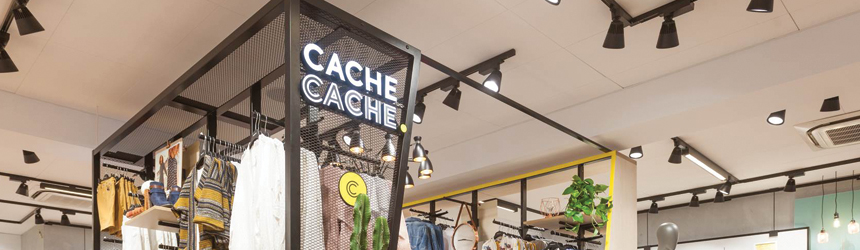
Above: Cache Cache, part of Group Beaumanoir, works with advanced technological software solutions from Lectra to develop its apparel line. This includes 3D visualization software, Modaris 3D.

Global Retailer
Founded in 1985, Group Beaumanoir is an European-based fashion retailer and solutions provider of logistics, ecommerce, consulting, and marketing for retail. The company has more than 2,850 sales points for its popular brands including Bonobo, Bréal, Cache Cache, Morgan, Scottage, and VIB’s. Created more than 35 years ago, its primary distribution center is located in Pleudihen-sur-Rance, France, close to its headquarters in St. Malo, France.

Group Beaumanoir partners with Lectra, an integrated technology solutions provider dedicated to industries using fabrics, leather, technical textiles, and composite materials to manufacture products. Of Lectra’s solutions, Group Beaumanoir utilizes Lectra Modaris, a fashion industry software solution for product development and pattern making designed to meet industry demands for shorter lead times, perfect fit, and streamlined development. The company also utilizes Lectra’s Diamino pre-costing and marker-making software solution.

While the company has partnered with Lectra for more than 15 years, in 2014 it turned to the technology solution provider’s 3D visualization software in search of a better way to envision and share prototypes for its Cache Cache brand.

Cache Cache is one of the retailer’s six fashion brands and is present in 21 countries with 14,000 collaborators worldwide including 1,500 stores located throughout France and across Asia, Europe, and the Middle East. Because it is part of a global operation with more than 2,700 stores nationally and internationally, competent supply chain management—starting from product development—is essential to its continued success.

Group Beaumanoir looked into Lectra Modaris 3D virtual prototyping software specifically for Cache Cache and decided to invest with a goal of saving time, reducing the number of samples produced, and increasing its volume of products for the womenswear brand.

As an existing Modaris user, the 3D virtual prototyping solution was appealing. Therefore, Modaris 3D was implemented in design offices located in St. Malo as well its Shanghai, China office.

Lectra created Modaris 3D to provide true collaboration through shared visualization. The company says its product development solutions are designed to give control early on in the product lifecycle to help manage costs and volume fluctuations. Lectra adds that 3D virtual prototyping shortens the fashion product development cycle by reducing the need for time-consuming physical samples, manual grading, and physical fitting sessions.

3D Product Creation
Group Beaumanoir’s St. Malo office is where the creation and development of Cache Cache products occurs. With Modaris 3D, the company reacts rapidly to evolving demand from its customers and suppliers. The technology allows its stylists and product managers to easily collaborate and make choices while on the same screen based on 3D prototyping.

While the Modaris 3D solution was first rolled out for dresses, it was soon extended across all of Cache Cache’s collections. A decision the fashion company says was driven by the reduction in the number of prototypes possible. Manufacturing for the brand is sub-contracted out to a network of suppliers, so by replacing the need for physical prototypes with virtual prototypes, exchanges between the design office and sub-contractors are simplified to save time, materials, and reducing stock—enabling high response rates.

Claude Pigearias, product officer expertise, and process director, and Jeannine Guillaume, technical manager, Cache Cache, explain that with a sketch from a designer, the model maker creates a pattern in Modaris 3D. The correct fabric is selected in the Modaris 3D software, which is used to create a virtual sample. When the virtual sample is ready, it is sent to the designer and product manager for approval. Once a virtual sample is approved, including the pattern and technical files, they are sent to the supplier to create the first physical sample.

Modaris 3D has improved the collaboration between model maker, designer, and product manager. The company plans to continue to use Modaris 3D and create more virtual samples.

“Highly responsive, Cache Cache is permanently adapting to developments in fashion across its many markets,” shares Guillaume. “3D is the right choice for our brand. By advancing more quickly at the product development stage, our teams have more time to dedicate to new creative ideas. In addition, we achieve considerable all-round savings thanks to improved exchanges between our suppliers.”

While Group Beaumanoir greatly benefits from the 3D prototyping solution, the deployment of the software did not come without challenges. When Modaris 3D was first implemented, Pigearias and Guillaume say they worked to improve the quality of the virtual sample to obtain a result that was as close to the actual product as possible.

Additionally, Pigearias and Guillaume explain that while all of the fashion company’s products are well suited for product development with Modaris 3D virtual prototyping software, some finishes are not very visible in the virtual sample.

Advanced Prototyping
With 3D prototyping software, Cache Cache and Group Beaumanoir—major contributors of the accessible fashion market in France—are able to move quickly through product development, allowing for a quicker time to market. It also brings cost savings due to a more seamless process for supplier communications.

Mar2018, Industrial Print Magazine

Scaling Up

By Olivia Cahoon

Additive technologies allow for design freedom and extend beyond the limits of conventional manufacturing. By building upon layers of material, additive manufacturing techniques enable a variety of three-dimensional (3D) printed prototypes for functional use. Manufacturers that take advantage of this can provide clients with cost-efficient volume manufacturing and reliable quality.

Above: Fit, based out of Lupburg, Germany, operates one of the largest EN-9100-certified additive metal production facilities in the world. It recently added five EOS M 400-4 additive manufacturing systems, designed for the industrial production of high-quality metal parts.

FIT Technology Group
Founded in 1995, FIT Technology Group is a provider of rapid prototyping services and additive design and manufacturing headquartered in Lupburg, Germany. The company started with two people out of a garage-sized workspace with a local outreach.

FIT originally offered paper lamination, which lead to its purpose-built factory for additive manufacturing—one of the largest capacities for metal parts to date. The company soon established itself as an all-in-one provider and special manufacturer in the field of additive manufacturing.
Today, the company has 330 employees with locations worldwide and operates from an 8,000 square foot factory. Both national and international companies rely on FIT to quickly and efficiently supply them with optimized, additive manufactured components.

FIT manufactures hybrid parts using additive and conventional manufacturing methods. The company also produces prototypes for functional testing as well as design models and pilot series. Its manufactured parts are offered in quantities as small as one to mass customization. For prototyping, the company uses materials like ceramic, metal, and plastic. “It is a common error to believe that you can produce one part by alternatively additive or conventional technologies. The two solutions cannot simply be compared, they are too diverse,” says Carl Fruth, CEO/founder, FIT. He believes some projects are more suitable for conventional techniques and others for additive technologies. Regardless of the manufacturing method, FIT performs a series of tests and trials to ensure full functional approval is given. This includes test drives, endurance tests, proof of temperature resistance, and test assembly.

Functional 3D Printing
FIT first offered 3D printing using selective laser sintering technology—an additive manufacturing technique that uses a laser to sinter powdered material and form a solid 3D model. Today, 80 percent of the manufacturer’s work is 3D printing.

In April 2016, the company started operating the FIT Factory where it deploys a number of EOS 3D printing systems. It is one of the largest EN 9100-certified additive metal production facilities in the world.

For example, the manufacturer uses the EOSINT M 280 for additive manufacturing metal products directly from CAD data. It is a direct manufacturing solution for high-quality metal tool inserts, prototypes, and end products. The EOSINT M 280 features a build volume of 9.85×9.85×12.8 inches with a scan speed of 23 feet per second. It is compatible with a range of materials from light alloys to high-grade steels, tool steels, and superalloys.

FIT uses a range of materials for 3D printing including metals like aluminum, steel, and titanium as well as plastics like FIT alumide and thermoplastic polyurethane. The manufacturer also creates industrial-scale ceramics using additive manufacturing methods. According to Fruth, 3D technology combined with traditional ceramic firing and glazing produces ceramics of unrivaled beauty, design innovation, and functionality.

The manufacturer also works with common elastomers like rubber, silicone, and viton to manufacture elastic molded parts. During rubber molding, each material undergoes a standard quality check regarding vulcametry, density, shore hardness, and elongation at break. Rubber molding is used for niche products, spare products, special machines, vintage/classic cars, and special purpose vehicles like ambulances, firetrucks, and communal utility vehicles.

3D objects that require finishing use further materials for a durable and polished appearance. After 3D printing, the finishing process can include assembling, color, glass bead blasting, metal coating, precision engineering, and sand blasting.

“The choice of material depends on the customer’s project and the specification regarding the intended part, as well as our recommendation,” offers Fruth.

To design 3D objects, the company uses Netfabb software and its own proprietary software. Netfabb is an additive manufacturing and design software from Autodesk Inc. with tools to streamline additive workflow. It includes features for editing models for production, additive manufacturing simulation, lattice and surface optimization, and automatic packing.

Fruth believes manufacturers can overcome these challenges by selecting the best-serving technology that offers quality compared to costs. Additionally, he says it’s important to have assistance for additive engineering and to train customers in engineering workshops.

EOS Innovation
FIT recommends metal 3D printing for functional prototypes and small batches. The manufacturer offers clients high accuracy, good mechanical properties, economical value in highly complex components, reduced lead times, and the ability to produce complex geometries that unachievable through conventional methods.

To keep up with the demand for metal 3D printing, FIT invested in five EOS M 400-4 systems in 2017. The EOS M 400-4 is an additive manufacturing system designed for the industrial production of high-quality metal parts. With the five EOS systems, FIT intends to increase the diversity of the materials it can process in house and boost its manufacturing capacity.

“The new generation of EOS systems not only convinced us with the outstanding quality of the produced components, but above all with its open interfaces, which allows us to seamlessly integrate these machines in our quality assurance concepts—a further big step toward achieving the industrial scale additive manufacturing of components,” says Fruth.

The system also recoats powder material from both sides to reduce non-productive time while a recirculating filter system with automated cleaning reduces filter changes and extends filter lifetime—ultimately reducing filter costs.

“It is our objective to supply customers with components of exceptional quality from one single source. We intend to achieve this objective as we move forward with EOS as a dependable partner and long-term supplier,” offers Fruth.

Opportunities Arise
Additive manufacturing provides manufacturers with the tools and technology to create prototypes and functional parts with greater detail in less time. Using this 3D printing method, FIT produces functional prototypes for multiple industries. By implementing five EOS M 400-4 systems, the company intends to expand its additive manufacturing offering on an industrial scale.

Mar2018, Industrial Print Magazine
Remaining in Control

By Melissa Donovan

There is always a need for graphic overlays, as they are typically found on devices requiring a control panel. Traditional printing methods are costly when it comes to variable runs of graphic overlays with increased SKUs. However, screenprinting offers a level of required durability in addition to a high-quality visual, which is an important element to any brand.

Digitally printing graphic overlays is a huge opportunity for manufacturers, whether in plants or outsourced label producers. Variable runs are much more cost effective, as are prototypes and runs of one. Tools and die costs are also removed as these functions are simply not required when digitally printing. Lastly, many digital printers offer clear coating in ink channels, which mimic embossing and create raised buttons or textures commonly found on graphic overlays.

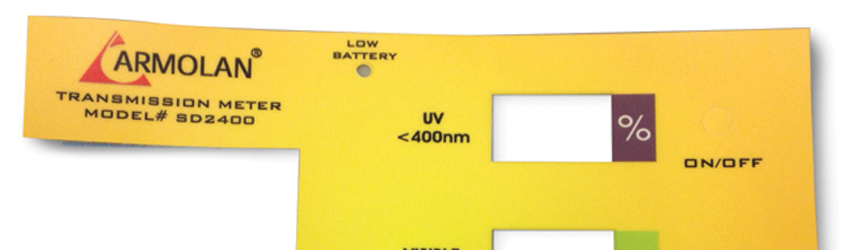
Above: This design, from Yorba Linda, CA-based Becker’s Fabrication, has a very fine gradation in the yellow along with a high color count. The company’s Roland VersaUV LEC makes the production of this piece efficient.

Creating an Impact
Based in Yorba Linda, CA, Becker’s Fabrication, Inc. celebrates over 30 years in business. It began in Carlsbad, CA in the 1980s with the goal of supplying shaft band labels for the golf industry using hot stamp machines and a small lithography press. Dan Becker started the company out of a 3,500 square foot building.

Today it offers digital, flexographic, hot stamp, and silkscreen printing processes. Custom labels, overlays, and membrane switches are created for pool manufacturers, medical suppliers, and industrial production companies in addition to continuing to support the golf industry. A staff of 25 employees works out of a 14,000 square feet shop.

Familiar with digital printing, the company incorporated the technology into its business in 1991. According to David Beilfuss, GM, Becker’s Fabrication, as a customer-driven business it looked for printing technologies that could accurately portray spot colors and other shading and graphic effects on materials like lexan or polyester.

“We have the challenge of printing 100 percent of our products on synthetic substrates like vinyl, polycarbonates, and polyester. As digital printing technology became more commonly used for printing on paper and other substrates, customers began searching for options. It quickly became apparent that we either needed to accommodate these requests, or risk losing business to competitors who were adopting newer digital printing technologies,” explains Beilfuss.

With the first digital printer it adopted in 1991, the team was able to print on smaller parts, but they soon realized they needed a printer that could output on wider and longer parts as well. Becker’s Fabrication decided to add a VersaUV LEC series 30-inch printer/cutter from Roland DGA Corporation. It is used for production parts as well as prototyping or membrane switches, overlays, and any sort of durable label.

The VersaUV LEC runs with Roland ECO-UV ink, which is fast curing and allows for printing and cutting in the same day. “Our Roland’s specially formulated UV inks and UV LED lamps allow for exceptionally fast curing times. We can print a part, add adhesive, and then cut the final product within hours. Not providing cure time can negatively affect the ultimate bond between the ink and substrate. With the Roland, curing time is virtually instantaneous,” shares Beilfuss.

Becker’s Fabrication runs CMYK and white in the printer on a regular basis. The white inks create opacity on clear film for certain applications, allowing the company to branch out into new directions. For example, it has used the VersaUV LEC to print customized iced tea and coffee urn wraps.

In addition to the Roland, the company’s digital printing equipment lineup includes an Afinia Label DLP-2000 mini digital label press and an HP, Inc. Indigo 5600. For finishing, it employs an Esko Kongsberg digital knife cutter and a 60-inch wide Advanced Greig Laminators, Inc. laminator.

Straight to Overlays
Graphic overlays like control panels and membrane switches are ideal for digitally printing. “The control panels and graphics are the visual interface between our customers’ products and the end customer. This puts the responsibility on the printer to create the perceived value that pleasing and intuitive controls can provide,” explains Beilfuss.

Becker’s Fabrication takes that responsibility seriously. With the Roland VersaUV LEC it is able to not only provide high-quality graphics, but quick time to market. “One of the major advantages of the Roland is the exceptionally fast screen-to-substrate time frame it allows. We can print within minutes, and the larger format enables us to maximize both material use and efficiency. The rapid UV curing makes production much quicker, allowing us to get the end products to our customer that much faster,” adds Beilfuss.

This is compared to screenprinting, where a film must be output and developed, then a screen shot, and each color printed one at a time—all multiple days of work.

The company still produces graphic overlays using either screen or digital print. Beilfuss says many considerations are taken into account when deciding between the two processes. The job is generally run on digital if it requires complex pictures or shading, the customer needs the finished part in a day or two, dynamic information like barcodes or database merging is required, the job involves more than four colors, or the size is too large for screen presses to handle.

Conversely, a project might be run on the screenprinters if the graphics allow for the use of spot colors or it involves higher quantities—or large total printing when viewed as total square inches.

The Digital Demand
Digital printing graphic overlays is a must for Becker’s Fabrication. “While screenprinting is still an efficient process, it’s now possible for us to use digital presses exclusively to supply the markets we serve. Digital printing is now a necessity for the industrial printing market,” concludes Beilfuss. The technology offers quick turnaround, variability if needed, and cost-effective short runs.

Mar2018, Industrial Print Magazine