Order Up

By Melissa Donovan

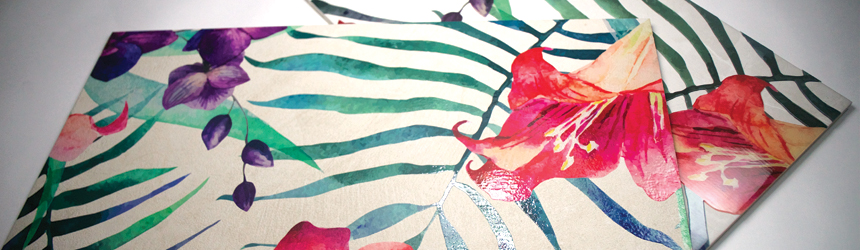
In 2016, the InPrint Industrial Print Show ran a survey with I.T. Strategies in regards to décor and its place in inkjet. The InPrint Décor Survey & Report asked participants which segments within décor have the strongest potential for digital/inkjet technology. 53.92 percent of respondents chose flooring and laminates.

Flooring, according to Mark Hanley, president, I.T. Strategies, is defined as anything covering a subfloor. The estimated value of the 2014 global flooring market was $240 billion wholesale dollars.

Thanks to advancements in inkjet technologies, short-run, custom work is becoming more common. Digital printers are integral in the creation of decorative laminates primarily used in flooring, but sometimes even countertop, doors, cabinets, siding, or wall applications. Features like expanded color gamut and durable UV ink sets are attractive to surface manufacturers.

Single-pass devices are frequently used in high-production facilities, but multi-pass printers are ideal for specialized, one-off requirements. Some presses print directly to the laminate substrate, but technology needs to fully mature to make that a cost-effective reality. Currently, most processes involve directly printing to a décor paper, which is then applied to the substrate. To increase the adoption rate of digital printers in the flooring space, manufacturer needs must be met.

Above: The Roland VersaUV LEJ-640FT UV flatbed printer utilizes CMYK, white, and clear coat inks to offer the ability to include textures and simulate embossing on output.

Influenced by Digital
Digital influences decorative laminates used in flooring, countertop, and wall applications. Prior to digital this work was accomplished in other ways, which are not as cost effective when it comes to smaller, more customized runs and quick time to market.

Printing decorative laminates traditionally involves the use of engraved cylinders or rotational gravure printing. “Gravure printing is a specialty process requiring an engraved cylinder that costs up to $10,000 for each color. With a four- or six-color process, it could cost up to $50,000 or more. And, there are fewer plate suppliers available to do this work, which reduces the number of designs available on the market,” explains Gerard Winn, senior product manager, Xaar.

“This method presents problems as printers try to scale the projects they’re printing, especially when it comes to minimum run rate. This ends up putting the liability for extra inventory on the laminators, a burden that, in the end, ends up costing them an extra $1 million dollars every year on average,” continues Patti Smith, VP, worldwide marketing and sales operations, commercial inkjet printing, Eastman Kodak Company.

The final part of the process is also time consuming, although it delivers in the durability department. “Traditionally, decorative laminate is manufactured either by a high-pressure laminate system or thermally fusing the laminate by layering and fusing a resin-impregnated sheet of décor paper directly to a special composite or substrate,” says Jay Roberts, product manager, UV printers, Roland DGA Corporation.

As small quantities and increased variety continue to be the norm, decorative laminate manufacturers look for ways to speed up time to market and shorten the production process. Digital printing technologies is one option.

“Digital makes the industrial production of small batch sizes possible. This goes along with the individualization of mass production. The producing companies can embed the digital printing in existing process chains. They can react quickly on market trends and customer demands and profit from the shorter time to market. The shorter set up times are another aspect of the flexibility that industrial inkjet ensures,” shares Dr. Rene Pankoke, owner/CEO, Hymmen GmbH.

Sumio Arima, senior manager, PD 2 sales department, corporate printing device group, Kyocera Corporation, agrees, explaining that the implementation of inkjet printheads has contributed to the shortened process by eliminating the need for printing plates and allowing for the immediate printing of only the required amount of design data.

Print on demand is just as useful to decorative laminate manufacturers as any other segment—think book publishing or textiles. “Organizations don’t have to keep a large inventory of material on hand just in case and are able to better allocate resources as they’re actually needed and save significantly on inventory and warehousing,” admits Smith.

Featuring Digital
Specific features on digital printers—for example wider color gamut to achieve better tones and realistic shades—make the technology ideal for decorative laminates.

At Kodak, the inks used in the company’s digital processes are micro-milled down to nanoparticles, which reduces scattering in order to get a wider color array, maximizing print quality on a variety of substrates. It also prevents metamerism, which is the perceived matching of colors in some lights that don’t actually match in other lights.

“In the décor market, metamerism can be a major detriment because people’s homes are lighted in different ways. The last thing a laminator wants is to have customers think they’re getting one color, only to find that, in a different light, they have a different one,” explains Smith.

Digital UV inks are another popular feature. “The advantages of UV inks in particular are of interest to us. They work on paper processed from roll to roll, and also directly on boards. This is a feature that did not exist before digital. The direct printing on boards is only possible since the flexibility of digital printing can be used,” says Pankoke.

Single and Multi
Digital printers used for decorative laminates are predominately single pass. However, that doesn’t mean multi-pass printers aren’t an option.

Winn explains that in single pass, the printheads move directly onto a moving substrate. “Simply put, printing directly onto a moving web minimizes any time delay between sheets, so that you can print as fast as the inkjet technology allows,” he continues.

“Most of these printers use single pass, primarily because of the speed and efficiency that method enables. Since digital printing is used for high-volume productions, it needs to be able to produce at scale. Multi pass is primarily used for small digital presses that create samples and design proofs. They still produce great results, but just can’t match the output needed for the kinds of orders today’s decorative laminate printing projects entail,” shares Smith.

Most of the mass production printers are single pass, agrees Roberts. Multi-pass devices, like those from Roland, are tailored to more customized, boutique parts of the industry, according to Roberts. Roland is also involved in prototyping with its multi-pass printers.

The Direct Challenge
Most decorative laminate manufacturers using digital print on décor paper and then fuse it to the substrate. It is possible to print directly to the substrate, but this process requires further technological advancements for single-pass printers in particular.

“The technology for printing direct just isn’t there yet. Technology is, however, moving quickly in that direction because of the clear benefits that printing direct offers. By printing direct, more pressure is applied to ink drops, allowing for continuous printing and a greater throw distance. All of this results in a higher quality print,” says Smith.

Pankoke argues that both—paper print and direct print—is possible. “With direct printing on the board there are different technologies used, lacquering with UV lacquer after printing or applying melamine resin and drying in a hot press. The process depends on the individual needs of the customer,” he explains.

Multi-pass UV flatbed digital printers like Roland’s and other traditional flatbed machines are also able to directly output onto a laminate-type material. “This makes customizing flooring or cabinets much easier and speeds up the production process. Architects and interior designers can create truly one-of-a-kind products for their customers. Although these innovative UV flatbeds don’t have the ability to produce massive amounts of generic products, they are unbeatable for cost-effectively creating artistic one offs,” argues Roberts.

Delaying Adoption
There are factors delaying increased adoption of digital print into decorative laminates, however, vendors foresee these being overcome in due time. A constant dialog between the wants and needs of the decorative laminate manufacturers and printer designers is key to increased adoption.

“In many of the industrial laminates markets, digital print is replacing or complementing an already existing analog printing technology. Companies already in the laminates business and digital print solution providers need to continue a dialog and agree on the benefits and establish and communicate the value and positioning of industrial scale digital printing of decorative laminate to the market,” explains John Harman, business development manager, Ricoh Company Ltd.

For some, the fear of a digital printer going down or not performing consistently is enough to deter an investment. “Organizations turn to digital printing to process large orders in an efficient manner, but when they can’t rely on the press to perform consistently, this effort ends up being undertaken in vain. Since these issues drive up cost while decreasing speed of production, they’re some of the primary reasons that the industry is being slow to adopt digital,” admits Smith.

Arima believes the cost of special ink types is another barrier. “As special types of inks are required to realize high resolution in decorative laminates, the price trends of ink used to achieve high image quality is a challenge in the further adoption of digital printing.”

Printers that Décor
Printer manufacturers bring to market single- and multi-pass product lines specially tailored to decorative laminate suppliers. Other products, not necessarily just for decorative laminates, are also available.

Hymmen Jupiter single-pass digital printing lines can print substrates in required lengths with any design. Each design can be placed in a row one after the other. The line allows for the reproduction of any design at any time in case of a special order. Six models make up the portfolio—JPT-W 840, JPT-W 280, JPT-W 560, JPT-C, JPT-W 1400, and JPT-L. All vary in maximum print width and some print board substrates versus roll materials.

Kodak’s laminate décor solutions are driven by Kodak Stream Inkjet Technology. It offers color consistency, robustness, and durability comparable to gravure printing. With water-based nano-particulate pigment, a wider color gamut, low cost, and image permanence are all offered.

Roland offers the VersaUV LEJ-640FT UV flatbed printer. It prints onto materials up to six inches thick and weighing 220 pounds. The multi-pass printer utilizes CMYK, white, and clear coat inks to offer the ability to include textures and simulate embossing on output.

SPGPrints announced in November 2017 the PIKE 700 UV inkjet hybrid printer. It combines digital capabilities with pre-treatment and added-value finishing processes, in a single pass. At 700 millimeters wide, the roll-to-roll press features up to ten inkjet positions in a central cylinder configuration with CMYK plus white standard. It reaches a maximum resolution of 1,200 dpi. The PIKE 700 is designed to enable consistent color uniformity within 1.5 DeltaE on both supported and unsupported paper and film materials up to 450 micrometers thickness.

Strong Value Proposition
Decorative laminates are increasingly used in flooring, as well as countertops, doors, cabinets, siding, and even wall applications. In using digital printing technologies, the capability to offer personalization in a quick manner becomes a reality. “As the world demands more customized products along with a faster time to market from designer to print, and a wider range of laminate designs, digital enjoys a strong value proposition,” concludes Winn.

Jan2018, Industrial Print Magazine
Redesigning Decor Manufacturing

By Cassandra Balentine

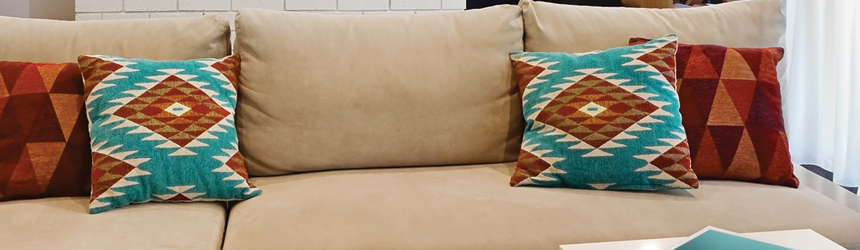
Digital textile printing is applicable for a variety of products. With a range of methods, including dye-sublimation (dye-sub), transfer dye-sub, and direct to textile, wide format digital print engines are an increasingly attractive solution for use in the manufacturing of home décor products like curtains, tablecloths, and other drapery items.

“Compared to other methods, digital printing currently comprises a very small percentage of this market. That means there’s plenty of room for growth and new opportunities,” suggests Lily Hunter, product manager, textiles and consumables, Roland DGA Corporation.

Above: Roland’s Texart series dye-sub printers-the RT-640 and XT-640- are equal for decor applications like drapery and bedding.

Mixed Print Benefits
Traditional print methods remain prevalent in industrial textile decoration. However, as digital print engines continue to advance and customer demands evolve, digital technologies are adopted for use in décor. Manufacturers bringing digital to the mix do so by incorporating it into existing processes, creating a mixed print environment.

Tom Wittenberg, Americas LF marketing manager – sign and décor, HP, Inc., points out that one of the best ways for digital and traditional print technologies to work together is by using digital as a prototyping unit. “With traditional print, the turn times for prototypes are too long. With digital, the prototype is turned around quickly for the end user and the selling process driven much more quickly for the manufacturer,” he says.

Digital allows for cost-effective sample making, which keeps all the sampling in house. “Digital also allows for small production runs in an almost immediate time frame,” agrees Randy Anderson, product man-ager, Mutoh America, Inc.

“Digital textile printing offers a cost-effective way to test designs and potential fabrics in a real-world setting before engaging long production runs,” adds Tommy Martin, product manager, textiles and apparel, Mimaki USA, Inc. “Digital printing also affords designers more freedom due to the wider color gamut available.”

Mark Sawchak, partner, PremEx Solutions, notes a manufacturer printing home furnishings with both traditional and digital high-speed production capabilities who found that for an order consisting of at least eight colors and two different color ways, digital is more efficient to produce run sizes of 16,000 yards or less. He adds that the manufacturing cost is also less in this scenario.

“This type of technology allows for gradients and photographic images, which can’t be easily archived through traditional processes like screenprinting,” says Hunter of digital textile printing. “By digitally printing in house instead of outsourcing, manufacturers can shorten turnaround time for proofs and/or production, increase quality control, and make changes more quickly. Used in conjunction with traditional print methods, digital printing can increase versatility and efficiency, allowing users to customize different types of décor faster and at a lower cost,” she adds.

In addition to environments that feature both traditional and digital print capabilities, hybrid solutions combine the technologies on one machine. “Hybrid printing offers many advantages, this goes far beyond inkjet imprints and the insertion of digitally printed supplements. Entire production lines combining both offset and digital presses are set to increase the economic viability of print production,” foresees Juan Kim, CEO, Valloy Incorporation.

He explains that when the hybrid printing concept was introduced it was more like adding an analog process on a digital workflow. “Digital, single-pass inline inkjet printing modules are added more easily than ever onto many different analog printing processes, including textiles. It adds variable data marking or spot varnishing to an existing process with minimum investment. So this approach will accelerate digitization everywhere without requiring a huge burden of full conversion into digital for large and fast facilities,” suggests Kim.

Popular Processes
Those interested in digitally printing onto textiles have options, including dye-sub, transfer dye-sub, and direct to fabric printing. These processes also involve different ink types.

The best process is really about the intended final output, suggests Martin, adding that it relates more to the ink set, rather than the printer.

He brings us through the different technologies, their strengths, and primary applications of traditional digital textile inks, including dye-sub, reactive, acid, and textile pigment.

Martin says dye-sub—also known as dispersion—inks yield vibrant colors with lower exterior longevity, but increased wash fastness. “This ink is primarily used in active sportswear and exhibit graphics. It is limited to polyester based on polymer-coated materials,” he continues.

While dye-sub inks are typically used in a transfer process, they are also used to print directly onto fabrics. Direct to fabric printing eliminates the need for transfer paper, making the overall process less step intensive. However, Martin explains that fabrics for direct printing need to be coated, which increases the cost of fabric. “Coated fabrics prepared for print are also limited in types and weights. When directly printing to the fabric, the images are not as sharp and colors don’t pop like in the transfer process. This process also requires post processing to set the dyes,” adds Martin.

Reactive ink is a chemical process using a molecular dye that yields excellent wash and light fastness for applications like home furnishings. According to Martin, it can be used on pre-treated natural fibers such as cotton, linen, silk, rayon, hemp, viscose, and bamboo. The printed fabric must be steamed and washed. The steaming process sets the dyes in the fabric. The time it takes to steam depends on the type of steamer and can be anywhere from ten to 20 minutes. “Washing is necessary to clear any uncured ink and pre-coating—required for bed linens and apparel. It is simply a hot water process, no detergents or chemicals are necessary. This adds a soft hand back to the fabric that was lost after the pre-coating,” offers Martin.

Acid ink offers improved exterior longevity, making it ideal for flag and banner applications. It etches into synthetic fabrics and can be used in swimwear. Acid ink is also used on pretreated synthetic materials such as nylon and spandex, as well as pretreated natural fibers including silk, wool angora, alpaca, and some leather. “The same steaming and washing process used for reactive ink is required to finish fabrics printed using acid ink,” says Martin.

Textile pigment ink offers excellent light fastness and can be used on all fibers. “This ink uses a heat fixation process and requires a resin-based carrier to bond to the fabric. The inclusion of resin removes pigment, resulting in lower wash fastness. It is a general purpose ink, more commonly used in offset and traditional analog printing methods,” explains Martin.

He points out that transfer dye-sub is popular for home décor applications. “This is an easy process and can be used with simple printing technology and simple heat transferring equipment.”

Anderson adds that dispersed pigment can be printed on a variety of fabrics—basically any coated fabric. Pigment also provides the best UV resistance. “This process works well for home furnishings.”

He explains dispersed dye can be printed on coated polyesters, but requires a sticky belt for stretch fabrics and the coating will add some hand to the product that may require washing.

Reactive die can be used to dye natural fabrics, suggests Anderson, but requires high-pressure steaming and washing as well.

“All methods of digital coloration have their place,” admits Sawchak. “It depends primarily on the market and the desired fabric type, which will define the type of ink required. This will then define the optimum method of printing. For example, a polyester product will be decorated by sublimation, direct disperse, or pigment ink depending on the end use product. Cotton products would be printed direct with either reactive ink or pigment.”

Manufacturer Considerations
Before investing in a digital textile printer for a manufacturing setting, several factors should be considered.

Valloy suggests thinking of the number of colors, printing width, ink compatibility, speed versus the number of printheads, accurate registration to print, and variable data control software.

Manufacturers should also consider the fabric types needed. “Polyesters are usually best done with dye-sub, natural fabrics need direct printing, and each fabric may use a different ink process to optimize the printed output,” says Anderson.

Color is another consideration. Anderson suggests eight channel digital versus four channel digital will give a greater color pallet where color gamut is critical.

“Keep in mind there will be a learning curve,” warns Hunter. “Printing is just one part of the equation, you will also need to focus on finishing—fixing the inks onto the textiles. For instance, in order for sublimation to take place, you’ll need a heat press.” She suggests factoring in the space available to accommodate the equipment required, including the printer and finishing devices.

Martin agrees, noting that primarily, the finished application including fabric type and maximum width should be considered when manufacturers are looking at digital print technology. “The target fabric and the type of finishing process will determine what type of ink can be used.”

Anderson notes that for bedding applications—sheets, comforters, and quilts—that the width is critical.
Hunter says a lot of fabric rolls are about 60 inches wide, so a 64-inch printer is ideal. “If you need to go wider, grand format printers can accommodate much wider media. Consider the widths of the fabrics you’ll be working with to determine whether a 64-inch printer is sufficient for the type of décor customization you’ll be doing.”

“Media handling is critical for natural fabrics to hold the fabric flat for good imaging, but stretch materials require a sticky belt system,” offers Anderson.

Manufacturers should consider speed to market. Sawchak points out that digital technologies allow rapid response and better customer service, flexible design, and custom printing. This provides new business opportunities to support e-commerce activities and the ability to consider restructuring supply chains that enable local manufacturing for local markets.

Wittenberg understands that every manufacturer wants to maximize the utilization of their equipment. “The key is asking this, ‘what else can I do with the printer besides décor?’”

Products on the Market
A variety of digital textile printers serve the décor market.

Within its FABRIJET Series, DGI offers its FD-1908 direct textile printer for mass production, including home textile applications. The device features a maximum print speed of 195 square meters per hour, a maximum resolution of 600×1,800 dpi, a print width of 1.9 meters, and eight colors—yellow, magenta, cyan, black, blue, red, orange, and gray.

The Durst US Alpha series offers print widths of 6.2 to 10.8 feet and can be configured with up to eight colors and 64 Alpha-S printheads that achieve a native resolution of 600 dpi and a print speed of 15,800 square feet per hour (sf/h). The series provides continuous ink circulation in all ink circuits for constant ink quality and reliable stand-by availability. A new intelligent feed system adapts automatically to different textiles and roll diameters. It combines new process technologies to control the interactions of printheads, ink system, textile material, tissue type, and pre- and post-treatment.

Within the series, the Durst Alpha 330 is used for the industrial production of home textiles including décor products such as duvets, linen, table cloths, curtains, and drapes. Depending on the number of printheads, the production output varies. Fully configured with 64 printheads, the Alpha 330 produces up to 460 running meters per hour and the Alpha 190 up to 620 running meters per hour.

The EFI Reggiani ReNOIR FLEXY is a digital textile printer equipped with the new Dynaplast system, which provides the ability to print with complete confidence on a variety of fabrics, ranging from knitted and woven to low- and high-stretch materials. For both sampling and production, the device features a production speed of over 400 square meters per hour maximum, with 240 square meters per hour with one pass. Typical print speed is 120 square meters per hour. It features eight printheads and a print width of up to 185 centimeters and up to 2,400 dpi resolution.

Epson’s Robustelli division manufactures the Monna Lisa printer in three wide format sizes, including 70-, 86-, and 126-inch options for roll to roll, direct to textile printing. It prints on cotton, silk, rayon, linen, wool, and polyester and leverages four individual ink sets—acid die, reactive dye, dye-sub, and pigment for the mass production of textiles. The Monna Lisa Evo Tre is the first industrial digital textile printer to integrate Epson PrecisionCore proprietary printing technology, which contributes to high productivity, with 402 square meters per hour in high quality.

HP offers a number of HP Latex technology printers for draperies from the HP Latex 365 to the HP Latex 3600. Wittenberg recommends always using media that is HP Certified for Latex inks for the best results.
Among its extensive line of textile printers, the Kornit Digital Allegro is a direct to fabric roll to roll system that offers a resolution of up to 600×800 dpi. Its maximum roll width is 70.8 inches. It features seven colors—CMYK, red, green, and grey. The Allegro prints to most common woven and knitted fabrics with Kornit’s water-based NeoPigment Intenso ink and fixation agent.

Media One offers the 3.3-meter Teleios Grande H6, which is a direct print and fixation solution. It features a maximum print width of 130 inches and resolution of up to 1,800 dpi. Printing up to 1,884 sf/h it offers six colors and six printheads. Ink sets include disperse dye, sublimation, and textile pigment. It includes a heat fixation unit that enables printing and color fixation at the same time without color difference in the front and rear/right and left.

Mimaki offers both transfer dye-sub and direct to textile printers. Its transfer dye-sub products include The TS30-1300, TS300P-1800, and TS500P-3200. The Mimaki TS30-1300 is a 54-inch, entry-level device available with fluorescent inks. Ideal for smaller items such as pillow covers, it can also be used for proofing designs. The Mimaki TS300P-1800 is a 77-inch production speed device available with fluorescent inks. It is used to create seating surfaces like pillow covers. The Mimaki TS500P-3200 is a 130-inch production speed device with bulk ink for long runs. It is used to create draperies and bedding without seams.

Mimaki’s direct to textile presses include the TX300P-1800, TX300P-1800B, and TX500P-3200DS. The Mimaki TX300P-1800 features a 75-inch dual-ink capability, which can print on materials with textile pigment ink or on polyester materials with direct dye-sub inks. The Mimaki TX300P-1800B is a 75-inch device that features a belt drive for stable. It can be used to create seating surfaces. The Mimaki TX500P-3200DS is a 130-inch production speed device featuring bulk ink for long runs. It can be used to create draperies and bedding without seams. This model includes an inline fixation unit that eliminates the need to calendar press the printed fabric.

Mutoh offers a variety of products for either dye-sub or direct printing. Dye-sub products are available from 25- to 104-inch widths. Its direct to textile products are available in 74-inch widths only.

PremEx Solutions provides a range of textile printers that include high-speed direct print and sublimation machines down to slower speed sample and prototyping equipment. The company also offers a range of finishing equipment to meet the production needs of a customer. In addition, it sells fabric, ink, and software as part of a total solution.

Roland’s Texart series dye-sub printers—the RT-640 and XT-640—are ideal for décor applications like drapery and bedding. These inkjets incorporate a host of advanced features that optimize sublimation output while minimizing operating costs. These include a bulk ink system, a choice of ink configurations, a heavy-duty take up system, and a specialized RIP.

SPGPrints offers the JAVELIN printer—available in either 72 or 126 inches in width. The machine has six Archer Technology print bars, each of which includes six Fujifilm Dimatix Samba printheads to achieve excellent and precise printing quality. It offers a print resolution of up to 1,200×1,200 dpi. For inks it offers reactive, disperse, and acid—six colors each.

Valloy offers the Topazet UV LED, which is a flatbed printer that can be used to print piece to piece, not with rolls.

Industrial Textile Decor
Digital textile printing technologies bring many benefits to industrial settings. While some devices are successfully used for prototyping, production runs are also possible for items like drapery, curtains, tablecloths, and bedding.

Jan2018, Industrial Print Magazine
Manufacturing Methods

By Olivia Cahoon

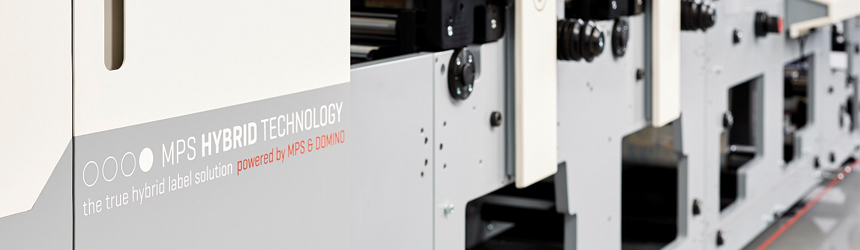
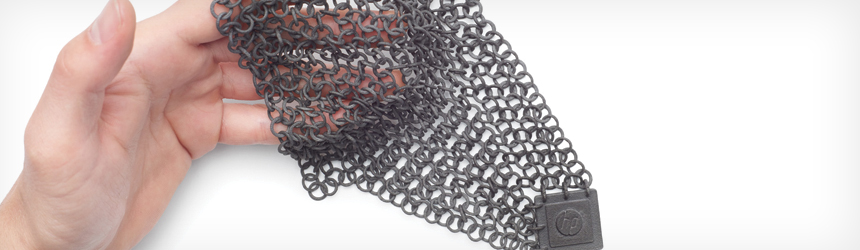
Three-dimensional (3D) printers are used in manufacturing settings to create prototypes, accelerate product development, and produce low-volume runs. Multiple methods of 3D printing exist, so manufacturers must decide which method best fits their needs.

Analyst firm, Gartner, identifies seven types of 3D printing technologies. Of these, two are comparable to print technology—binder and material jetting. Within these two types of 3D printing methods are various subcategories developed by 3D printer manufacturers using materials like acrylic, gel, metal, plaster, polymers, powder, and UV lighting.

Above: Proto Labs of Maple Plain, MN uses an HP Multi Jet Fusion using an HP Jet Fusion 3D 4200 3D printers to create custom prototypes for customers in the aerospace, automotive, consumer electronics, medical, and industrial machinery industries.

Binder Jetting
Binder jetting is an additive manufacturing 3D printing method that was developed in 1995 at MIT. It is also known as inkjet 3D printing or powder bed printing for its use of powder layers that bind to create an object.

The binder jetting process is similar to inkjet printing because it relies on printheads. 3D printers with binder jetting technology first distribute a layer of powder onto a build platform. The printheads then apply a liquid bonding agent, also known as a binder, which bonds the binder and powder together. The build platform is then lowered, and the next layer of powder and binder is repeatedly added until the object is complete.

Binder jetting allows for full-color printing by adding pigments, generally CMYK and white, to the binder. Because of its full-color capabilities, binder jetting technology is often used for rapid prototyping designs. In addition to color, parts can be made with a range of materials like acrylic powder, ceramics, metal, plaster, polymers, and sugar. “The inkjet component is the binder that holds the powder together and the color component for the outside of the print,” says Josh Hope, 3D printing and engineering products, Mimaki USA, Inc.

Using two materials, binder and powder, this 3D method allows for numerous combinations and various object properties like elastic, porous, smooth, rigid, and rough. It can be used for architectural construction, sculptures, statues, and short-run manufacturing in aerospace, automotive, and medical industries.

This technology is fast and inexpensive compared to other 3D printing processes. However, because a binder and powder are used, it generally produces fragile parts with limited mechanical properties unless additional post processing is applied, which prolongs the process. Additional mechanical properties include adhesives, epoxy, and melted wax. “Binder jetting prints are less expensive to produce but are more limited in resolution and are more fragile,” adds Hope.

Multi Jet Fusion
HP, Inc.’s Multi Jet Fusion is a sub-category of binder jetting that uses an inkjet array to selectively apply fusing and detailing agents across a bed of nylon powder. The powder and agents are fused by heating elements into a solid, which build upon layers to create a completed 3D part. “The process utilizes an engineering-grade nylon 12 powder, so parts are durable and suitable for functional testing and end use,” explains Ramon Pastor, VP/GM, HP Multi Jet Fusion, HP.

The process uses dual carriages that scan across the work area in perpendicular directions. As one carriage recoats the working area with fresh material, the other prints HP functional agents and fuses the printed areas. Pastor says this separates the processes of recoating and printing/fusing to optimize for performance, reliability, and productivity.

HP Multi Jet Fusion is used for short-run production, prototyping, and manufacturing production quality parts. Service bureaus and manufacturers can use this technology for parts traditionally produced with injection molding and CNC machining.

Released in November 2016, the HP Jet Fusion 3D 4200 uses HP Multi Jet Fusion for 3D printing. It produces at speeds of up to 42.29 square inches per hour with layer thicknesses from 0.07 to 0.12 millimeters. According to Pastor, by jetting HP functional agents using HP printheads, materials in the working area can be detailed, fused, and transformed point by point.

It uses thermoplastics including HP 3D High Reusability PA 12—a multipurpose thermoplastic. “HP 3D High Reusability PA 12 is ideal for making parts with complex surfaces and internal shapes for housings, panels, enclosures, and connectors,” shares Pastor. It also produces functional parts like gears, rotational joints, and sliders.

Material Jetting
Similar to inkjet printing and binder jetting, material jetting uses photopolymers as a replacement for ink, which builds to form layers cured with UV light. Material jetting is an additive manufacturing process also known as drop on demand and wax casting.

Material jetting uses printheads that jet accurate droplets of melted wax materials onto a build platform. Once the materials cool they are solidified, which allows additional layers to build on top of each other. Material jetting machines vary in complexity and methods for controlling the material’s deposition. Once building is finished the material layers are cured and hardened using UV lights.

During this process, a different type of wax with a lower melting temperature acts as a support structure for overhangs. It allows complicated geometries to be successfully printed. Support materials can be removed by hand, in a heated bath, or with a high-powered water jet station.

Material jetting can use multiple print materials in one process. These devices are preferred for color, high accuracy, and smooth surface finishes. The ability to use multiple materials allows for the production of multi-color parts using CMYK and white. Textured layers can also be applied like brush strokes, gradient colors, patterns, and wood grain. Opaque, rigid, rubbery, and transparent materials can also be produced.

These types of characteristics enable dental, jewelry, and medical industries to adopt material jetting devices. For example, medical industries use this 3D process to create educational anatomical models.

However, because the material is deposited in drops, there is a limited number of materials that can be used including plastics, polymers, and waxes. 3D printed products produced with material jetting are unable to handle high temperatures and are generally fragile. This limits its use for products that require functional testing or real-world applications. Post-processing methods for material jetting include dying, metal plating, polishing, sanding, and support removal.

Hope believes the main difference between binder and material jetting is what material is used to build structures. “Typically, binder jetting prints are less expensive to produce but are more limited in resolution and more fragile. Material jetting prints are more expensive and more durable,” he continues.

The Mimaki 3DUJ-553 is a material jetting device, released in December 2017. It uses CMYK, white, and clear inks alongside support material. The device includes an ICC compliant workflow, 20x20x12-inch build area, 22 micron layer thickness, and water-soluble support material. According to Hope, it achieves over ten million colors.

MultiJet Printing
MultiJet Printing is a type of material jetting that deposits plastic resin or casting wax materials by layers. 3D printers using this method use piezoelectric printhead technology for depositing consumables. The process uses thin layers of two UV-curable liquid waxes for building parts and support material. The support wax melts at a lower temperature and is post-processed with a no-touch method to prevent detail being lost during support removal.

MultiJet Printing builds molds, parts, and patterns with fine feature detail and layers as thin as 16 microns and resolution up to 1,200×1,200×1,600 dpi. These printers are typically office compatible and use standard electricity to create prototypes and indirect manufacturing aids. They are often used in aerospace, dental, jewelry, and medical applications because of the sharp-edge detail and high-resolution output.

3D Systems, Inc. released its MultiJet Printing 3D printer, ProJet MJP 2500W, in March 2017. It uses 100 percent RealWax VisiJet M2 CAST and eco-friendly, hands-free dissolvable wax VisiJet M2 SUW. The ProJet MJP 2500W prints 6.5 cubic inches per hour.

Jeff Blank, SVP, MultiJet Printing product development, 3D Systems, says the VisiJet M2 CAST wax material melts like standard casting waxes with negligible ash content in casting. “This wax material is durable for handling and casting fine features and the high contrast purple color allows for better detail visualization,” he offers.

The ProJet MJP 2500W is intended for intricate precision metal parts manufacturing with reduced metal hand polishing. According to Blank, casting foundries can eliminate tooling time, costs, and geometrics limitations while optimizing part and labor costs with the device.

PolyJet Technology
Created by Stratasys Ltd., PolyJet Technology jets a liquid photopolymer solidified by UV light. This process is similar to material jetting and uses an additive manufacturing technique that builds upon layers until an entire part is formed. It also uses a removable gel-like support material where overhangs or complex shapes require support. Support material can be removed manually or with a water jet.

PolyJet Technology can jet layers as thin as 16 microns to produce fine details and smooth surfaces. Multiple materials and full CMYK colors are jet into a single print allowing for over 100 material combinations. It’s used to produce anatomical models, fixtures, form and fit models, jigs, molds, and presentation models.

The Stratasys J750, which uses PolyJet Technology, features full-color capability because it operates five different colors at once. Parts are produced in over 360,000 colors, textures, gradients, transparencies, and durometers. In September 2017, Stratasys introduced new material compatibility for the printer—Stratasys PolyJet Agilus30 rubber-like material and Digital ABS Plus engineering-grade material. Agilus30 is ideal for many prototyping requirements including advanced design verification and functional performance testing. Digital ABS Plus enables users to build strong functional prototypes, manufacturing tools, molds, snap-fit parts for high- or low-temperature use, electrical parts, and product casings.

Gel Dispensing Printing
Massivit 3D’s patented Gel Dispensing Printing (GDP) is a material jetting process that uses photosensitive gel dispensed onto a platform and cured with UV light. “GDP cures rapidly under UV light, enabling instant solidification of the printing material and consequently achieving very fast print speeds,” says Judith Vandsburger, director of sales, North America, Massivit.

Released in May 2016, the Massivit 1800 3D printer uses GDP with speeds up to 14 inches per hour and optional dual-object printing. The Massivit 1800 requires Dimengel, a proprietary photo polymeric acrylic gel. It’s compatible with a variety of coatings and finishes like epoxy, fiberglass, polyester, polyurethane, and self-adhesive vinyl.

According to Vandsburger, the printer utilizes techniques that allow it to print non-vertical walls and ceilings without the need to produce a solid object or intensive support structure. “These unique material properties mean the Massivit 1800 can produce impressive objects while reducing material costs, weight, and time,” she offers.

The Massivit 1800 produces hollow, lightweight products. It includes a touchscreen printer control and a vacuum print table with printing liner for object handling. The printer produces displays, life-sized statues, and prototypes.

For wide format print providers and sign businesses, Vandsburger believes the Massivit 1800 could potentially open the door for new business. “If you are running such a company, the Massivit 1800 will give you the ability to differentiate your offering and enhance your application gamut,” she explains.

Fused Deposition Modeling
Invented by Scott Crump, founder, Stratasys, Fused Deposition Modeling (FDM) is an additive manufacturing 3D printing process that builds layers by heating and extruding thermoplastic filament. It’s an office-friendly solution that supports production-grade thermoplastics and produces complex geometries and cavities.

Using FDM technology, the 3D printer heats plastic filament to a semi-liquid state and deposits it in ultra-fine beads along the extrusion path. If the 3D product requires support or buffering, the printer deposits a removable material that acts as scaffolding.

It uses materials like acrylonitrile butadiene styrene, polycarbonate, and Utem 9085 to create prototypes with chemical and thermal resistance. FDM is used in applications like carbon fiber layup tooling, fixtures, functional prototypes, jigs, low-volume production parts, and manufacturing aids. Medical industries use FDM for biocompatible and MRI transparent products while industrial settings with heavy equipment use it for strength and heat resistance. FDM is also used in aerospace applications for flame, smoke, and toxicity certifications.

According to Vandsburger, FDM technology produces lightweight, high-performance tools in less time and reduced costs, improving production line efficiency and accelerating time to market. “For low-volume production applications, FDM and its advanced materials offer manufacturers the ability to 3D print customized, durable production parts on demand—reducing the dependency on tooling,” she explains.

Compared to inkjet technology, Ben Malouf, director of marketing, Aleph Objects, Inc., says that FDM printers are much simpler. “In FDM, we are melting a thermoplastic filament and pushing the melted material through a nozzle. The result is generally a single-color object,” he offers.

Released in June 2017, Aleph Objects offers the LulzBot TAZ 6 that uses material extrusion FDM printing methods. It prints up to 200 millimeters per second and uses a three millimeter thermoplastic filament. According to Malouf, it features open source hardware, big build volume, a heated PEI build surface, and more than 30 support materials.

“With the ever-growing variety of materials that open filament format printers can utilize, and more advanced post-processing methods developing regularly, the use of FDM 3D printers in production is just starting to gain traction with manufacturers,” adds Malouf.

However, FDM printing has been criticized for its slow process and inability to produce parts strong enough for industrial applications. Michael Schuldt, COO, Stacker LLC, says slow speed can be addressed by using a 3D printer that incorporates multiple heads so users can effectively print faster by printing multiple copies of the same objects.

One such printer is the Stacker S4, released in August 2016. It requires a 1.75 millimeter diameter filament and has four printheads that can print up to four copies of the same object at once. It features a build volume of up to 14x20x25 inches and uses a variety of nozzle sizes for higher detailed prints or faster speeds.

Additionally, companies like Stacker are currently creating technologies to produce plastic parts with added durability. “In 2018, Stacker printers will begin to include FlashFuse technology by Essentium, which will revolutionize 3D printed parts because now we are actually producing plastic parts that are stronger than injected molded parts,” says Schuldt. Parts with added durability include annealed parts printed with annealable PLA like I-Beam IMPACT PLA.

The 3D Future
3D printing in the manufacturing space has a large growth opportunity. According to Pete Basiliere, research VP, imaging and printing services, Gartner, by 2020, 75 percent of manufacturing operations worldwide will be using 3D printed tools, jigs, and fixtures made in house or by a service bureau to produce finished goods.

“Beyond their use as production tools, 3D printers are invaluable for manufacturing jigs and product testing fixtures,” says Malouf. Prototyping is the first use for Aleph Objects’ 3D printers with jigs and fixtures coming in second.

Additionally, Malouf believes the growth for 3D printing in manufacturing settings is tremendous. In fact, he says Aleph Objects manufactures LulzBot desktop 3D printers using 3D printers to fabricate many of the parts. At its factory in CO, the company operates 155 LulzBot 3D printers 24/7 to keep up with printer production and have printed nearly two million production quality parts since 2011.

“We have customers doing the same thing, printing retail-ready components for off-road motorcycles, photography accessories, automated testing equipment, and electronics enclosures. 3D printers make the customization process so affordable, it’s crazy not to take advantage of it” says Malouf.

According to Pardon, the 3D printing market is projected to grow at a 30 percent compound annual growth rate over the next five years. “With that said, the big opportunity is addressing and transforming the $12 trillion manufacturing market,” he explains. “From design to workflow to materials to fabrication to post-processing to supply chain to recyclability, there is an opportunity to transform every step of the value chain.”

For a better outlook on how 3D printing will become the norm in production environments, manufacturers can look at the foundry industry, which has extensively incorporated 3D printing.

By using 3D printers, foundries receive design freedom, reduced labor, higher speeds, and the ability to create intricate features. “Just like my children cannot understand how a world without smartphones and the internet could have functioned, foundries who adopt 3D printing do everything with improved efficiency—once they move this direction, there is no reason to move backward,” shares Schuldt. The potential for 3D printers in manufacturing is so high that he believes it will likely be common in most industries over the next ten years.

Blank agrees and says there is a significant growth opportunity for 3D printing that enables real metal parts to be produced in a variety of alloys at lower part costs. For example, using a traditional wax injection tool to create an axial turbine blisk mold requires at least five weeks and may cost upwards of $20,000.

In comparison to traditional methods, Blank says the time and cost investments for 3D printed investment casting patterns is much lower. “A typical 3D Systems customer can create a 3D printed investment pattern overnight and in the morning it is ready for the foundry at a cost of under $2,000,” he points out.

3D Production
3D printing methods like binder and material jetting are additive manufacturing processes comparable to inkjet printing technologies. FDM is another 3D printing method also commonly used in manufacturing. With a variety of consumables, these 3D printing processes aim to provide manufacturers with fast and cost-effective solutions for advancing productivity and providing full-color, intricate details. With reports of 3D printing expected to increase in manufacturing settings, opportunities for growth and automated manufacturing also increase.

Jan2018, Industrial Print Magazine
Surfaces Stay on Trend

By Melissa Donovan

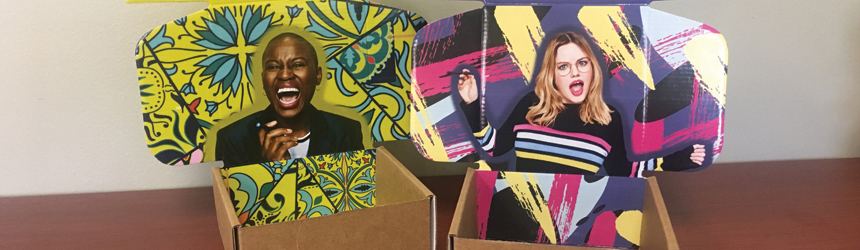
The decorative laminate space is full of possibilities, especially as digital printing technologies enter the picture. Not only does this technology offer the freedom to bring to life virtually any design, but its time to market is quick—something essential in today’s 24/7 internet purchasing world. In addition, smaller run lengths are much more cost effective compared to traditional technologies.

Buyers for both residential and commercial spaces look for unique, one-of-a-kind designs for anything from flooring to countertops or doors. Surface manufacturers with digital printing capabilities capitalize on this by offering bespoke services to their clients.

Above: The Related Group worked with Wilsonart to create 167 laminate sheets with eight different design patterns using the WxY service. The HPL was created using a proprietary digital print process and then manufactured into doors by Ampco by AJW. The doors are found in The Related Group’s luxury condominiums, Baltus House, located in Miami, FL.

Niche to Mainstream
Wilsonart began in 1956, founded by Ralph Wilson Sr., and today is a world-leading manufacturer and distributor of engineered surfaces like laminate, solid surface, and quartz used for cabinets, countertops, doors, furniture, lockers, kitchenettes, partitions, wall panels, and window sills. Globally, it staffs 4,500 employees with manufacturing out of 15 locations throughout Australia, China, France, Germany, North America, Thailand, and the U.K. Its headquarters is based in Temple, TX.

The company’s brand portfolio is vast, including Arborite, Bushboard, Durcon, KML, Laminart, Polyrey, Ralph Wilson, Resopal, and Wilsonart—found in big box stores like Home Depot and Lowes for consumers and other wholesale channels for commercial contractors and designers.

For the past 20 years, Wilsonart has offered decorative laminates via a proprietary digital print process. Prior to this—and like many companies—it relied on rotogravure printed decorative papers or solid color decorative papers to create high-pressure decorative laminates.

“In the early years, digitally printing was more of a niche, but as demand for customized decorative solutions grew, we dramatically increased our ability to respond to the market,” explains Ricky Crow, director of high-pressure laminate (HPL), Wilsonart.

He says that the company used a number of digital printers and evolved its practices as technology advanced. Currently, its decorative laminate manufacturing process involves pressing layers of resin treated paper. The digital printer prints on one of these layers before the pressing occurs. “We do this because it allows us to offer customers a product that has unlimited design flexibility paired with the high performance of a traditional HPL,” shares Crow.

Traditional HPLs are growing in popularity as architects, designers, and consumers realize the potential. According to Wilsonart, HPL possesses up to 12 times better wear performance, five times better impact resistance, and four times better scruff resistance compared to veneer—based on NEMA/ISO 4586 test results. Not only does HPL offer superior surface performance, the material is able to provide a realistic look resembling wood, stone, or tile.

Offering More with Digital
With one of the key benefits of using digital printers to create decorative HPLs being speed to market, Wilsonart collaborates with leading designers to create capsule collections that capitalize on trending designs. For example, Allie Douglass—a notable illustrator of magazines, newspapers, greeting cards, advertisements, and books—fabricated a whimsical collection that includes cityscapes, nature, and cotton candy-like skies. Other designs from additional artists include various countertop and wall applications from retro boomerangs to timeless architectural finishes.

“Capitalizing on the ease and speed to market with digital processes, we can launch on-trend designs at a much faster pace than that of the past,” says Crow.

Digital also propelled the company to start a custom service, WilsonartXYou (WxY). Anyone can submit their own artwork, photos, or illustrations and the WxY team will create a one-of-a-kind HPL. Files are submitted by CD, photo sharing service, or email. Once received, Wilsonart sends a free 15×19-inch pressed laminate sample in three to four days. After approval, lead time is around three weeks. Orders can be as small as one sheet thanks to the cost effectiveness of digital print. Sheets are available in three-, four-, and five-foot widths.

Condo Décor
The WxY service is attractive to buyers from many different backgrounds, from the household consumer to real estate groups looking for something unique. The latter is true for The Related Group, a real estate company that worked with Wilsonart to create custom doors for its latest development in Miami, FL.

The 15 story, 167 unit new construction development was led by Beauchamp Construction and designed by Cohen Freedman Encinosa. The Baltus House condominiums are located in Miami’s Design District. As such, a design was needed to reflect the area in which they are located. The idea was that every floor would resemble an art gallery—with each unit’s door displaying a different painting from Spanish artist Javier Martin.

The team at Wilsonart Engineered Surfaces and The Related Group initially met and discussed long-term durable alternatives to silk screening metal doors. One suggestion was to transpose artwork onto a wood veneer surface. However, this proved unsuccessful when it was discovered that the wood veneer surface did not carry the approved fire rating required of the condominiums’ doors. In addition, the wood veneer surface was too soft to paint over and dents and scratches would appear on the artwork over time.

Wilsonart proposed the WxY service. “There was no better solution. The ability to print created images on demand and imprint them onto a laminate surface—combined with our embossing plate technology to add realistic dimension—offers unlimited design possibilities. On top of that, you get the benefits of product consistency and long-term durability. We are very proud of the fact that Wilsonart’s decorative laminate solution addressed The Related Group’s needs for cost-effective, fire-rated, and long-lasting material,” explains Alina Van Katwyk, metro manager, Wilsonart.

Artwork submitted and laminate samples sent out, The Related Group approved the creation of 167 laminate sheets cumulative of eight different Javier Martin design patterns. A Fine Velvet Textured finish was applied to enhance the color in the artwork when lit by overhead lighting fixtures.

Wilsonart partnered with door fabricator Ampco by AJW to create the final product. “As a fabricator, we want to offer high-performing decorative surfaces for a value on any architectural doors that we produce. It is clear there is growing demand in the market for HPL given its multi-purpose applications from doors to partitions to lockers. We understand the desires for developers, architects, and designers to want unique and dynamic designs that can differentiate themselves from others. There’s no doubt that these distinct high-pressure laminate applications have raised eyebrows in the industry, heightened end user interest, and increased the value of the property overall,” shares Mike O’Neill, senior VP of corporate pricing and product development, Ampco by AJW.

Custom HDL
Wilsonart continues to expand its market reach in engineered surfaces by offering digitally printed decorative HPL. Through its custom service, WxY, anyone can upload a design and have it turned into a surface used for a door, floor, or countertop. Not only is this attractive to consumers, it is also a big business for real estate companies and partners looking to make commercial and residential buildings unique to their surroundings. The Related Group is just one of many businesses realizing the potential of digitally printed laminates and the benefits of working with companies that offer them.

Jan2018, Industrial Print Magazine
Hybrid Capabilities

By Cassandra Balentine

Brand owners rely on image to sell products and stand out on shelves. Therefore, product labels represent an important application that isn’t likely to go away anytime soon. Digital print has penetrated into this market, offering the ability to incorporate variable data and versioning economically with shorter runs.

Label converters are aware of this trend and employ digital printing technologies to meet the evolving demand of its constituents.

Meyers is a printing business owned by the Dillon family since 1949. The organization started with a single piece of printing equipment and has grown to an over 60 million dollar company operating out of a 250,000 square foot facility in Minneapolis, MN. It has 250 dedicated employees.

The print provider offers a range of services, including large format graphics, displays, cards, and coupons, as well as primary and functional labels for both established organizations and emerging companies. “We utilize digital printing technology primarily to produce large format graphics and primary labels. Digital printing allows us to offer the high level of print quality our customers have come to expect while doing so economically on short runs,” says Dave McConnon, VP of operations, label and card division, Meyers.

With an investment in large and versatile presses that print on virtually any substrate, the company has the skill set and equipment to get the job done whether it requires digital, offset, flexography, or finishing.

Above: Meyers recently utilized its MPS EF SYMJET printer to create holiday promotional labels for Ulta Beauty. The job incorporated four print technologies-cold foll, inkjet, rotary screen, and flexographic.

Digital Strength
Meyers invested in digital early, after adding an HP, Inc. Indigo digital press to its facility in 2003. The primary reason for the install was to produce variable data. Since then, Meyers has continuously upgraded its digital printing capabilities and expanded the utilization of the technology, enabling it to provide decorative effects on its prime labels. Today it operates both liquid toner and UV inkjet ink along with traditional printing methods.

Among its digital equipment line up, the company runs an HP Indigo WS6600. It was selected due to its ability to offer fast, high-quality printing. McConnon says the press’ output is consistent with what customers expect. A continuous-feed label printer, the HP Indigo WS6600 offers print speeds of 130 feet per minute (fpm) and a maximum speed of 196 fpm in one- or two-color mode.

One of its recent investments is the MPS EF SYMJET hybrid printing solution. “Meyers is committed to staying on top of new technology. In fact, we are the first organization in North America to add the MPS EF SYMJET hybrid printing press to our facility,” says McConnon.

The MPS EF SYMJET press is a hybrid flexographic inkjet solution that gives converters new print potential with the symbiotic combination of conventional and digital printing technologies. The press is built with the standard MPS EF platform and an integrated Domino digital N610i inkjet printer. With a Domino digital inkjet unit integrated on the EF platform, flexography and digital capabilities are combined and used integrated inline or separately to work offline.

The Domino digital unit uses Kyocera printheads to print a resolution of 600×600 dpi, with up to six colors and opaque white. With a 13-inch web width, the MPS EF SYMJET can run in standalone inkjet mode up to 240 fpm, in combination inkjet/flexographic mode, or as a standalone flexographic press.

The fully automated Quick-Change die unit enables faster job changeovers. It is developed in cooperation with Kocher+Beck. There is no need to stop the press to change the die cylinder, as the new die station is equipped with two slots. The changeover is completed through an automatic switch of the impression roller to the vacant slot. With this feature, die-cutting jobs are prepared during production. With additional MPS automation packages, die settings are recalled out of job memory for even faster job changeovers.

“We purchased the MPS EF SYMJET because of the flexibility it offers in our ability to produce decorative effects and die cutting inline along with digital,” comments McConnon.

Digital Acceptance
While digital is an important aspect of the company’s business, McConnon estimates that it only makes up about 15 percent of Meyers’ label production. “In the future, we expect to see this number grow and anticipate our digital production will double by 2020,” he offers.

Choosing which jobs will use a digital versus flexographic process is a decision determined by the task at hand. “Jobs with short run lengths or a high number of SKUs are a great fit for digital production because of the ability to control costs through shorter set up times. Decorative effects such as textures and complicated screen patterns are also accomplished digitally,” adds McConnon. “Additionally, features such as microtype are printed digitally to enhance the security on a label when needed.”

Digital printing technologies enable Meyers to pursue a larger customer base including those requesting shorter run lengths but still valuing high-quality graphics. “In addition, our current customers benefit from our mixture of digital and flexographic production. We can start a new product line for a customer in digital, and then switch it to flexographic as the product line grows. Likewise, we can switch a product line that is near the end of its lifecycle from flexographic to digital and help our customers hold their costs inline,” shares McConnon.

Meyers offers premium products at an economic rate with fast set up times and consistent quality made possible with digital printing technology. “In fact, in many cases the first images off our digital presses are sellable. This high level of consistency allows us to produce press proofs that are true to form,” he continues.

McConnon admits that one of the main challenges of digital print technology is that it is constantly changing. “Deciding when to invest in the newest technology and when to hold out for product improvements is difficult. Meyers is committed to staying on top of current technologies and dedicates internal resources to this initiative,” he shares.

Label Services
Meyers offers an extensive range of label products and services, including primary labels, coupons, games and promotions, converting solutions, code management, and durable labels. From almost the very start of the self-adhesive label and specialty converting industry, it’s supplied high-quality labels to some of the most ambitious customers, under the most intense requirements.

In addition to label printing and converting services, the company celebrates a long history of selling and maintaining label application equipment. “Out of that came expertise that allows us to consult with our customers regarding how to most effectively use labels inline on their application equipment,” says McConnon. The company’s technical sales and research and development teams audit customer plants to help them understand where cost savings can come from and advise on label best practices.

Label Work
Meyers works with many well-known brands on label products from conception to completion. According to the company the average consumer sees, feels, and interacts with one of its products in the retail marketplace almost every day. Clients include Frito Lay, General Mills, Hormel, Verizon, and Ulta Beauty.

Meyers recently utilized its MPS EF SYMJET printer to create holiday promotional labels for Ulta Beauty. The job incorporated four print technologies—cold foil, inkjet, rotary screen, and flexographic. It was printed on the MPS EF SYMJET hybrid printing press using flexographic adhesive for cold foil, digital inkjet, zone flexographic matte and gloss finishes, and rotary screen with glitter for enhancements. Labels were die cut inline and printed on a 2.3-mil BOPP substrate.

The creative was submitted to Meyers through PDF art with a description of the unique features and enhancements the customer was looking for. Measuring 3.75 inches across and 1.45 inches around, two versions of the labels were run, with 53,000 labels in each run.

McConnon admits maintaining registration on any job that utilizes three technologies is always a challenge.

Committed to Customers
Offering label services to well-known brands is demanding work. It is imperative for companies like Meyers to remain on top of trends in order to meet the latest demands without slipping on quality or productivity.

“At Meyers we’re committed to collaboration and entering into strategic partnerships with our customers because we know excellence is driven through collaboration,” comments McConnon.

The company actively listens to its customers’ challenges and continues to explore new technologies that better support them.

Jan2018, Industrial Print Magazine
Prosperous Packaging

By Olivia Cahoon

Corrugated products in the manufacturing segment include point of purchase (POP) displays, large boxes, and runs of less than 10,000 for items like food, shoes, and wine.

To make short runs cost effective, corrugated packaging manufacturers look to the newest digital technologies to provide customization efficiency.

Above: CDP, based in Concord, NC, installed the first EFI Nozomi C18000 single-pass digital printer in the U.S. in 2017. The corrugated packaging provider produces custom industrial boxes, pallet and floor displays, permanent POP displays, power wings, retail-ready packaging, and retail signage.

Growing into Print
Established in 2002, Complete Design & Packaging (CDP) is an independent corrugated packaging provider in Concord, NC. The company started with five employees focused on design and service while operating minor equipment. Large scale printing and die cut jobs were completed by collaborating with local converters. Originally, CDP offered its services within a 75 mile radius of its 35,000 square foot work area.

Today, the company provides design, digital printing, die cutting, flexographic printing, litho laminating, manufacturing, fulfillment, and warehousing services. Its high-end analog flexographic and litho lamination capabilities primarily serve retail packaging applications. The company has grown to 85 employees with a 120,000 square foot manufacturing and fulfillment space and a 40,000 square foot warehouse and distribution center. Its services are available in the U.S. nationwide in addition to Mexico.

The packaging manufacturer offers warehousing for clients with limited space, large products, and high-volume orders. For customers with repeat orders, the company manages and stores finished inventory and releases quantities to clients as needed.

CDP also prototypes and short-run digital prints. It produces corrugated packaging and displays for marketing, POP, promotional, prototyping, and retail industries. Its packaging applications include custom industrial boxes, pallet and floor displays, permanent POP displays, power wings, retail-ready packaging, and retail signage.

Clients include food and consumer product manufacturers in a range of industries from home improvement to home electronics. CDP has produced packaging used at Home Depot, Sam’s Club, and other warehouse clubs and big box stores throughout the Southeastern U.S.

Entering the Digital Space
20 percent of CDP’s work is digital corrugated printing, which it began in 2011. By 2014, it purchased a 60×120-inch CET Color Q5-500 flatbed UV printer with goals of providing printed prototypes. With the press the company increased its attention to retail and display.

After implementation, it quickly became obvious that the company could provide short-run orders to make up production shortages. “At the time of purchase, CET offered the highest print quality, best bond to corrugated, and faster speeds than other options,” explains Howard Bertram, president, CDP.

For three and a half years the CET Q5-500 was used. During that time, Bertram monitored emerging trends among clients and prospects. He noticed a steep incline in demand for digitally printed corrugated packaging. “My research shows that the supply will rapidly grow with new printers coming out in the market, but the demand will outpace the supply for many years,” he adds.

The benefits of digitally producing corrugated packaging include no print plate tooling or litho labels, less waste, consistent color, speed to market, quantity flexibility, no setup time, and variable data capabilities. CDP soon began its search for a method to obtain these benefits and to help customers capture a broader range of brand building opportunities with high end, localized, and customized packaging.

Production Printing
In 2017, the packaging manufacturer viewed the first EFI Nozomi C18000 corrugated package converting installation in Spain. “We were initially shocked at how large the machine is. But EFI’s attention to detail within the primer and print sections is what attracted us most,” says Bertram.

Nearly 30 days after viewing the EFI Nozomi C18000 in Spain, CDP finalized its purchase and became the first business in the U.S. to install the ultra-high-speed production printing technology.

“EFI offers the highest quality and most flexibility among competitors,” admits Bertram. CDP intends to use the six-color press for cost effective, high quality, direct to board digital printing while extending its client brand presence in retail corrugated packaging.

The EFI Nozomi C18000 single-pass printer handles widths up to 71 inches wide, paper board thicknesses from 14-point cardstock, and a variety of corrugated flutes. It includes top and bottom feeding options for maximum flexibility with speeds up to 246 linear feet per minute and throughput up to 6,600 2.6×3.3-foot boards per hour. It reaches resolutions up to 360×720 dpi with four level grayscale imaging.

The press utilizes 100 percent inline, post print, quality inspection for image defects. The inline inspection system manages print optimization technologies like inkjet nozzle, alignment, and uniformity correction. Its camera system is used for remote monitoring of complete printing processes to optimize print quality in real time. Additionally, its quality inspection system uses tunable thresholds to reject failed sheets with board or print defects.

According to Bertram, digitally printed packaging is revolutionizing the corrugated industry and by implementing the EFI Nozomi C18000 the company is in for a complete game changer. With the press, CDP intends to offer its current and prospective customers print flexibility for customized promotions, speed to market, and brand awareness. “The ability to print smaller quantities with a more specific brand message to a regional audience creates consumer brand loyalty that marketing departments are unable to cost-effectively achieve today,” shares Bertram.

The EFI Nozomi C18000 features a permanent printhead architecture that reduces downtime by eliminating the need to replace consumable printheads. Its inline primer allows for control over dot gain and ink absorption on different types of corrugated top sheets.

At press time, the printer was scheduled to arrive in late November 2017. CDP’s goal is to add about 6,000 square feet of digital production per month by the end of 2018.

With the addition of any new technology comes learning curves. However, the company is prepared to adjust its routines and expand its ability to handle the new digital technology. “We plan to align ourselves with a select few customers and friendly competitors facing the same digital opportunity and maneuver each challenge by sharing our experiences with one another,” shares Bertram.

Ink, Media, & Workflow
With the EFI Nozomi C18000, the manufacturer intends to use EFI ink systems for UV applications. EFI UV LED inks are supplied in a variety of volumes including bulk containers. Inks are available in CMYK, orange, violet, and white.

CDP also plans to use the best coated sheet stock for its press, which will offer the company the best results for customers. The EFI Nozomi C18000’s LED imaging capabilities provide accurate color imaging on nearly any board substrate including Kemi, mottled, bleached, and kraft materials. Packaging produced with the printer is fully recyclable and certified for OCC recyclability and repulpability from the Western Michigan University Recycling, Paper, and Coating Pilot Plant.

An EFI Fiery NZ-1000 high-performance digital front end (DFE)—based on Fiery XB bladed architecture—drives the EFI Nozomi C18000. The DFE provides job processing to eliminate downtime spent waiting for jobs and offers advanced EFI Fiery job preparation and color management tools for high quality.

Compared to traditional manufacturing techniques, Bertram believes digital printers are sophisticated machines that are easy to operate. This is due to the absence of printing plates, setting up sheets, or changing ink between runs.

“The traditional way to print on corrugated—using ink, mounting print plates, and running setup sheets to register the print colors—is a more complex process and produces an inferior print image result when compared to digital,” offers Bertram.

With the addition of the EFI Nozomi C18000, CDP hopes to broaden its market reach. “Mass produced digitally printed materials for the corrugated industry is new, so the market is wide open. In my opinion, there are no limitations regarding its potential to sell into a specific industry,” concludes Bertram.

Perfecting Packaging
Packaging manufacturers like CDP adapt to the evolving packaging industry by implementing digital printing technology like the EFI Nozomi C18000. CDP hopes to improve efficiency and satisfy clients with innovative designs, fast turnarounds, and superior quality.

Jan2018, Industrial Print Magazine
Take a Seat

By Melissa Donovan

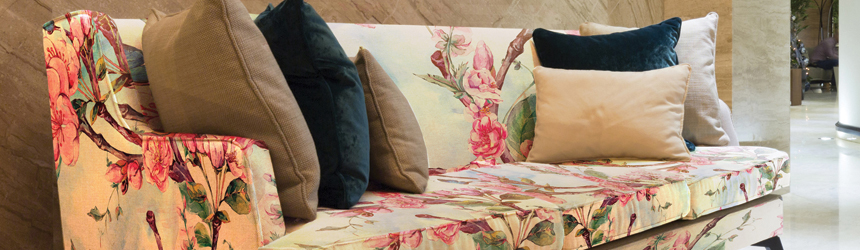
It’s no surprise that customization is becoming common in all aspects of daily life. Consumers look for unique products with favorite colors, patterns, characters, or logos. Digital fabric enables personalization to expand into décor items like ottomans, chairs, couches, and loveseats as well the pillows and cushions that complement them.

Fabric optimized for digital printing and dedicated to upholstery applications is mainly either cotton, a cotton blend, or polyester. Depending on the material it can be printed via dye-sublimation (dye-sub) transfer or direct and direct printed with ink sets such as UV or latex. Specific features in these fabrics define them as acceptable for upholstery. Durability as well as crock fastness and abrasion resistance are important factors to consider.

Above: PremEx Solutions’ DuraVibe fabrics are available in cotton, cotton blends, and polyester.

Demand Settles In
For manufacturers looking to break into a new market, fabric printing—specifically with upholstery applications in mind—is a lucrative option. Customized furniture is alluring to consumers from many backgrounds. There is the media buyer looking to promote a brand in a unique way, a chain of hotels planning to decorate rooms with a one-of-a-kind feel, or a designer hoping to reach out to residential clients with the offer of never-before-seen prints used in their homes.

“Designers and buyers don’t want to be limited to cookie-cutter fabric options like in the past,” admits Sharon Roland, advertising and PR manager, Fisher Textiles. “People like options to showcase creativity and individuality, especially in home or business living spaces. Additionally, design challenges in coordinating elements for living spaces increases the demand for customized upholstery printing.”

Hunter Ellis, president, Jacquard Inkjet Fabric Systems, says customized upholstery allows both renters and homeowners to quickly and affordably put their own spin on furnishings and decorations. “It’s a great way to make a house feel like a home,” he adds.
Digital print is well suited for customized upholstery fabric. “Typically the run length of custom fabric is short, and digital can meet this demand more cost effectively than analog technology,” explains Dan Halkyard, senior marketing manager, S-One Holdings Corporation.

The ability to quickly turnaround smaller volumes has other benefits. “It also allows for the supply chain to respond quicker to market trends and enables more test marketing programs,” says Ann Sawchak, partner, PremEx Solutions.

According to Kathryn Sanders, product marketing manager, Top Value Fabrics, designers and artists look to use digital instead of traditional rotary screen and flatbed printers because of the cost savings. “Screens typically range from $350 to $1,000 each with a maximum of 16 color ways. Designers can print short, exclusive collections, incorporate unlimited colors, and experiment with scale without breaking the bank,” she suggests.

“The demand for customized upholstery is growing fast due to the fact that digital printers are becoming more efficient, cost effective, and user friendly. Heat presses and calendar units offer more solutions. You can do short runs, customize to end users’ preferences, offer one-of-a-kind artwork, and print on demand,” shares Marty Meisner, sales manager, Media One Digital Imaging Solutions, LLC.

In addition to positive improvements to digital hardware, fabric optimized for this process continues to advance. “Digital textile fabrics now have the same rich quality, weave, and abrasion characteristics as traditional analog printed fabrics,” adds Sawchak.

Resting on a Fabric Type
Certain types of digitally printed fabric are ideal for upholstery use. Vendors overwhelmingly suggest cottons and cotton blends or polyester. Print processes—dye-sub transfer and direct, or another type of ink—also need to be considered.

“Cottons and cotton blends are printed with reactive dye, direct pigment, and latex. Pigment has come far in reaching the durability desired by the customer as it relates to crock fastness,” says Sawchak.

Sanders agrees that cotton and cotton blends are successfully printed with pigment, but cautions that they need to pass the American Association of Textile Chemists and Colorists (AATCC) crocking standards. For example, the AATCC TM8-2016, Colorfastness to Crocking: Crockmeter Method and the AATCC TM116-2013, Colorfastness to Crocking: Rotary Vertical Crockmeter Method are both designed to determine the amount of color transferred from the surface of colored textile materials to other surfaces by rubbing.

On the other hand, polyester fabrics are ideal because of their durability in indoor and outdoor environments and compatibility with dye-sub printing, according to Sanders. She adds that polyester is also advantageous because finishes like DuPont Teflon Durable Water Repel (DWR) and soil release can be applied that are not normally compatible with other print processes.

“Polyester fabrics can be printed either transfer or direct. Direct uses disperse dye inks or pigment. We have found to get fine details when printing direct with disperse dye it is necessary to have the fabric pretreated so the ink does not migrate so you can achieve fine details. If the design does not have fine details you may not need to pretreat,” recommends Sawchak.

Ellis shares that most of Jacquard’s upholstery customers request linen or canvas. “Permanent pigment textile inks are what I recommend most, although a few are printing high-end silk pillows that call for acid dyes,” he adds.

Features that Take a Load Off
Fabric ultimately used as upholstery must remain durable despite human interaction, safe in regards to fire hazards, and still be comfortable. In addition to durability, safety, and soft hand, abrasion testing and lightfastness are important considerations.
Sawchak says abrasion testing is important to understand the strength of the fiber. Most standards begin at 15,000 rubs and higher to see where the fiber will break. Popular testing standards are held by ASTM International.

“It is imperative that print providers choose textiles that pass the ASTM D4157-13 abrasion test. If the fabric doesn’t meet that standard, then it simply is not suited for the home furnishings market,” argues Sanders. This test method covers the determination of the abrasion resistance of woven textile fabrics using an oscillatory cylinder tester. It may not be applicable for some fabric constructions.

ASTM also conducts the ASTM D3884-09 abrasion test. This covers the determination of the abrasion resistance of textile fabrics using a rotary platform, double-head tester. “It uses a specialized machine to determine the number of cycles a fabric can go through before it is worn down. The test measures the fabric’s deterioration, including the effects of abrasion,” explains Roland.

When fabric is placed in direct sunlight it could fade. This is especially true in regards to cushions or pillows used for outdoor furniture. “Another consideration is lightfastness—dyes placed in direct sunlight will fade over time, which is another reason to turn to natural fabrics printed with pigmented inks,” adds Ellis.

“Pigment, latex, and high-energy disperse inks have the best lightfastness properties,” suggests Sawchak.

Sit Back and Relax
While many digitally printable textiles are available, here we include ones specifically tailored for upholstery use. When possible, each vendor has shared ideal furniture applications, any testing standards passed, maximum width and thickness, weight, compatible print processes, and pricing.

Aurora Specialty Textiles Group, Inc. offers Upholstery FR, which consists of tightly woven ring spun yarns. The polyester fabric gives a look of fine cotton upholstery. It is treated to meet the NFPA 701 flammability standard. It is printable with UV and dye-sub transfer processes. Available in roll widths of 60 and 120 inches, the material is 19-mil thick and 8 oz.

Fisher Textiles provides several fabrics for upholstery purposes. GF 1010 Element is a woven fabric that is waterproof, bright white, and sturdy, making it ideal for outdoor upholstery. It is compatible with dye-sub transfer and UV-curable printing and offered in 60- and 125-inch widths at a weight of 8.5 oz. 7777 Casino Suede is a soft, warp knit fabric treated with a durable water resistant coating and tested under ASTM D3884-09 to withstand 9,000 cycles on a rotary platform machine. It is ideal for chairs and ottomans, compatible with dye-sub transfer, and offered in 72 inches wide at a weight of 7.4 oz. GF 9766 Poly Cube is a 100 percent polyester knit that is dye-sub transfer compatible and 118 inches wide at 6.6 oz. It is popular for pillows due to its unique texture and soft hand.

Jacquard carries a variety of furniture-favored fabrics. 3.5 oz. bleached linen, 5.5 oz. bleached linen, 5.5 oz. natural linen, 6.5 oz. optic white canvas, 8 oz. optic white duck, 10 oz. optic white canvas, and soon a 10 oz. canvas grown and woven in the U.S. Fabrics are treated for pigment, reactive dye, or acid dye ink. Linens are available up to 54 inches in width and canvas is available up to 58 inches in width. Pricing ranges from $228 to $411 for a full width 50-foot long roll, depending on the type of fabric.

Media One offers Endutex Napa Print for upholstery, specifically sofas, ottomans, and bean bags. It is a combination of PVC and polyester and features brilliant colors, elasticity, and softness. Compatible with solvent, eco-solvent, UV, and latex ink, it is available in 55 inch by 50 meter rolls. It weighs 550 gsm. Pricing is less than $0.80 per square foot.

PremEx Solutions’ DuraVibe fabrics are available in cotton, cotton blends, and polyester. The cotton and cotton blends are printable with reactive, pigment, and latex. The polyester is printable via direct or transfer dye-sub, with direct using disperse dye or pigment ink. The products are available in widths of 56 inches up to 3.2 meters. The average price per square yard for the cottons and cotton blends is $5.50. The polyesters average $6.25 per square yard. According the company, the media is ideal for upholstery due to its durability in both crock and abrasion.

Top Value Fabrics offers multiple fabrics specifically engineered for upholstery applications using dye-sub printing. Glacier S/567, Denali S/568, Zion S/569, Yosemite S/570, and Heavy Poly Linen S/535 are all 100 percent polyesters available with DuPont Teflon DWR finish. Weights are 15 oz., 11.5 oz., 10.3 oz., 9.4 oz., and 9.4 oz., respectively. Widths vary around 56 inches.

Pull Up a Chair
Upholstery fabric has specific requirements, but most importantly it needs to be able to withstand abrasion. Textiles optimized for digital print—when paired with the correct print process—are available to meet this need and more. Not only are they durable, they also offer a soft hand, crock fastness, and lightfastness.

Manufacturers expanding into new markets should consider textile printing and by extension upholstery applications. Designers and artists are a group of new clientele worth pursuing. Digital print’s short-run capabilities make customization of furniture including couches, chairs, and ottomans a possibility for many buyers.

Jan2018, Industrial Print Magazine

Shaping Complex Concepts

By Olivia Cahoon

With three-dimensional (3D) printers, manufacturers create a variety of products from prototypes to custom parts for concept review and form-fit function testing. However, 3D printing in the manufacturing space requires higher quality and more production capabilities than a desktop 3D printer provides. To meet deadlines and keep customers satisfied, manufactures utilize the latest technology and industrial grade 3D printers to maintain short and efficient production times.

Above: Proto Labs of Maple Plain, MN works with additive manufacturing technologies such as HP Multi Jet Fusion using an HP Jet Fusion 3D 4200 3D printers to create custom prototypes for customers in the aerospace, automotive, consumer electronics, medical, and industrial machinery industries.

Proto Labs
Founded in 1999 as ProtoMold by Larry Lukis, Proto Labs is a custom prototypes manufacturer headquartered in Maple Plain, MN. The company originally offered custom injection molded parts and prototypes.

Lukis, an entrepreneur and computer geek, wanted to radically reduce the time to create injection molded plastic prototype parts. His solution was to automate the traditional manufacturing process by developing software that communicated with a network of mills and presses.

“As a result, plastic and metal parts were produced in a fraction of the time,” says Greg Thompson, global product manager, 3D printing, Proto Labs. Over the next decade the company continued to expand its injecting molding practice, introduced quick-turn CNC machining, and opened global facilities in Europe and Japan.

In 2014, it entered the industrial 3D printing space, which gave product developers, designers, and engineers a simpler solution for moving from early prototyping to low-volume production. By acquiring 3D company FineLine Prototyping Inc., Proto Labs was grounded as a technology agnostic, on demand manufacturing partner that produced single parts. Thompson says parts were produced in significantly less time, with less risk and financial burden than traditional manufacturing methods.

Today, Proto Labs is a manufacturer of custom prototypes and on demand production parts. Its customers range from entrepreneurial hardware startups to Fortune 500 companies. According to Thompson, in 2016, the company served more than 30,000 unique product developers and its customer base is growing in the double digits each year. It currently has 2,000 employees worldwide.

Eight manufacturing locations on three continents with two manufacturing facilities in MN make up Proto Labs’ brick-and-mortar locations. Its European operations are in England with offices in France, Germany, and Italy. In 2009, Proto Labs expanded into Asia with the opening of a manufacturing facility in Japan.

Its 3D printing services are managed in Raleigh, NC, where Proto Labs recently opened a 77,000 square foot facility. “It was previously operating out of several smaller locations in this area, but we brought the expanding team—and growing number of machines—under one roof after the FineLine acquisition,” explains Thompson. Its original 3D printing space was 18,000 square feet across two buildings.

The company creates custom parts and prototypes for several industrial segments including aerospace, automotive, consumer electronics, medical technology, and industrial machinery and equipment. Thompson believes product developers and engineers approach Proto Labs because they are under increasing pressure to bring their finished products to market faster than their competition.

3D Printing
Prior to acquiring FineLine, Proto Labs focused on mostly subtractive manufacturing techniques. After implementing 3D printing services, the company offered total solutions to customers at any stage of the product development lifecycle.

Thompson says at the time of the acquisition, FineLine offered high-quality stereolithography (SLA), selective laser sintering (SLS), and direct metal laser sintering services to corporate customers in a variety of industries. “The addition of an additive manufacturing service is highly complementary to Proto Labs’ existing CNC machinery and injection molding services,” he explains.

70 percent of Proto Labs customers utilize an additive manufacturing service in their product development process. “Proto Labs creates more than 60,000 3D printed parts each month and the technology represents roughly 13 percent of the business by revenue,” says Thompson. 3D printing is also one of the fastest growing parts of the business.

The company uses 3D Systems, Inc., Concept Laser a GE Additive Company, HP, Inc., and Stratasys Ltd. machines. However, Thompson points out that Proto Labs is manufacturer and technology agnostic. “We select machines and processes based on consumer demand. Also, we select machines and technologies whose capabilities are in alignment with our value proposition of producing high-quality, high-resolution, 3D printed parts,” he explains.

With its 3D printers, Proto Labs creates prototypes used in product research and development and complex parts that cannot be reasonably manufactured by other methods. According to Thompson, many companies use 3D printing to cut costs through accelerated production, reduce waste, and minimize the tooling costs associated with injection molding.

Proto Labs selects materials suited for each individual application. “The properties of any material become increasingly important as a product progresses from concept and functional prototyping to production,” admits Thompson.

In addition to being technology agnostic, the company is also material agnostic and strives to offer a broad range of resolutions and material properties. This includes ALM PA 650, cobalt chrome, DMLS aluminum, DMLS titanium, DuraForm HST Composite, Inconel 718, PA 615-GS, PA 850 Black, and stainless steel printing materials.

The company’s software automation reduces development cycles and design risks to drive savings for customers. Proto Labs was founded on proprietary software that draws a digital thread from 3D CAD software to product design, through its e-commerce driven digital model, where customers upload, interact, and order parts through a secure storefront. “Custom software connects Proto Labs’ digital model with hundreds of machines around the world,” adds Thompson.

Industrial Manufacturing
While 3D printing quickly produces prototypes for concept review and form-fit function testing, it’s also becoming popular for production and end-use parts. If volumes are low enough that casting and molding are not cost effective, or part complexity prohibits processes like machining, 3D printing is favored.

“3D printing has been around for more than 30 years, but is gaining traction in industrial manufacturing because of its ability to produce highly complex and custom parts quickly, while reducing waste and risks associated with larger production runs,” says Thompson.

Traditional manufacturing methods reduce materials to achieve a final part. While this practice is considered subtractive, 3D printing is additive—parts build upon themselves with precision and complexity to achieve intricate results.

According to Thompson, the largest industries that utilize 3D prototypes are in medical, automotive, and aerospace segments. Automotive and aerospace customers are focused with light weighting, a trend in product design intended to cut as much weight and bulk from industrial parts to save on fuel costs. “Some 3D printing processes can accommodate the complex geometries that achieve these characteristics and produce parts strong enough for end use,” he explains.

Despite its benefits, 3D printing still presents challenges for manufacturers. For Proto Labs, one of the biggest challenges is selecting the proper 3D printing process and materials and also designing parts that are optimized for that method. He says some 3D printing methods are quick and inexpensive, but the finish quality of the parts is low. Other methods produce high-quality parts but at higher prices.

Finishing 3D Parts
While industrial 3D printing creates functional plastic parts, the parts can sometimes benefit from secondary operations and finishing techniques that improve appearance, durability, and functionality.

Threads don’t form well in 3D printing due to layering, tolerances, and over-curing the material, according to Thompson. To improve thread performance, manufacturers can thread or tap holes after the build is completed, which provides smooth threads and enhanced performance. Threaded inserts can also be installed to improve strength.

“With SLA, we install threaded inserts by gluing them in place. With SLS, we heat stake them in because SLS uses commercial-grade thermoplastic nylon,” explains Thompson.

Part performance can also be improved by using a nickel plating (SLArmor) applied to SLA parts which increases heat and mechanical properties. SLArmor is selected when parts need to mimic die cast aluminum. It can also be applied with different surface finishes. However, it has two thicknesses that can change material properties.

Color and cosmetic appearance options are generally limited. This can be improved in post-production so 3D printed parts resemble injection molded parts. Proto Labs has a few different ways of altering part color, which include applying a colored dye, custom paint, or soft-touch paint to SLA and SLS parts.

Polishing, texturing, and clear coatings are used when manufacturers need to produce clear parts without layer lines or to produce a matte finish. A clear coat may also be used if a part requires longer UV protection.

Automotive Projects
In 2017, a repeat customer in the automotive industry requested speaker covers and housing. Proto Labs was tasked with developing a functional prototype for an injection molded part. The company worked with the client to understand the process and optimize their design.

“We helped the engineer assess the properties of 3D printing against injection molding by balancing cost, strength, and structural integrity,” says Thompson. He believes 3D printing was the best option because the product’s complex geometry would have been expensive to mold during design iterations.

The company utilized an HP Jet Fusion 3D 4200 with PA 12, a unified nylon 12 printing material. It is powered by HP Multi Jet Fusion technology, which uses an inkjet array to apply fusing and detailing agents across nylon powder. These are then fused together by heat into a solid layer. This process is completed for each layer until the part is finished.

After building the speaker prototype, the entire powder bed with the encapsulated parts was moved to a processing station where a majority of loose powder was removed by an integrated vacuum. Parts were then bead blasted to remove any of the remaining residual powder before reaching the finishing department where they were dyed black to improve cosmetic appearance.

After the order was placed, Proto Labs shipped a complete set of parts in less than ten days and the first set was shipped out within four days. The company printed nearly 40 11x11x5-inch speaker covers and housing pieces.

“Although HP Multi Jet Fusion is a new process, we can leverage our experience in SLS to get high-quality parts to customers in a fast turnaround, and add value in the design and part feedback,” offers Thompson.

The client was very impressed with the completed parts including quality, appearance, and functionality. The parts are now integrated into its broader assembly and the client continues to work with Proto Labs and use HP Multi Jet Fusion technology.

3D Innovation
On demand manufacturers like Proto Labs use the latest 3D printing methods to produce prototypes and custom parts for industrial segments including aerospace, automotive, electronics, and medical. With a background in custom injection molded parts and prototypes, additive manufacturing practices like 3D printing were the next logical step for the company. Its use of this technology allows Proto Labs to accelerate production times and reduce costs associated with more traditional prototyping methods.

Jan2018, Industrial Print Magazine